




Broker Lays Off Most Staff, Leaving Carriers with Unpaid Loads
Motor carriers that have been having trouble getting paid by Elite Transit Solutions may have more struggles to get what they’re owed, with reports of sudden layoffs at the 3PL and an apparent pending cancellation of its broker surety bond.

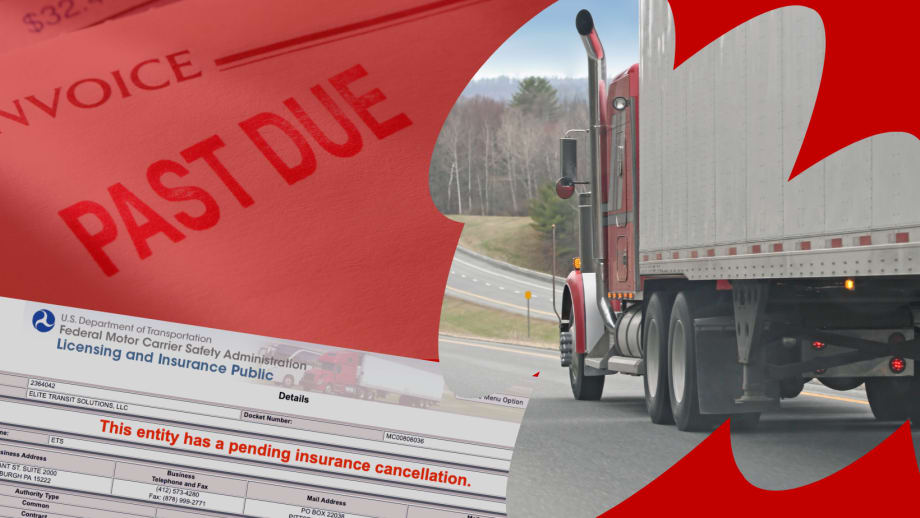
Some trucking companies that hauled for a Pennsylvania-based broker haven't been paid for months.
Image: HDT Graphic
The folks at Armada Transport are at their wits’ end trying to get paid more than $22,000 owed to them by third-party logistics provider Elite Transit Solutions.
They and other motor carriers that have been having trouble getting paid by Elite Transit Solutions may face more struggles to get what they’re owed, with reports of sudden layoffs at the Pittsburgh, Pennsylvania-based company and an apparent pending cancellation of its broker surety bond.
According to published reports, the company has let go nearly all its staff. The most recent, on Nov. 3, saw some 65 people fired via Microsoft Teams.
In a LinkedIn post, Melissa Bucci, VP of people and culture for Elite Transit, wrote, “today is a sad day for me and most of the Elite Transit Solutions team as we had to say goodbye to the company we worked so hard to build.”
Many former Elite employees have posted on LinkedIn in the past week with news of their own layoffs and looking for new jobs.
Elite Transit also has offices in North Carolina, Chicago, and Arizona. Just two months ago the company was hiring for its Scottsdale, Arizona, operations, based on its LinkedIn posts.
As of Nov. 7, according to FMCSA records, Elite Transit Solutions has a pending surety insurance cancellation. It shows that pending cancellation being for Allegheny Casualty Company, with a cancellation date of Nov. 22. And the agency shows a surety insurance for Southwest Marine and General Insurance Company cancelled 11/2/23.
HDT reached out to Elite Transit via the contact form on its website and to founder Michael D. Jones via social media for comment but had not yet received a response at time of publication.
One Carrier’s Experience
Armada, a small Illinois-based fleet, reached out to trucking media this week about its problems with Elite, which still owed the company $22,000 in unpaid settlements for loads hauled in July, August, and September.
The company has just three trucks and couple of owner-operators, "So this amount they don't pay is huge for us."
On Oct. 25, an Elite Transit representative wrote that its plan was “to make payments on these loads over the next three weeks.”
But as of Nov. 8, those payments had not materialized.
“They never paid us and they are not replying on our emails and phone calls,” the dispatch representative told HDT. “Every time we reach them, they are saying that they will pay on Friday — but they never do.”
Earlier in the day, Michael St. Julien, Elite vice president of customer sales, told Armada in an email that “our legal counsel and owner are working on setting up payment plans for all past due payments. … This is the last response that you will see from me as I am being laid off from Elite.”
Armada has also reached out to the shipper, Starbucks, asking to be paid since the broker had not. On Nov. 6, a Starbucks representative responded that Starbucks does not have a contract with the motor carrier and that Armada should stop “harassing” Starbucks for payment.
What About Broker Bonds?
Federal law requires brokers and freight forwarders to have enough financial security for circumstances when they do not pay their carriers — a minimum of $75,000. Carriers can submit claims to the financial responsibility of the broker if they don’t receive payment.
This is often done via surety bonds, also called freight broker bonds, and motor carriers can file a claim against that surety bond through the Department of Transportation.
However, as the Federal Motor Carrier Safety Administration explained in a proposal earlier this year to make changes in those rules, if the financial responsibility provider has received claims against an individual broker that exceed $75,000, the financial responsibility provider will often submit the claims to a court in an “interpleader action” to determine how to allocate the broker bond or trust fund. This process can be costly and time-consuming and generally results in carriers only getting a portion of their claims.
The FMCSA has proposed changes to freight broker and freight forwarder financial responsibility requirements to try to address the problem of brokers that don’t pay motor carriers.
That rulemaking included examples of how the current requirements fall short in protecting carriers. As we reported previously, one surety provider submitted an example of a logistics company that had accumulated $945,739 in unpaid motor carrier claims after paying out the full $75,000.
More Fleet Management

Geotab Links Fleet Card to Vehicle Data
The new card combines fuel discounts with telematics-based purchase controls. Geotab’s analysis also points to potential savings from choosing lower-priced fuel stops.
Read More →
How MFA Helps Protect Trucking Fleets
Multi-factor authentication adds protection when passwords are stolen. Here’s how it works and where fleets should start.
Read More →
How Better Freight Data Helps Trucking Teams Get Ahead of Disruption
Trucking and logistics teams have plenty of data. The problem is getting the right information in front of the right people soon enough to act. Better-connected data can help teams spot trouble earlier and make smarter decisions before small problems become big ones.
Read More →

Trimble: Taking Artificial Intelligence in Trucking Beyond Faster Tasks
At Insight 2026, Trimble executives argued that fleets may need to redesign workflows to get more from AI as it introduced new products and enhancements. AI’s value will depend on how fleets combine automation with their people's knowledge.
Read More →
Build a bulletproof fleet: Uniting ELDs and dash cams for total compliance
An ELD can prove compliance, but it cannot always prove what happened on the road. Discover how uniting accurate ELD data with AI-powered dash cam video can help your fleet strengthen compliance, defend against liability, protect drivers and reduce operational costs.
Read More →
Nominations Open for HDT Emerging Leaders
Heavy Duty Trucking is looking for accomplished trucking fleet professionals under 40 who are making an impact and helping lead the industry forward.
Read More →
Why Private Fleets Are Taking More Freight
Private fleets are putting their own trucks on demanding customers and high-cost lanes as companies seek greater control over service, costs, and capacity.
Read More →
Color Match Smarter: Tools That Restore & Perform
For fleet managers and collision repair professionals keeping heavy-duty trucks on the road, getting the color right the first time isn't just about appearance — it's about efficiency, turnaround time, and bottom-line results. Discover how today's digital color tools are transforming the repair process from guesswork to precision.
Read More →
FMCSA Pauses Biennial-Update Enforcement Amid Motus Transition
Carriers whose updates were due on or after June 1 have more time, while FMCSA works to stabilize its new registration system and warns of phishing sites impersonating its new carrier registration system, Motus.
Read More →
2026 Blueprint for Countering Smarter Supply Chain Theft
Cargo theft is no longer just the cost of doing business. It's a multi-billion-dollar criminal enterprise exploiting vulnerabilities across your fleet, drivers, and supply chain.
Read More →