



What is Biofuel?
Biofuel is produced from biomass — organic materials including plants, agricultural waste, and wet waste. Biofuel can be blended with conventional fuel to reduce emissions and improve fuel and engine performance.
 MENU
MENU SEARCH
Research has shown that biofuel combined with advanced engine design can reduce greenhouse gas emissions by roughly 60%.
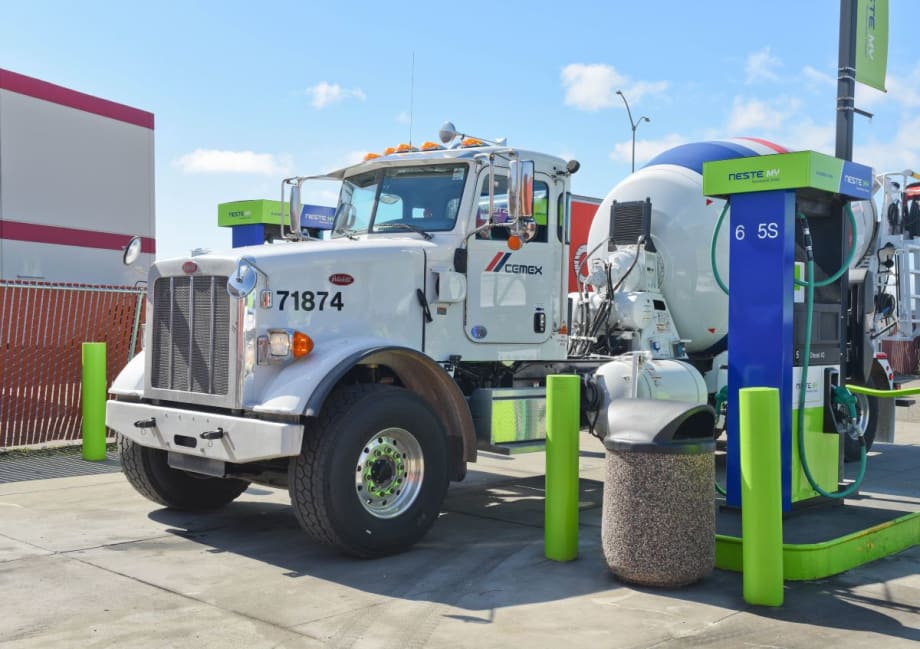
While biofuel production pathways target cars and diesel trucks, Argonne researchers are also studying the potential for using these pathways in hard-to-electrify sectors like aviation and maritime industries.
Photo: Neste
Biofuel combined with advanced engine design can reduce greenhouse gas emissions of cars and trucks by roughly 60% while improving fuel efficiency or reducing tailpipe emissions, according to two new studies.
The U.S. Department of Energy’s Argonne National Laboratory collaborated with the DOE’s National Renewable Energy Laboratory (NREL), Pacific Northwest National Laboratory (PNNL), and Idaho National Laboratory (INL) on the research to identify promising fuels for different engine types. Researchers considered cost, environmental impact, and potential for expanding to commercial markets.
“The idea is to develop new biofuels blended with conventional fuels to improve engine performance," said Troy Hawkins, Argonne’s group manager of the fuels and products group, and author on both ACS Sustainable Chemistry & Engineering studies. "This means a gasoline car or truck could go further on the same amount of fuel or a diesel vehicle could meet more stringent emissions standards.”
The research is supported by the Co-Optimization of Fuels & Engines (Co-Optima) initiative jointly led by DOE’s Office of Energy Efficiency and Renewable Energy, Bioenergy Technologies Office, and Vehicle Technologies Office. Argonne is part of Co-Optima’s consortium of nine national laboratories and over 20 university and industry partners. The consortium studies how simultaneous innovations in fuel and engines can boost fuel economy and vehicle performance while reducing emissions.
“This research is a really good example of how laboratories can work together to help the DOE accomplish its mission,” he added.
Argonne Energy System Analyst Pahola Thathiana Benavides, NREL Process Engineer Andrew Bartling, and PNNL Engineer Steven Phillips were lead analysts for the two studies published in ACS Sustainable Chemistry & Engineering.
Co-Optima’s research builds on the goal to identify and understand bioblendstocks, or biofuel. Biofuel is produced from biomass — organic materials including plants, agricultural waste, and wet waste. Biofuel can be blended with conventional fuel to reduce emissions and improve fuel and engine performance.
Collaborating with Co-Optima fuel experts, researchers used a screening process to develop a list of biofuels for their research, Benavides said.
“We worked with other experts to use specific criteria to narrow many biofuel candidates down to a short list for our research, added Benavides. "This list was developed based on the required properties and the engine’s combustion mode.”
Converting biomass to biofuel is a complex process involving variables in feedstock, conversion technologies and fuel types. It is especially challenging finding biofuel pathways that also meet economic, technology, and energy goals.
One study was co-first-authored by Benavides. The team assessed 12 biofuel production pathways for optimizing multimode internal combustion engines. Multimode engines can deliver greater efficiency and cost savings by using different methods of ignition, combustion, and/or fuel-preparation, depending on driving demands.
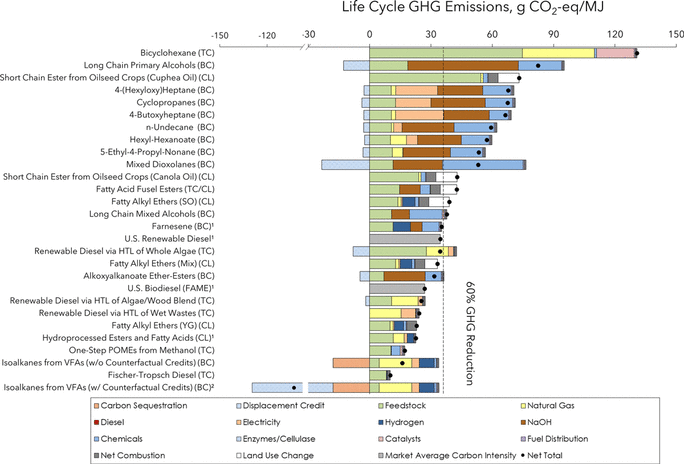
Life cycle greenhouse gas emission breakdown bioblendstocks. The vertical dashed line corresponds to a 60% GHG emission reduction from conventional diesel.
Source: ACS Sustainable Chemistry & Engineering
Researchers used renewable biomass feedstock found in forestry byproducts such as wood waste and agricultural byproducts such as corn stover. They used conversion technologies including either fermentation, catalysis under high heat and pressure, or a combination of both.
“We found that not only can seven biofuels be produced cost-competitively, but that these seven are varied in terms of feedstock used and conversion technology,” Bartling said. “This means that biorefineries can be more flexible in choosing where and how to build their facilities.”
NREL and PNNL researchers did a techno-economic assessment of the biofuel production pathways, analyzing cost and technology performance.
“Our findings showed that many of the biofuels are competitive with the current cost of petroleum fuel,” Phillips said.
Researchers also analyzed environmental impact. A life cycle analysis of the pathways using Argonne’s GREET (Greenhouse Gases, Regulated Emissions, and Energy used in Technologies) model showed 10 biofuels have the potential to reduce GHG emissions by 60% compared to petroleum gasoline. The list includes alcohols, furan mixtures, and olefins.
A second study was co-first-authored by Bartling. Researchers analyzed 25 ways of producing biofuel optimized for a type of engine known as mixing-controlled compression ignition. This diesel engine is mainly used in freight transportation.
To develop biofuel production pathways, researchers used feedstocks ranging from plant materials such as wood chips or corn stover, to oils from soybean and cuphea, to wet wastes and recycled grease. They used conversion technologies including fermentation, gasification, and hydrothermal liquefaction.
“The diverse set of biomass resources available in the U.S. has great potential to replace a portion of fuels and chemicals that now come from petroleum,” said Damon Hartley, INL’s operations research and analysis group lead. “However, one of the largest barriers is the wide variability in quality in the raw materials. This can have a large impact on how the material performs in conversion.”
As with the first study, most of the technologies performed well. Most of the biofuels were cost-competitive with current gas prices.
In terms of environmental impact, GHG emissions were reduced more than 60% in 12 of the 25 pathways, according to the GREET life cycle analysis.
“We evaluated the life cycle GHG emissions for each mixing-controlled compression ignition engine pathway," added Hawkins. "This included not only the tailpipe emissions but also upstream emissions resulting from biomass cultivation, feedstock transportation, biofuel production and biofuel distribution."
Researchers did not intend to produce a definitive list of biofuels, Benavides said. Instead, the studies offer a guide for stakeholders on selecting biofuel pathways that best meet their needs.
“We provide researchers and industry guidance on assessing biofuels based on a number of complex variables,” she added. “The life cycle and techno-economic analysis is important in guiding stakeholders as early as possible. We can’t tell stakeholders what choices to make but these tools can point them in the right direction from the beginning.”
While many of these biofuel pathways could potentially be cost-competitive, it is too soon to lock in prices in a constantly fluctuating gas market.
“The challenge is providing cost-competitive prices in the long term,” Hawkins said.
While these biofuel production pathways target cars and diesel trucks, Argonne researchers are also studying the potential for using these pathways in hard-to-electrify sectors like aviation and maritime industries. The goal is to bring biofuel to market across a range of industries as quickly as possible.
“DOE is constantly working on sustainable solutions for decarbonizing the transportation sector. Biofuel is a big piece of that,” Hawkins said. “We will continue to expand on Co-Optima’s important work.”

Volvo’s updated D13 promises lower emissions without sacrificing performance or fuel economy. Take a closer look at what changed inside the engine in this HDT Spotlight video.
Read More →
Energy Vision estimates fleets could recover the higher purchase price of an RNG-fueled Class 8 tractor in 1.3 to 2.8 years under current fuel-price scenarios.
Read More →
Calstart is now Catalyst Mobility, reflecting the nonprofit’s growing national role in clean transportation, including zero-emission trucks, infrastructure and incentive programs.
Read More →
Average U.S. diesel prices have climbed to nearly $6 a gallon, surpassing the 2022 record as tight refinery capacity and Middle East disruptions keep fuel costs elevated.
Read More →
Fuel delivery depends on more than what happens at the injector. For fleet, maintenance and technical professionals, looking at the full path from pump to injector can provide useful context for understanding engine performance.
Read More →
The Port Authority of New York and New Jersey announced millions in incentives for zero-emission drayage trucks, yard tractors, and new charging hubs near the port.
Read More →
Why do battery-electric Class 8 trucks remain so expensive? A California bill headed to Gov. Gavin Newsom would give fleets and state agencies more visibility into what manufacturers charge.
Read More →
Detroit isn’t starting from scratch to meet EPA 2027 diesel emissions standards. Its Gen 6 DD13 and DD15 engines keep much of today’s platform while updating the fuel and aftertreatment systems.
Read More →
California, Oregon, Washington, British Columbia and Baja California are coordinating plans for truck charging and hydrogen fueling from Canada to Mexico.
Read More →
Learn more about Kenworth's T880E battery-electric vocational truck at the Paccar Technical Center, including its range, applications, upfitting considerations, and PTO options, in this HDT Spotlight video.
Read More →