





More from Run on Less-Electric: Half of all Regional-Haul Trucks Could Go Electric Now
Benefits and Challenges in Electrifying Medium-Duty Box Trucks
Medium-duty box trucks are a good fit for battery-electric vehicles, but battery-electric trucks are not the solution for all medium-duty box truck applications, according to a new report from the North American Council for Freight Efficiency.
June 28, 2022

Day & Ross ran a Class 6 Lion6 electric truck in ROL-E.
Photo: NACFE
4 min to read
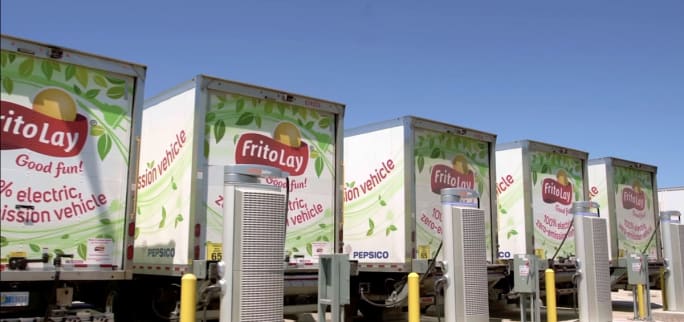
Frito-Lay had a Class 6 Peterbilt-Cummins 220EV in ROL-E.
Photo: NACFE
Medium-duty box trucks are a good fit for battery-electric vehicles, but some applications will be harder to electrify than others.
That’s among the findings in the North American Council for Freight Efficiency’s new report, Electric Trucks Have Arrived: The Use Case For Medium-Duty Box Trucks. It’s the fourth and final market segment report based on findings from last year’s Run on Less – Electric (RoL-E) freight efficiency demonstration.
When the simpler box truck portion of this market segment, about 380,000 trucks in the U.S. and Canada, electrifies, it will result in the avoidance of nearly 7.7 million metric tonnes (MT) of CO2e annually.
“Electrification should happen fast for the simple trucks, and the industry should prioritize the other applications with regard to benefits and difficulty to bring to production given the smaller unit volumes,” says Mike Roeth, NACFE’s executive director.
Three fleet-OEM pairs in RoL-E operated medium-duty box trucks:
Day & Ross with a Class 6 Lion6.
Frito-Lay with a Class 6 Peterbilt-Cummins 220EV.
Roush Fenway Racing with a Class 6 Roush CleanTech Ford F-650.
The report found that medium-duty box trucks are a great application for electric trucks given their short distances and return-to-base operations. The vast majority of medium-duty box trucks are not driven long distances and are home very night. They are an ideal portion of the overall medium-duty truck market for electrification.
However, more complex Class 6 and 7 trucks such as snowplows, refuse trucks, and fire trucks will require significant efforts which will delay the timing of electrification.
The report includes some basic information about medium-duty box trucks and the size and scope of the market. It looks at duty cycle and charging considerations and presents the benefits and challenges of battery-electric vehicles. It includes information on the manufacturers and fleets that had medium-duty box trucks in the Run and provides details on what metrics were measured. There also is a discussion of total cost of operation.
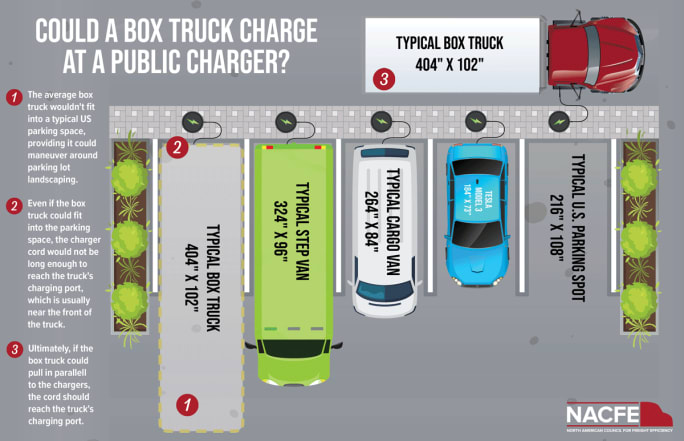
Public charging facilities need to be larger to accommodate medium-duty trucks.
Source: NACFE
Lessons Learned on Medium-Duty Box Truck BEVs
Battery integration can take many forms.
In order to be valuable for medium-duty box trucks, public charging stations need to be bigger.
Training, training, and even more training will be needed.
Expanded production capacity is needed for body builders and dealers.
Body integration will be new and challenging.
The public will like medium-duty BEVs in their neighborhoods.
Drivers will love electric medium-duty box trucks.
New BEV OEMs are emerging frequently; consolidation is expected.
Predicting battery life is difficult with significant body loads.
Application expansion will happen.Charging ports on trucks need to be standardized.
The road to electrification for medium-duty box trucks can take several different paths. There’s the traditional production line vehicle that is built from the ground up. Another option is upfitting, which allows a fleet to electrify a new vehicle that would otherwise be powered by a gasoline or diesel engine. The third option is remanufacturing or repowering an existing vehicle that is already in operation.
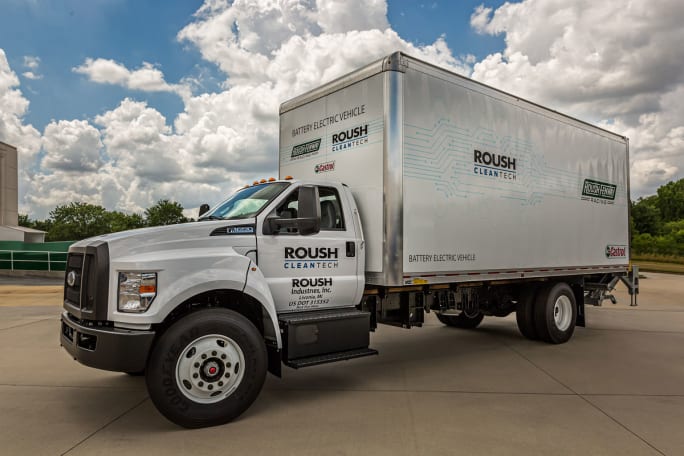
Roush Fenway Racing participated in ROL-E with a Class 6 Roush CleanTech Ford F-650 BEV.
Photo: NACFE
“We are very proud of the fact that the trucks look sharp, and they work great. They are extremely reliable and allow us to deliver on time all the time,” said — Ryan Klaus, senior director of operations, Frito-Lay.
Challenges in Medium-Duty Truck Electrification
Battery-electric trucks are not the solution for all medium-duty box truck applications, the report cautions. Challenges include:
Cost of the vehicle and charging: In all commercial vehicle classes, CBEVs are chasing cost parity with their incumbent counterparts. Incentives and grants continue to play a major role in the TCO equation for the vehicles, the charging and the infrastructure.
Demand is significantly outpacing supply: According to a recent Calstart report, approximately 1,200 medium- and heavy-duty electric vehicles had been deployed in the U.S. as of December 2021, with more 140,000 on order. The pressure to get these vehicles into the market sooner rather than later, can be intense. There have been numerous start-up companies in this market segment with promising ideas that never fully materialized. Other new entrants have experienced some public growing pains including recalls, extended production timelines and pivots to different vehicle segments.
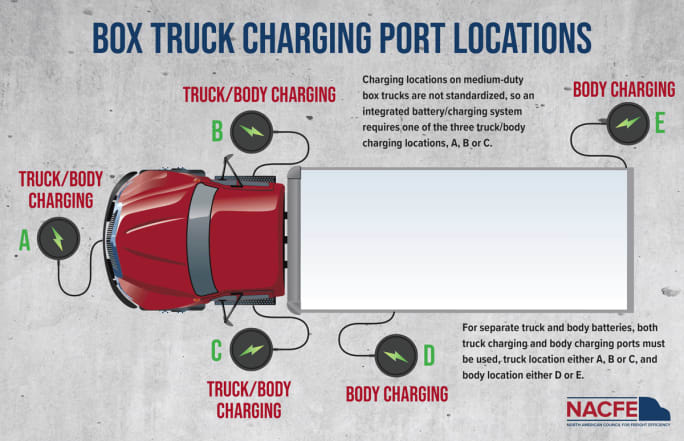
One of the challenges faced in electrifying medium-duty box trucks is there's no standardization in charging port location.
Source: NACFE
Transitioning depots: Transitioning a location to a commercial EV hub can be very difficult, according to the report, with timelines encompassing design, permitting, construction and installation. Added expense can be incurred if additional transformers are needed to support the new power requirements or if conduit must be run to more optimal locations at the site. Furthermore, for those sites that are leased, all the design, upgrades and installation work also must be approved and likely paid for by the landlord, which may entail additional cost for the fleet. Lead time for these large projects can easily last more than a year or even two, especially if infrastructure upgrades are required by the utility.
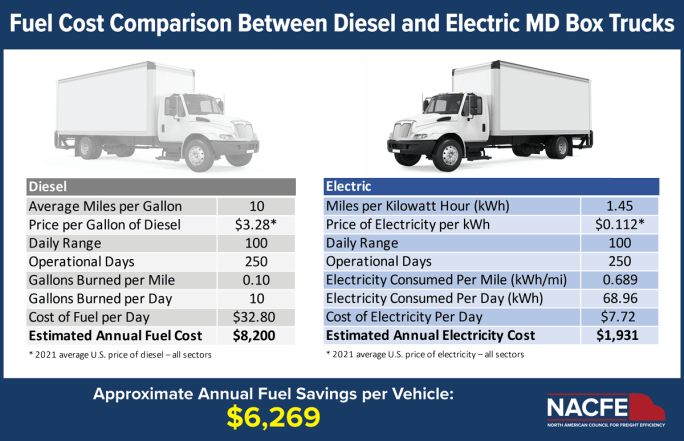
While battery-electric trucks have higher up-front costs, NACFE says, they save money in "fuel" and maintenance.
Source: NACFE
More Fuel Smarts

How Volvo Updated Its D13 for EPA 2027 [Watch]
Volvo’s updated D13 promises lower emissions without sacrificing performance or fuel economy. Take a closer look at what changed inside the engine in this HDT Spotlight video.
Read More →
Diesel Price Spike Shortens Payback for Natural Gas Trucks, Report Says
Energy Vision estimates fleets could recover the higher purchase price of an RNG-fueled Class 8 tractor in 1.3 to 2.8 years under current fuel-price scenarios.
Read More →
Calstart Becomes Catalyst Mobility, Reflecting Broader Focus
Calstart is now Catalyst Mobility, reflecting the nonprofit’s growing national role in clean transportation, including zero-emission trucks, infrastructure and incentive programs.
Read More →

Record Diesel Prices Squeeze Trucking Fleets
Average U.S. diesel prices have climbed to nearly $6 a gallon, surpassing the 2022 record as tight refinery capacity and Middle East disruptions keep fuel costs elevated.
Read More →
Sponsored•September 9, 2026
How Fuel Delivery Shapes Engine Performance
Fuel delivery depends on more than what happens at the injector. For fleet, maintenance and technical professionals, looking at the full path from pump to injector can provide useful context for understanding engine performance.
Read More →
East Coast Port Launches $45M Electric Truck Push
The Port Authority of New York and New Jersey announced millions in incentives for zero-emission drayage trucks, yard tractors, and new charging hubs near the port.
Read More →
California Bill Could Shed Light on Electric Truck Prices
Why do battery-electric Class 8 trucks remain so expensive? A California bill headed to Gov. Gavin Newsom would give fleets and state agencies more visibility into what manufacturers charge.
Read More →
Detroit Opens Orders for EPA 2027 Engines
Detroit isn’t starting from scratch to meet EPA 2027 diesel emissions standards. Its Gen 6 DD13 and DD15 engines keep much of today’s platform while updating the fuel and aftertreatment systems.
Read More →
Zero-Emission Truck Corridor Planned for West Coast
California, Oregon, Washington, British Columbia and Baja California are coordinating plans for truck charging and hydrogen fueling from Canada to Mexico.
Read More →
A Closer Look at Kenworth’s Electric T880E Vocational Truck [Video]
Learn more about Kenworth's T880E battery-electric vocational truck at the Paccar Technical Center, including its range, applications, upfitting considerations, and PTO options, in this HDT Spotlight video.
Read More →