




Baltimore Bridge Collapse Disrupts East Coast Truck Fleets
Like ripples from a rock thrown in a pond, the effects of the collapse of the Francis Scott Key Bridge in Baltimore are starting to be felt all over the East Coast.

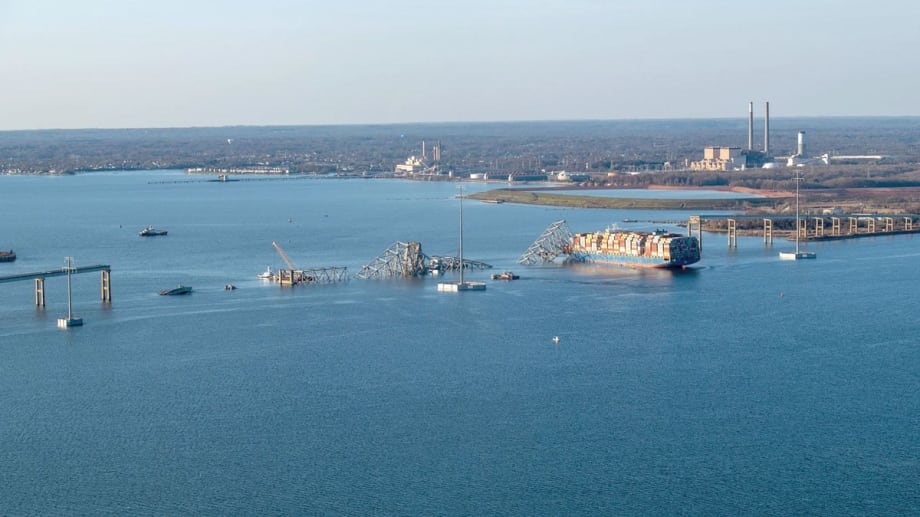
The worst traffic disruptions will come after the port fully re-opens, because until the bridge is rebuilt, that's a key access route taken out of the picture.
Photo: Maryland Transportation Authority
It was a disaster in slow motion. On the night of March 26, as various surveillance cameras passively watched, the massive container ship Dali lost power for as-yet-unexplained reasons and plowed into one of the support structures of the Francis Scott Key bridge in Baltimore, Maryland — a major artery in and out of the Port of Baltimore. The bridge never stood a chance against a container ship of that size. It collapsed like it was made of matchsticks.
The I-695 bridge is also a vital artery for highways on both sides of the Potomac River in the City of Baltimore and Washington, D.C., including I-95 in Maryland.
The collapse of such a major highway bridge feeding a major port will have serious consequences for trucking logistics on the East Coast for some time to come.
In an interview on MSNBC on April 5, Maryland Gov. Wes Moore noted that the Port of Baltimore is responsible for $70 billion annually,, importing agricultural equipment, new cars and heavy trucks, as well as sugar and spices into the U.S.
“So this event is not just impacting Marylanders,” he said. “It’s also impacting farmers in Kentucky, an auto dealer in Ohio and a restaurant owner in Tennessee. In fact, it will have an impact on our entire country and our economic growth."
Significant Traffic and Freight Issues
At ground zero, the bridge collapse is a massive logistical and transportation problem for the Port of Baltimore. The Port of Baltimore is still open for truck transactions, but ships can't get in or out.
“Because the debris from the bridge is in the primary channel for the Port, there is no egress in or out of the Port,” said Richard M. Franza, Ph.D., professor of management, James M. Hull College of Business Augusta University. “The port is completely out of action right now for any ships.”
Franza, an expert in supply chain logistics, said the only activity in the immediate aftermath of the collapse was to empty ships already in the port. While there has been good movement in terms of getting the resources such as heavy-duty cranes in place to remove the debris on site, the channel will likely not fully re-open until mid to late May at the earliest. And that is a very optimistic estimate.
“It's a huge problem,” agreed Tinglong Dai of the Johns Hopkins University Carey Business School. “The Port of Baltimore is virtually shut down right now. There's only one terminal, Tradepoint Atlantic, that's outside the bridge and it's open. It serves Volkswagen and BMW, so they're fine, but other auto makers are not.
"The reported death of the Port of Baltimore has been exaggerated, but it's definitely true that it's operating at much, much reduced capacity.”
“We are seeing significant issues with both freight movement and traffic in and around the port as well,” said Rishi Mehra, vice president, maps division, Trimble. “Because of the closure of the I-695 bridge limits access to several major warehouses and distribution centers in the port. Amazon and Home Depot have major distribution centers there. And all that freight stacked up isn’t moving.”
The U.S. Army Corps of Engineers on April 4 announced a tentative timeline for the restoration of safe navigation in and out of the Port of Baltimore.
USACE expects to open a limited access channel 280 feet wide and 35 feet deep to the Port of Baltimore by the end of April. This channel would support one-way traffic in and out of the Port of Baltimore for barge container service and some roll on/roll off vessels that move automobiles and farm equipment to and from the port.
Engineers are aiming to reopen the permanent, 700-foot-wide by 50-foot-deep federal navigation channel by the end of May, restoring port access to normal capacity.
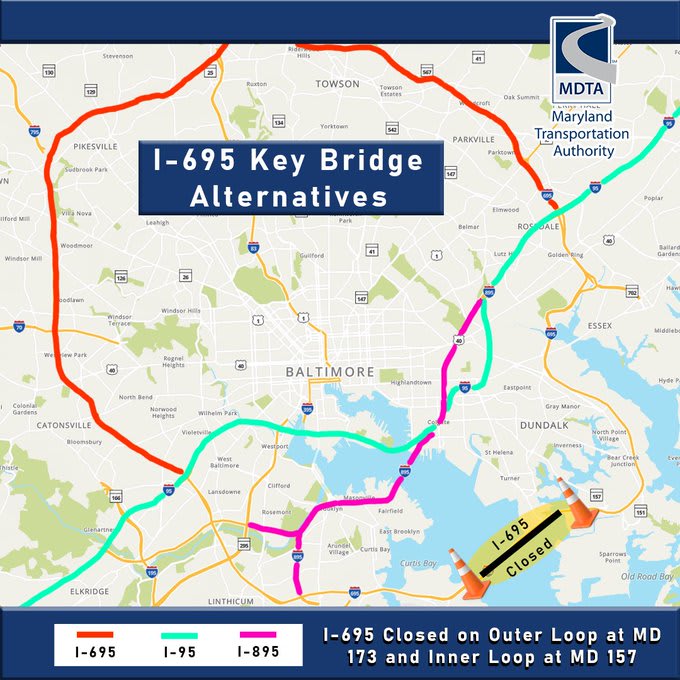
The Maryland Transportation Authority posted these detour routes.
Photo: Maryland Transportation Authority
Slower Traffic in Baltimore
Of course the most immediate impact from the disaster is in the city of Baltimore itself. Mehra said southbound traffic in the affected area is particularly difficult — although not as bad as he initially predicted.
“There is a significant detour around the impact zone,” he noted. “Vehicles must first travel north and then back south. Hazmat loads are prohibited from using any of the tunnels in the area. And authorities have made it clear they will not lift those restrictions.”
The Maryland Department of Transportation State Highway Administration is assisting the Maryland Transportation Authority with traffic control related to the collapse of the bridge. Guidance issued by the agency encourages drivers to prepare for extra commuting time until further notice.
Specifically, MDOT listed the following closures, detours and alternate routes for motorists in the area:
The outer loop I-695 closure has shifted to exit 1/Quarantine Road (past the Curtis Creek Drawbridge) to allow for enhanced local traffic access.
The inner loop of I-695 remains closed at MD 157 (Peninsula Expressway). Additionally, the ramp from MD 157 to the inner loop of I-695 will be closed.
Drivers should use I-95 (Fort McHenry Tunnel) or I-895 (Baltimore Harbor Tunnel) for north/south routes.
Commercial vehicles carrying materials that are prohibited in the tunnel crossings, including recreation vehicles carrying propane, should plan on using I-695 (Baltimore Beltway) between Essex and Glen Burnie. This will add significant driving time.
The outer loop I-695 is closed at MD 10 (Arundel Expressway) and the inner loop of I-695 is closed at MD 157 (Peninsula Expressway). Additionally, the ramp from MD 157 to the inner loop of I-695 will be closed.
Commercial vehicles carrying materials that are prohibited in the tunnel crossings, including recreation vehicles carrying propane, should plan on using I-695 (Baltimore Beltway) between Essex and Glen Burnie. This detour will add significant driving time, MDOT added.
All told, Mehra said ,Trimble data shows an average increase in travel times from nine to 12 miles for most travelers affected by the bridge collapse. “However,” he added, “We anticipated a much larger impact on traffic. Overall, we’ve only seen about a 5% reduction in vehicle speeds routing around the bridge collapse. And that is quite good.”
Franza agreed with that assessment.
“For trucking fleets, it’s basically a wash in and around Baltimore,” he said. "The Francis Scott Key Bridge was originally built to provide enough traffic capacity to supplement the two tunnels and other routes. However, since there is nothing going in and out of the port, right now, delays should not be an issue.”
The problem, Franza said, will come when the port reopens and capacity gets back close to normal volumes.
“When that happens, and freight capacity is back up, trucks will have one less route to get in and out of the port,” he explained. “There will be significant delays then unless they figure something out in lieu of a lengthy re-build of the bridge.”
A Gut-Punch to the East Coast
The collateral impact of the Francis Scott Key Bridge collapse will spill over and affect trucking operations all over the East Coast and toward the interior of the U.S. as well.
“The bridge collapse has sent shockwaves through the East Coast transportation network,” Dai said. “As a major cargo hub, especially for the automotive industry, the port's closure is forcing freight to be diverted to other East Coast ports. But these alternatives lack the capacity to fully absorb Baltimore's volume.”
Both Franza and Mehra noted that since the port is going to be closed for at least six to eight weeks, ships enroute to Baltimore need to be diverted to other East Coast ports. The largest of these are New York/New Jersey; Norfolk, Virginia; Charleston, South Carolina; and Savannah, Georgia. Franza noted that limited capacity at some of those ports could be an issue.
“Future shipments at least through the end of May will need to be planned to arrive at one of those ports, or other smaller East Coast ports,” Franza said. “Assuming the ports have capacity for more arrivals, then there needs to be adequate transportation (mostly trucking) capacity to get what is in the containers to their final destinations.”
This scenario is particularly tricky for imports of autos and light trucks, Franza added. Baltimore is the largest East Coast port for such deliveries.
“The Port of Brunswick, Georgia, has the best capacity to unload such deliveries,” he said. “But that area may be challenged in terms of having enough car haulers to ship autos to their final destinations. All other items that are now shipped to other ports instead of Baltimore will also need to be primarily trucked to their final destination. So, more trucking capacity will definitely be needed at these other ports.”
“The collapse is a gut punch for fleets and truckers in the region,” Dai added. “Rerouting around the city costs time and money and disrupts traffic patterns in the region, and with the port closed, there's going to be a ripple effect that's going to clog other East Coast hubs as well. While it's hard to pinpoint a specific radius affected by the collapse, we're looking at a wide regional radius, possibly hundreds of miles beyond the city itself.”
President Biden Visits Baltimore, Vows to Pay for Bridge Rebuilding
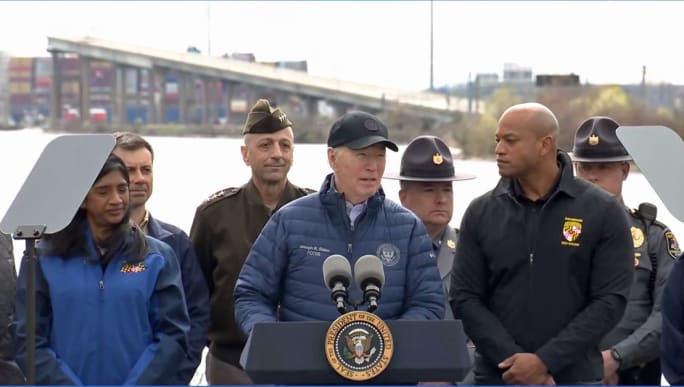
President Biden said reopening the Port of Baltimore, one of the country's largest shipping hubs, is a priority.
Photo: Screen Capture of Biden's April 5 remarks streamed on Whitehouse.gov.
President Joe Biden visited Baltimore on April 5, saying "heaven and earth" would be moved to re-construct a new bridge. He said the main priority was to open the Port of Baltimore.
Biden said his Task Force on Supply Chain Disruption has been working to minimize the impact on the supply chain. Federal government will provide $8 million in grant funds to make infrastructure improvements at Sparrow's Point to allow it to take on more ships.
The president vowed that the federal government would pay to build a new bridge, but Congress must actually vote to make that appropriation. Fox News reports that the far-right Freedom Caucus has demanded that any federal funds allocated to rebuild the bridge be offset by cuts elsewhere. It also said federal funds should only be for structural repairs.
Reports have estimated that the cost to rebuild the bridge could be as much as $2 billion.
More Fleet Management

Color Match Smarter: Tools That Restore & Perform
For fleet managers and collision repair professionals keeping heavy-duty trucks on the road, getting the color right the first time isn't just about appearance — it's about efficiency, turnaround time, and bottom-line results. Discover how today's digital color tools are transforming the repair process from guesswork to precision.
Read More →
FMCSA Pauses Biennial-Update Enforcement Amid Motus Transition
Carriers whose updates were due on or after June 1 have more time, while FMCSA works to stabilize its new registration system and warns of phishing sites impersonating its new carrier registration system, Motus.
Read More →
2026 Blueprint for Countering Smarter Supply Chain Theft
Cargo theft is no longer just the cost of doing business. It's a multi-billion-dollar criminal enterprise exploiting vulnerabilities across your fleet, drivers, and supply chain.
Read More →


How Telematics Improves Visibility, Control, and Performance in Refrigerated Fleets
Explore how telematics help refrigerated fleets improve visibility, uptime, efficiency, compliance, and cargo protection across connected cold chain operations.
Read More →
What the U.S.-Canada Trade War Means for Trucking
Escalating U.S.-Canada tariffs could disrupt cross-border freight, reduce truck volumes, raise costs, and create new uncertainty for carriers on both sides of the border.
Read More →
What Are Trucking’s Top Concerns for 2026?
The American Transportation Research Institute wants to know what's worrying trucking fleet managers, drivers, and other stakeholders in its annual Industry Issues survey.
Read More →
American Trucking Associations Looks for a New Leader
ATA President and CEO Chris Spear abruptly left his job at the association on August 21, at a pivotal time for the trucking industry.
Read More →
Public Wi-Fi Cybersecurity Risks: How Truck Drivers and Fleets Can Protect Their Data
Public Wi-Fi can expose truck drivers and fleets to credential theft, malware, and other cyber threats. Here’s how to reduce the risk on the road.
Read More →
For Nicky Cupp, Fleet Innovation Starts With Frustration
HDT Truck Fleet Innovator Nicky Cupp turns everyday pain points at Fraley & Schilling into opportunities for better technology and smarter processes.
Read More →
Adam Buttgenbach’s Approach to Electric Trucks: Start With Where They Fit
HDT Truck Fleet Innovator Adam Buttgenbach helped PepsiCo build one of North America’s largest EV fleets by focusing on where electric trucks make operational sense.
Read More →