




Autonomous Trucks Can Reduce Emissions, Fight Climate Change
A white paper published by Aurora Innovation found that autonomous trucking technology has the potential to increase energy efficiency and reduce emissions in the freight and logistics industry.


A new white paper published by Aurora Innovation found that autonomous trucks can be a fast and cost-effective route to lower emissions and help fight climate change.
Photo: Aurora Innovations
Aurora Innovation has released a white paper indicating that autonomous trucking has the potential for significant environmental benefits, the company reported.
The paper finds that autonomous trucking could increase energy efficiency by up to 32% relative to traditional trucking – helping the freight and logistics industry reduce emissions, meet environmental regulatory mandates, and bring down operating costs.
Transportation is a Significant Source of Emissions
Aurora noted in the study that transportation makes up approximately 29% of greenhouse gas emissions in the United States. Of this, medium- and heavy-duty trucks account for 23% of those emissions.
In some freight-heavy states, this number is even greater – transportation causes approximately 50% of greenhouse gas emissions in California, for example.
As Aurora advances toward driverless commercial operations, the company has examined ways to maximize the environmental benefits of autonomous trucks.
The white paper identifies seven opportunities to use autonomous trucking to make freight transportation more energy efficient, including:
Optimizing Highway Speeds: Autonomous trucks are not limited by hours-of-service restrictions, meaning there is less incentive to drive at high speeds to reach their destination faster. This enables lower speed driving that consumes less fuel per mile. Aurora’s approach of driving 65 mph instead of 70-75 mph on the highway could reduce highway fuel consumption by 9%-17%.
Limiting Idling: Today’s trucks often consume fuel by idling when drivers take breaks to rest, eat, or relax between hauls. This represents 4%-9% of fuel consumption. While autonomous trucks cannot completely eliminate idling, they could better maximize driving time.
Eco-Driving: Significant automotive energy usage comes from inefficient acceleration and braking. Autonomous trucks are capable of eco-driving – strategically optimizing acceleration, braking, and coasting to increase energy efficiency and reduce fuel consumption. One study cited in the white paper found increased strategic coasting could lead to 9.5% fuel savings.
Traffic Reduction: Because autonomous trucks can operate nearly 24 hours per day, they can shift a greater proportion of freight to off-peak driving hours. Not only would this reduce autonomous trucks’ fuel consumption by decreasing time stuck in traffic, shifting a portion of truck traffic to off-peak hours would help reduce congestion and fuel consumption for other vehicles.
Additionally, the white paper explains how the introduction of autonomous trucks into the supply chain can be a longer-term catalyst for accelerated adoption of next-generation powertrains, like battery electric and hydrogen fuel cell platforms, given the following:
Faster Return on Investment: New powertrains will likely have higher upfront costs, and the lower operating costs and higher utilization of autonomous trucks could enable faster returns on those investments.
Better Range Management: Because autonomous trucks are not restricted by hours-of-service limitations, they can better manage range and charging/fueling limitations of next-generation platforms.
Fixed Routes: The fixed route model of deploying autonomous trucks supports focused installation of charging/fueling infrastructure along these routes.
Additional Autonomous Advantages
The paper also detailed more indirect ways that autonomous trucks can reduce emissions while enhancing fuel efficiency for both fleets and the trucking industry at large. Many of these findings note a considerable reduction in the number of deadhead miles run by fleets.
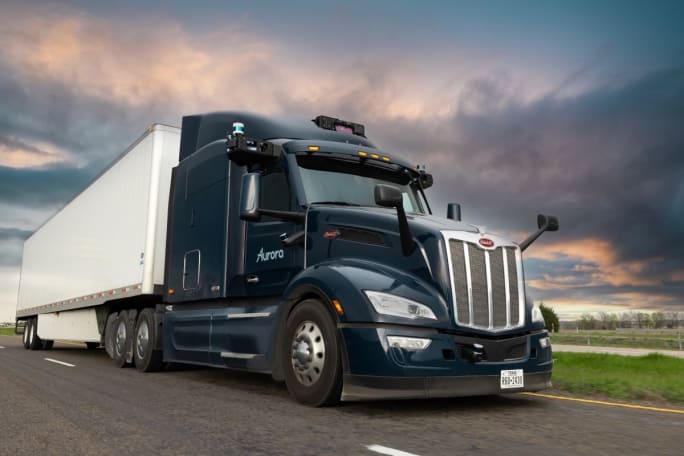
The Aurora white paper notes that autonomous trucks are not limited by hours-of-service restrictions, meaning there is less incentive to drive at high speeds and the opportunity to consume less fuel per mile.
According to the American Trucking Associations, about 15% of miles run by trucks in America are considered deadhead miles. Some of these empty miles can be attributed to load schedules, where a driver needs to travel from one drop-off location to a different pickup location, but many are attributed to human driver-specific reasons, such as when a driver takes an empty truck back home or off their commercial route to visit a rest stop.
However, the use of autonomous trucks changes that dynamic in several ways, Aurora found:
No Need to Return to Origin: The report notes that human driver may need to drive deadhead miles to get home after their shift, which could take place daily, weekly, or even monthly. Because autonomous trucks have flexible start points and end points depending on the needs of the business using them, they do not have such a requirement.
Optimized Load Capacity: Today, the white paper points out, there are common scenarios where a driver makes a dropoff and then the optimal action to reduce costs and increase energy efficiency would be to wait for hours until another nearby load is available. This would, however, frustrate the driver who may not be paid for that time. Carriers avoid this by dispatching Drivers to a different pickup location to get a load that is available sooner – incurring additional deadhead miles. Autonomous trucks are not limited in this fashion and are capable of waiting for the next optimal action without the same con[1]sequences as human drivers.
Terminal-to-Terminal Model: Aurora found that a terminal-to-terminal model can create efficiency by decoupling long haul freight from local shuttle operations – creating flexibility that can help optimize logistics management and may reduce deadhead miles. The longer terminal-to-terminal trips can be highly utilized while the factors that drive deadhead are more constrained to the shorter local trips, thereby reducing overall miles.
The white paper also notes that autonomous trucks are unlikely to eliminate the occurrence of all deadhead miles, they may – through a combination of the above mechanisms – enable a reduction of today’s 15% deadhead mile occurrence. Some of this reduction should occur immediately, such as the removed need for drivers to return to the point of origin, the alleviated need to keep human drivers busy, and the decoupling of long hauls from local shuttle through the terminal-to-terminal model.
Safe, Efficient, and Sustainable Autonomous Trucks
“As autonomous trucks make hauling freight safer, we have a responsibility to make logistics more sustainable as well,” said shared Garrett Bray, product director at Aurora and the author of the white paper. “Self-driving technology can fight climate change by increasing energy efficiency and reducing emissions in the supply chain.”
Bray holds a PhD in Engineering and a master’s in engineering for Sustainable Development from the University of Cambridge.
For carriers, Aurora found that autonomous trucks’ more efficient fuel consumption could reduce operating costs, and reductions in emissions would help meet federal and state environmental regulatory mandates.
You can download the Aurora white paper here: The Sustainability Opportunity of Autonomous Trucking.
More Fuel Smarts

How Volvo Updated Its D13 for EPA 2027 [Watch]
Volvo’s updated D13 promises lower emissions without sacrificing performance or fuel economy. Take a closer look at what changed inside the engine in this HDT Spotlight video.
Read More →
Diesel Price Spike Shortens Payback for Natural Gas Trucks, Report Says
Energy Vision estimates fleets could recover the higher purchase price of an RNG-fueled Class 8 tractor in 1.3 to 2.8 years under current fuel-price scenarios.
Read More →
Calstart Becomes Catalyst Mobility, Reflecting Broader Focus
Calstart is now Catalyst Mobility, reflecting the nonprofit’s growing national role in clean transportation, including zero-emission trucks, infrastructure and incentive programs.
Read More →

Record Diesel Prices Squeeze Trucking Fleets
Average U.S. diesel prices have climbed to nearly $6 a gallon, surpassing the 2022 record as tight refinery capacity and Middle East disruptions keep fuel costs elevated.
Read More →
How Fuel Delivery Shapes Engine Performance
Fuel delivery depends on more than what happens at the injector. For fleet, maintenance and technical professionals, looking at the full path from pump to injector can provide useful context for understanding engine performance.
Read More →
East Coast Port Launches $45M Electric Truck Push
The Port Authority of New York and New Jersey announced millions in incentives for zero-emission drayage trucks, yard tractors, and new charging hubs near the port.
Read More →
California Bill Could Shed Light on Electric Truck Prices
Why do battery-electric Class 8 trucks remain so expensive? A California bill headed to Gov. Gavin Newsom would give fleets and state agencies more visibility into what manufacturers charge.
Read More →
Detroit Opens Orders for EPA 2027 Engines
Detroit isn’t starting from scratch to meet EPA 2027 diesel emissions standards. Its Gen 6 DD13 and DD15 engines keep much of today’s platform while updating the fuel and aftertreatment systems.
Read More →
Zero-Emission Truck Corridor Planned for West Coast
California, Oregon, Washington, British Columbia and Baja California are coordinating plans for truck charging and hydrogen fueling from Canada to Mexico.
Read More →
A Closer Look at Kenworth’s Electric T880E Vocational Truck [Video]
Learn more about Kenworth's T880E battery-electric vocational truck at the Paccar Technical Center, including its range, applications, upfitting considerations, and PTO options, in this HDT Spotlight video.
Read More →