





Related: More Details Emerge on New Autocar Conventional Truck
Autocar's New Conventional Truck to Get Bodies on Assembly Line
Autocar said its Power of One integration body installation processes shows a substantial improvement in uptime and reliability for refuse fleets in the first 90 days of truck ownership.
June 11, 2019
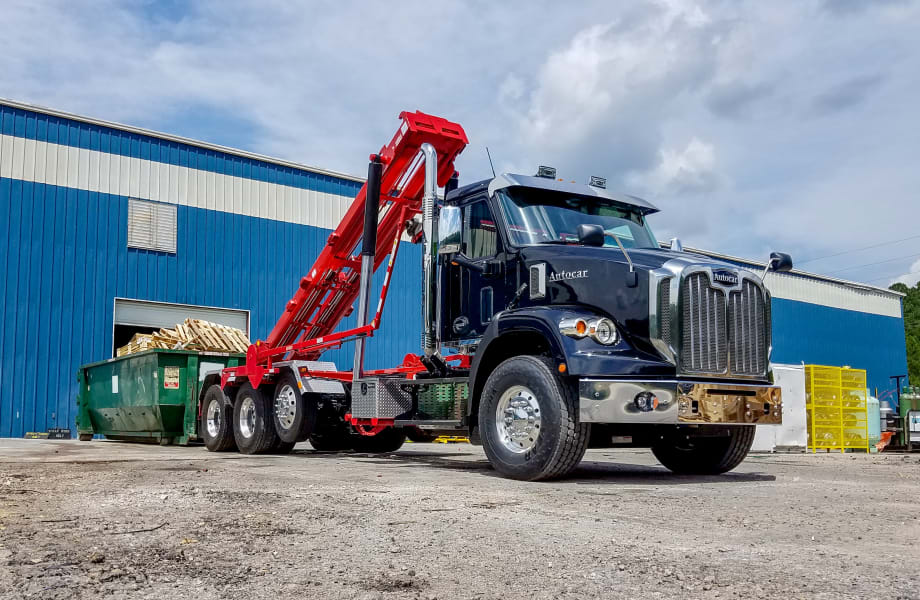
Autocar announced it is mounting roll-off hoist bodies directly on its new conventional Autocar DC truck production line.
Photo: Autocar
3 min to read
Autocar announced it is now mounting refuse and other vocational bodies directly on its new conventional Autocar DC on the production line. The company said this is an “unprecedented” change to the model of refuse truck production, bringing together the two main components – the chassis and the body -- and treating the truck as one complete tool. Autocar calls this process the Ultimate Power of One and said refuse truck operators will experience several significant benefits from this innovation.
“We’ve always known that improving the integration of our refuse truck chassis and refuse bodies is essential to reducing our customers’ downtime,” explained James Johnston, president of Autocar. “So flawless integration is a key aspect of our Always Up mission. We decided to take responsibility for building the truck as one compete tool. When we engineer the truck as a complete tool and mount body components right on the Autocar production line, we call that ‘Power of One’.”
Autocar introduced Power of One integration on the ACX cabover truck recently, and data reported by truck operators for the first 90 days in service shows a substantial improvement in uptime and reliability, the company said. The Power of One integrated trucks also demonstrated cost savings not only from avoided repairs but also from other downtime-related costs such as lost driver hours and towing that were eliminated, Autocar said. As a result, the company said it will offer Power of One integration with all refuse body manufacturers.
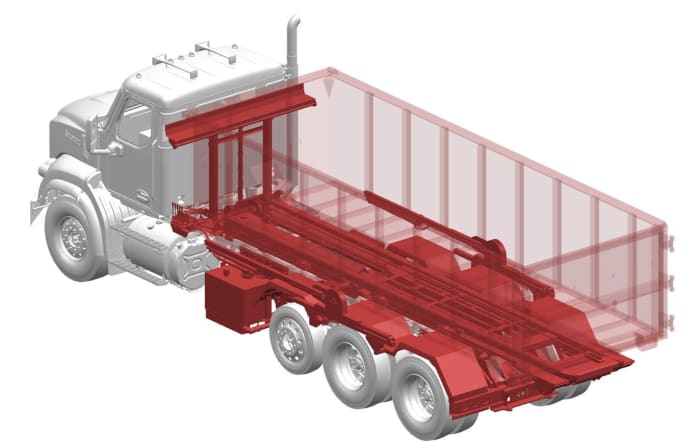
Since the whole system – chassis plus body – is pre-engineered and then assembled as one complete tool, Autocar said its finished trucks comply with all FMVSS and EPA regulations when they roll off the assembly line.
Image: Autocar
Enhanced safety is another benefit of Autocar’s Power of One integration, according to the company. Since the whole system – chassis plus body – is pre-engineered and then assembled as one complete tool, Autocar’s finished trucks comply with all FMVSS and EPA regulations when they roll off the assembly line. This is one more aspect of the Always Up model that Autocar said differentiates it from other truck brands which typically are modified with specialty bodies after they are built, increasing the risk of noncompliance with safety standards and other government regulations.
According to Autocar, the Ultimate Power of One process starts with engineering each truck based on that specific customer’s needs and working closely with the selected body company’s engineers. All the body components are then installed during Autocar’s production process. So all the electrical harnesses are installed together, eliminating the risk of splices, loose connectors, or drilled access holes. Body components are huck-bolted onto the frame rails in the precisely correct locations, not welded, avoiding misplacement and damage to the rails. Autocar will also fully mount tarp systems and lighting kits, so when the truck rolls out of the Autocar factory it can go to work immediately.
“Building trucks with the Power of One process is a game-changer for our customers," said Eric Schwartz, managing director of Autocar Trucks. "They tell us they have experienced a significant improvement in uptime for the Power of One trucks already in service. There’s another benefit that the Ultimate Power of One takes ever further: We are able to deliver ready-to-work truck months faster than ever before. In fact, for trucks ordered now, we are committing to deliver completed trucks in calendar [year] 2019.”
Autocar offers the DC-64R with a wide range of Ultimate Power of One specifications. Roll-off hoists are available with 60,000- and 75,000-lb. capacities for 22- and 24-foot-long dumpsters. Telescopic, single-forward, and single-rearward-mounted cylinder configurations are also available. The DC-64R can be engineered with a rear-cab guard and with or without pusher axles, as the customer’s needs require. All are installed on Autocar’s production line.
More Equipment

How Volvo Updated Its D13 for EPA 2027 [Watch]
Volvo’s updated D13 promises lower emissions without sacrificing performance or fuel economy. Take a closer look at what changed inside the engine in this HDT Spotlight video.
Read More →
Michelin Tire Improves Efficiency and Durability for Regional Fleets
The Michelin X Multi Energy D2 is a regional haul drive tire engineered to help fleets improve fuel efficiency, durability and traction in demanding stop-and-go operations.
Read More →
ZF Expands Commercial Vehicle Push in North America
ZF is expanding its North American commercial-vehicle presence with new transmission applications, electrification, trailer technology and autonomous-driving systems.
Read More →
Tesla Wants a Self-Driving Semi. Are Cameras Enough?
Could Tesla’s camera-only autonomous driving technology work on an 80,000-pound Semi? In this commentary, HDT's Deborah Lockridge takes a look at Tesla, Cybercab, and how autonomous trucks see the road.
Read More →
Kodiak: Driverless Long-Haul Truck Launch on Track for 2026
Kodiak AI says its driverless long-haul safety case is 93% complete and it remains on track to begin commercial operations by year-end 2026.
Read More →
What DOT’s Automated Vehicle Strategy Means for Trucking
The U.S. Department of Transportation issued a new automated-vehicle strategy that outlines plans for driverless-truck regulations, cross-state freight corridors, and federal safety standards.
Read More →
East Coast Port Launches $45M Electric Truck Push
The Port Authority of New York and New Jersey announced millions in incentives for zero-emission drayage trucks, yard tractors, and new charging hubs near the port.
Read More →
PlusAI Going Public to Fund Autonomous Truck Launch
A SPAC deal could provide PlusAI with up to $300 million as it works toward a 2027 commercial launch of factory-built autonomous trucks.
Read More →
NHTSA Moves to Rewrite Truck Fuel-Economy Rules
The National Highway Traffic Safety Administration says it lacks authority to regulate medium- and heavy-duty truck engines separately from complete vehicles, but the existing standards have not yet been eliminated.
Read More →
Detroit Opens Orders for EPA 2027 Engines
Detroit isn’t starting from scratch to meet EPA 2027 diesel emissions standards. Its Gen 6 DD13 and DD15 engines keep much of today’s platform while updating the fuel and aftertreatment systems.
Read More →