




ATRI: Trucking's Annual Congestion Costs Top $94.6 Billion
The latest Cost of Congestion study, published by the American Transportation Research Institute, reports traffic congestion cost the trucking industry $94.6 billion in 2021.


Reflecting the dramatic post-Covid economic recovery, annual truck congestion costs in 2021 hit a peak of $94.6 billion. The 2021 congestion cost figure is an increase of $20.1 billion in annual congestion costs from the 2016 baseline,
Source: ATRI
Traffic congestion on U.S. highways added $94.6 billion in costs to the trucking industry in 2021 according to the latest Cost of Congestion study published by the American Transportation Research Institute.
ATRI said it utilized a variety of data sources including its unique truck GPS database to calculate trucking delay impacts from 2017 through 2021 on major U.S. roadways.
While year-over-year congestion costs decreased in 2020 due to the Covid-19 pandemic, they rose sharply in 2021 with a total of 1.27 billion hours of lost productivity.
This increase in costs reflects the dramatic post-Covid economic recovery, with high GDP growth and freight demand borne from record levels of consumer spending.
This level of delay equates to more than 460,000 commercial truck drivers sitting idle for one work year, and the 2021 figure represents a 27% increase from the report’s baseline year of 2016 – an increase that is twice the rate of inflation.
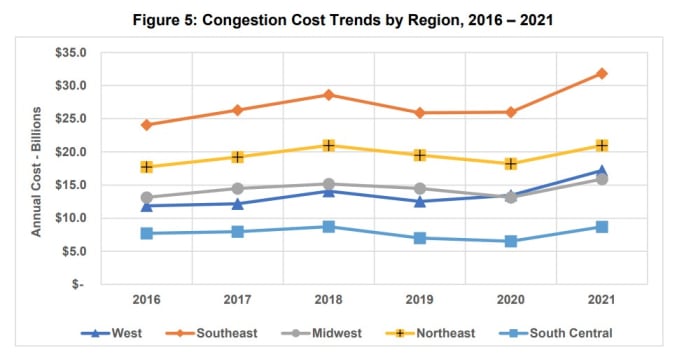
Regional trends show a pattern similar to the national trend, with congestion costs rising into 2018, then dropping in 2019 and 2020, with a visible rise in congestion costs in 2021.
Source: ATRI
Costs by State
In addition to the national findings, ATRI’s analysis also documented state and metropolitan delays and related cost impacts.
The top 10 states each experienced costs of more than $3 billion. Those states are:
California — $9 billion
Texas — $7.26 billion
Florida — $7.16 billion
New York — $4.91 billion
Louisianna — $4.21 billion
Georgia — $4.02 billion
New Jersey — $3.83 billion
Illinois — $3.37 billion
Pennsylvania — $3.26 billion
Tennessee — $3.15 billion
These 10 states combined ultimately account for more than half, 53%, of trucking’s congestion costs nationwide.
Nevada saw the largest percentage increase in truck congestion costs, rising from $293 million in 2016 to $636 million in 2021, an increase of 117.2%. Louisiana had the second-largest increase, growing from $2.3 billion to $4.21 billion. Georgia, which ranked sixth overall, increased from $2.21 billion to $4.02 billion.
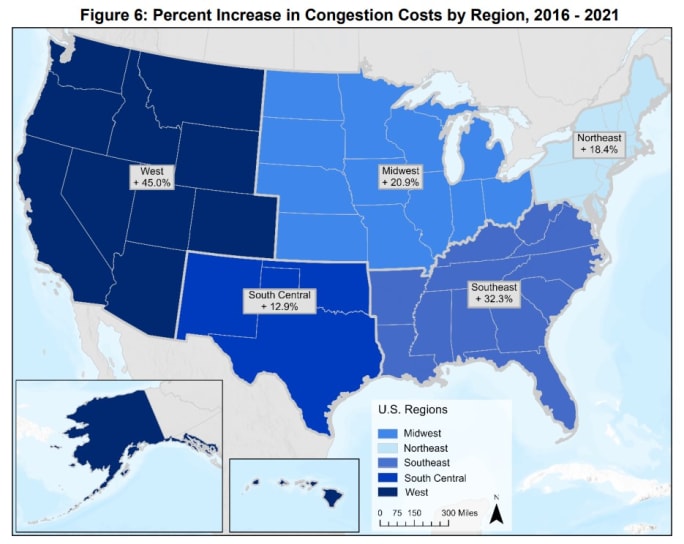
The region with the highest congestion costs remained the Southeast, followed by the Northeast. The West, however, saw the largest percentage increase in congestion costs from 2016 to 2021, followed by the Southeast.
Source: ATRI
Metro Areas
The New York City metropolitan area ranked highest for cities in terms of truck congestion costs, with costs approaching $5.5 billion annually. The top 10 metropolitan areas by total cost of congestion are:
New York City Metro — $5.49 billion
Miami Metro — $2.61 billion
Chicago Metro — $2.57 billion
Philadelphia Metro — $2.1 billion
Los Angeles Metro — $1.8 billion
Dallas Metro — $1.79 million
Houston Metro — $1.63 billion
Washington DC Metro — $1.61 billion
Nashville Metro — $1.44 billion
Atlanta Metro — $1.39 billion
Miami, Dallas, Houston, and Nashville all moved up one spot, the Washington D.C. metro fell two spots, and Chicago and Atlanta each fell one spot. New York, Philadelphia, and Los Angeles saw no change.
Transportation Investments
The report also documents transportation investment by states through the Infrastructure Investment and Jobs Act (IIJA), which could provide as much as $350 billion in funding to address congestion.
"Over the last several years, our industry has experienced some of the most dramatic increases in operating costs, including fuel, labor and equipment,” said Michael Lasko, vice president of EHS and Quality at Boyle Transportation. “Imagine how those costs are magnified by sitting still in traffic. We all should keep in mind that those costs are passed down directly to consumers resulting in higher prices for goods and services throughout the economy. Hopefully we can leverage the new infrastructure spending to get our supply chains moving again.”
Fuel Costs
ATRI’s analysis also found that the trucking industry wasted over 6.7 billion gallons of diesel fuel in 2021 due to congestion, resulting in more than $22.3 billion in additional fuel costs.
A copy of the full report is available on ATRI’s website here.
More Fleet Management

Color Match Smarter: Tools That Restore & Perform
For fleet managers and collision repair professionals keeping heavy-duty trucks on the road, getting the color right the first time isn't just about appearance — it's about efficiency, turnaround time, and bottom-line results. Discover how today's digital color tools are transforming the repair process from guesswork to precision.
Read More →
FMCSA Pauses Biennial-Update Enforcement Amid Motus Transition
Carriers whose updates were due on or after June 1 have more time, while FMCSA works to stabilize its new registration system and warns of phishing sites impersonating its new carrier registration system, Motus.
Read More →
2026 Blueprint for Countering Smarter Supply Chain Theft
Cargo theft is no longer just the cost of doing business. It's a multi-billion-dollar criminal enterprise exploiting vulnerabilities across your fleet, drivers, and supply chain.
Read More →


How Telematics Improves Visibility, Control, and Performance in Refrigerated Fleets
Explore how telematics help refrigerated fleets improve visibility, uptime, efficiency, compliance, and cargo protection across connected cold chain operations.
Read More →
What the U.S.-Canada Trade War Means for Trucking
Escalating U.S.-Canada tariffs could disrupt cross-border freight, reduce truck volumes, raise costs, and create new uncertainty for carriers on both sides of the border.
Read More →
What Are Trucking’s Top Concerns for 2026?
The American Transportation Research Institute wants to know what's worrying trucking fleet managers, drivers, and other stakeholders in its annual Industry Issues survey.
Read More →
American Trucking Associations Looks for a New Leader
ATA President and CEO Chris Spear abruptly left his job at the association on August 21, at a pivotal time for the trucking industry.
Read More →
Public Wi-Fi Cybersecurity Risks: How Truck Drivers and Fleets Can Protect Their Data
Public Wi-Fi can expose truck drivers and fleets to credential theft, malware, and other cyber threats. Here’s how to reduce the risk on the road.
Read More →
For Nicky Cupp, Fleet Innovation Starts With Frustration
HDT Truck Fleet Innovator Nicky Cupp turns everyday pain points at Fraley & Schilling into opportunities for better technology and smarter processes.
Read More →
Adam Buttgenbach’s Approach to Electric Trucks: Start With Where They Fit
HDT Truck Fleet Innovator Adam Buttgenbach helped PepsiCo build one of North America’s largest EV fleets by focusing on where electric trucks make operational sense.
Read More →