





From the archives (2017): Self-Driving Trucks Need to Gain Traction on Capitol Hill
ATRI Research Redefines Role of Government in Autonomous Truck Testing
The American Transportation Research Institute has published a new report that looks at how government regulations are affecting the evolution of autonomous vehicle technology, as well as the role government plays in the testing and overseeing of these technologies in the real world.
January 14, 2020

Source: ATRI
3 min to read
The American Transportation Research Institute has published a new report that looks at how government regulations are affecting the evolution of autonomous vehicle technology, as well as the role government plays in the testing and overseeing of these technologies in the real world.
The study also proposes a framework by which autonomous truck standards could be developed.
The report documents the dozens of local, state and federal activities that guide and regulate autonomous truck activities. While most attempt to create a framework for the safe testing of autonomous trucks, ATRI notes, the myriad state and local activities ultimately impede the creation of a seamless and standardized autonomous truck network.
Even those government rules that ostensibly support autonomous truck development often are too prescriptive to generate meaningful outcomes, it says. For example, multiple vendors highlight Level 4 testing, even though regulations require constant control of the vehicles by both drivers and onboard engineers – making it difficult for motor carrier executives to accurately assess the real value of ATs.
A Closer Look at Federal Autonomous Vehicle Oversight
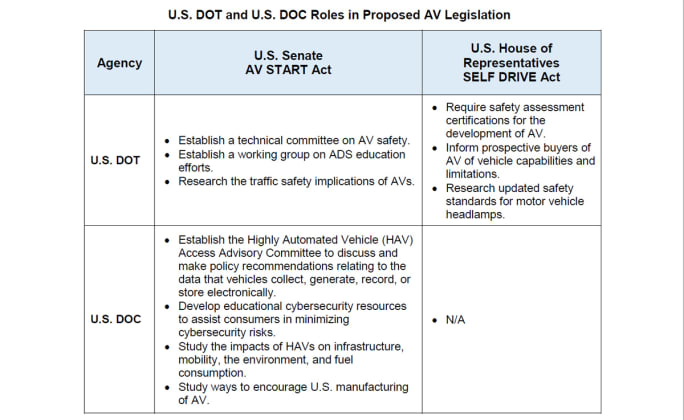
Congress initially entered the legislative fold concerning autonomous vehicles during the 2017-2018 session with the development of two bills, the SELF DRIVE Act in the House of Representatives and AV START Act in the Senate, which both relate to the development, testing, and implementation of these technologies. While neither of the bills made it to the floor for a vote, it is important to understand the foundation they both attempted to lay down concerning autonomous technology.
Source: ATRI
The SELF DRIVE Act would have preempted “states from enacting laws regarding the design, construction, or performance of” AV technologies “unless such laws enact standards identical to federal standards.” The AV Start Act would have preempted “states from adopting, maintaining, or enforcing any law, rule, or standard regulating” AV technologies “regarding certain safety evaluation report subject areas.” But, due to the complexity of trying to connect the network of state laws concerning interstate commerce, ATRI highlighted the fact that the potential use cases for AV should probably limited to local or regional operations in locations with favorable regulatory frameworks.
“The pace of technology development in the autonomous truck sphere is moving at lightning speed,” said Jeff Reed, Skyline Transportation President and chair of the ATA Automated Truck Subcommittee. “Our industry needs states to collaborate on seamless policies and regulations, and we need more proactive federal guidance on AT development. Government activities at all levels must be dynamic enough to address the constantly evolving technology landscape.”
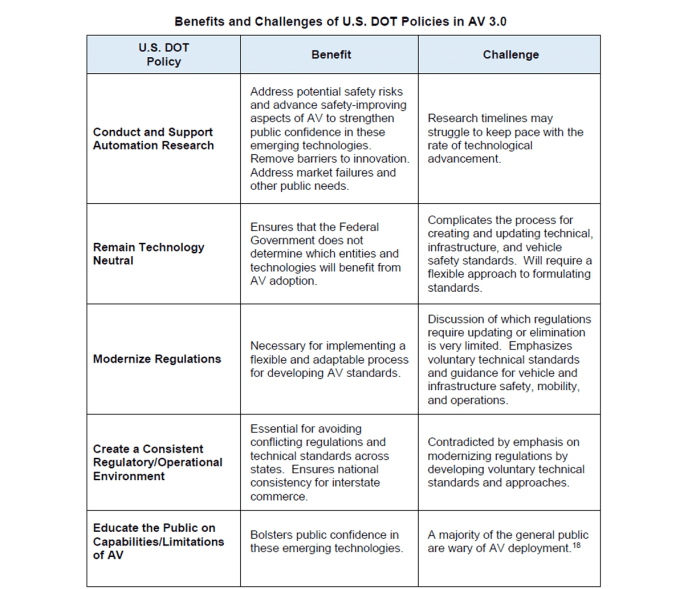
The U.S. Department of Transportation’s guiding policies outlined within its report, “Ensuring American Leadership in Automated Vehicle Technologies: Automated Vehicles 4.0,” emphasizes how these technologies could both positively or negatively impact the adoption of AV technologies in trucking.
Source: ATRI
Connectivity and Autonomous Tech
One of the key policy areas discussed in the DOT’s report is cooperative automation and connectivity. This relates to the how complementary to automation technology, whether its vehicle-to-vehicle, vehicle-to-infrastructure or vehicle-to-everything, can help. Other potential uses of cooperative automation include:
Wireless speed harmonization to reduce traffic congestion and bottlenecks;
Improving traffic flows at interchanges through cooperative lane change and merge functions; and
Coordinating traffic movements of AV-equipped vehicles at intersections using Signal Phase and Timing data.
According to the report, it is up to the trucking industry to ensure that there is enough bandwidth to support the deployment of these technologies.
Source: ATRI
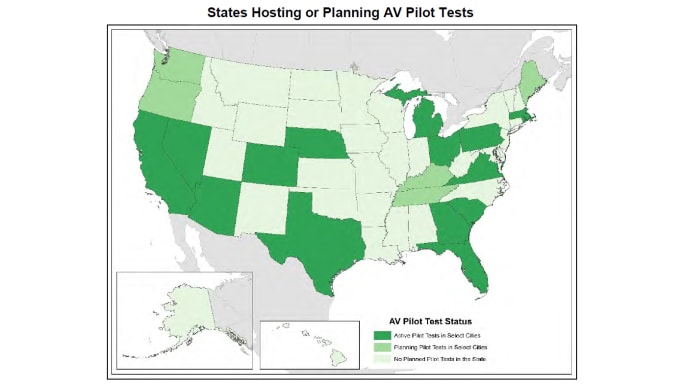
There are currently pilot tests in 50 cities across 20 states and Washington, D.C., which are a necessary precursor to the widespread adoption of trucking applications of these technologies. As pointed out by the Governors Highway Safety Association’s whitepaper, “Automated Vehicle Safety Expert Panel: Engaging Drivers and Law Enforcement,” it is important that the public understand that AVs will not be void of accidents, and that public education programs that highlight AV testing outcomes can have a positive impact on the public’s perception of these technologies.
You can download the full report here.
More Equipment

How Volvo Updated Its D13 for EPA 2027 [Watch]
Volvo’s updated D13 promises lower emissions without sacrificing performance or fuel economy. Take a closer look at what changed inside the engine in this HDT Spotlight video.
Read More →
Michelin Tire Improves Efficiency and Durability for Regional Fleets
The Michelin X Multi Energy D2 is a regional haul drive tire engineered to help fleets improve fuel efficiency, durability and traction in demanding stop-and-go operations.
Read More →
ZF Expands Commercial Vehicle Push in North America
ZF is expanding its North American commercial-vehicle presence with new transmission applications, electrification, trailer technology and autonomous-driving systems.
Read More →
Tesla Wants a Self-Driving Semi. Are Cameras Enough?
Could Tesla’s camera-only autonomous driving technology work on an 80,000-pound Semi? In this commentary, HDT's Deborah Lockridge takes a look at Tesla, Cybercab, and how autonomous trucks see the road.
Read More →
Kodiak: Driverless Long-Haul Truck Launch on Track for 2026
Kodiak AI says its driverless long-haul safety case is 93% complete and it remains on track to begin commercial operations by year-end 2026.
Read More →
What DOT’s Automated Vehicle Strategy Means for Trucking
The U.S. Department of Transportation issued a new automated-vehicle strategy that outlines plans for driverless-truck regulations, cross-state freight corridors, and federal safety standards.
Read More →
East Coast Port Launches $45M Electric Truck Push
The Port Authority of New York and New Jersey announced millions in incentives for zero-emission drayage trucks, yard tractors, and new charging hubs near the port.
Read More →
PlusAI Going Public to Fund Autonomous Truck Launch
A SPAC deal could provide PlusAI with up to $300 million as it works toward a 2027 commercial launch of factory-built autonomous trucks.
Read More →
NHTSA Moves to Rewrite Truck Fuel-Economy Rules
The National Highway Traffic Safety Administration says it lacks authority to regulate medium- and heavy-duty truck engines separately from complete vehicles, but the existing standards have not yet been eliminated.
Read More →
Detroit Opens Orders for EPA 2027 Engines
Detroit isn’t starting from scratch to meet EPA 2027 diesel emissions standards. Its Gen 6 DD13 and DD15 engines keep much of today’s platform while updating the fuel and aftertreatment systems.
Read More →