




ATA Truck Tonnage: Modest December Gain Closes Out Tough Year
Despite a modest freight volume gain to close out 2025, overall tonnage remains subdued, according to ATA.

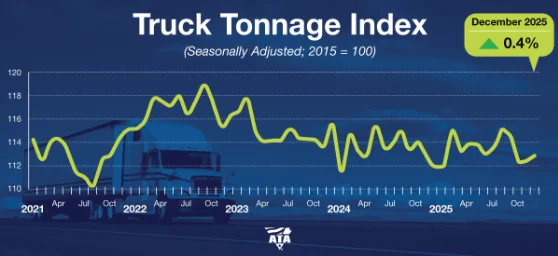
ATA reported that its seasonally adjusted truck tonnage index increased 0.4% in December, following a 0.2% gain in November.
Chart: American Trucking Associations.
U.S. truck freight volumes edged higher in December, but overall tonnage remained subdued as the industry closed out another challenging year.
In fact, the American Trucking Associations’ For-Hire Truck Tonnage Index grew only 0.1% in 2025.
Historically Soft Freight Levels Linger
ATA reported that its seasonally adjusted truck tonnage index increased 0.4% in December, following a 0.2% gain in November.
Despite the back-to-back increases, the modest improvement did little to offset sharp declines in the fall, leaving freight volumes at historically low levels.
“Despite two consecutive gains, tonnage remains at low levels as the freight metric contracted a total of 2.7% in September and October,” said ATA Chief Economist Bob Costello in a news release.
“Soft manufacturing and construction activity are continuing to suppress freight levels, as they did for much of last year.”
For all of 2025, truck tonnage rose just 0.1% compared with the 2024 average. While that marks the first annual increase since 2022, the gain underscores how difficult freight conditions remained throughout much of the year.
December’s seasonally adjusted index registered 112.9, up from 112.4 in November, using 2015 as the baseline year. On a year-over-year basis, tonnage increased 0.9% compared with December 2024, snapping two months of year-over-year declines.
An Overall Weak Fourth Quarter
Still, the fourth quarter told a weaker story. The index average for the final three months of the year fell 1.8% compared with the third quarter, marking the largest sequential quarterly decline since the second quarter of 2023. Compared with the fourth quarter of 2024, tonnage was down 0.3%.
ATA pointed to ongoing weakness in manufacturing and construction as key drags on freight demand. Both sectors have struggled to regain momentum, limiting freight opportunities even as capacity continues to slowly exit the market.
The muted growth reinforces what many carriers have been experiencing on the ground: a market that has stabilized somewhat from its lows but has yet to generate a meaningful rebound in volumes or pricing power.
The tonnage index is heavily weighted toward contract freight rather than spot market activity, making it a useful indicator of core, longer-term freight demand rather than short-term volatility.
Raw Tonnage Shows Seasonal Lift
On a not seasonally adjusted basis, which reflects raw changes in freight volumes, December tonnage totaled 111.9—up 4.3% from November’s reading of 107.3.
That increase reflects typical seasonal patterns, including year-end shipping activity, rather than a fundamental shift in freight demand.
ATA noted that November’s seasonally adjusted gain was unchanged from what it first reported in late December.
Despite the prolonged freight downturn, trucking continues to serve as a key barometer of the U.S. economy. Trucks account for 72.7% of all domestic freight tonnage, moving manufactured goods, retail products, and industrial materials across the country.
In 2024, trucks hauled an estimated 11.27 billion tons of freight. Motor carriers generated $906 billion in revenue, accounting for nearly 77% of total revenue across all freight transportation modes.
Cautious Outlook Heading into 2026
While December’s increase offers a small positive signal, the data suggest the industry is entering 2026 still searching for a sustained freight recovery.
With manufacturing and construction activity remaining soft, carriers are likely to continue operating in a cautious environment where efficiency, cost control, and disciplined capacity management remain critical.
More Fleet Management

Color Match Smarter: Tools That Restore & Perform
For fleet managers and collision repair professionals keeping heavy-duty trucks on the road, getting the color right the first time isn't just about appearance — it's about efficiency, turnaround time, and bottom-line results. Discover how today's digital color tools are transforming the repair process from guesswork to precision.
Read More →
FMCSA Pauses Biennial-Update Enforcement Amid Motus Transition
Carriers whose updates were due on or after June 1 have more time, while FMCSA works to stabilize its new registration system and warns of phishing sites impersonating its new carrier registration system, Motus.
Read More →
2026 Blueprint for Countering Smarter Supply Chain Theft
Cargo theft is no longer just the cost of doing business. It's a multi-billion-dollar criminal enterprise exploiting vulnerabilities across your fleet, drivers, and supply chain.
Read More →


How Telematics Improves Visibility, Control, and Performance in Refrigerated Fleets
Explore how telematics help refrigerated fleets improve visibility, uptime, efficiency, compliance, and cargo protection across connected cold chain operations.
Read More →
What the U.S.-Canada Trade War Means for Trucking
Escalating U.S.-Canada tariffs could disrupt cross-border freight, reduce truck volumes, raise costs, and create new uncertainty for carriers on both sides of the border.
Read More →
What Are Trucking’s Top Concerns for 2026?
The American Transportation Research Institute wants to know what's worrying trucking fleet managers, drivers, and other stakeholders in its annual Industry Issues survey.
Read More →
American Trucking Associations Looks for a New Leader
ATA President and CEO Chris Spear abruptly left his job at the association on August 21, at a pivotal time for the trucking industry.
Read More →
Public Wi-Fi Cybersecurity Risks: How Truck Drivers and Fleets Can Protect Their Data
Public Wi-Fi can expose truck drivers and fleets to credential theft, malware, and other cyber threats. Here’s how to reduce the risk on the road.
Read More →
For Nicky Cupp, Fleet Innovation Starts With Frustration
HDT Truck Fleet Innovator Nicky Cupp turns everyday pain points at Fraley & Schilling into opportunities for better technology and smarter processes.
Read More →
Adam Buttgenbach’s Approach to Electric Trucks: Start With Where They Fit
HDT Truck Fleet Innovator Adam Buttgenbach helped PepsiCo build one of North America’s largest EV fleets by focusing on where electric trucks make operational sense.
Read More →