




ATA Pushes for FMCSA Response on Crash Accountability
The American Trucking Associations continues to prod the Federal Motor Carrier Safety Administration to change its approach to measuring crash accountability in its CSA safety enforcement program. Yesterday, the association challenged the agency to release a study it has done on the feasibility of using police reports to gauge crash accountability
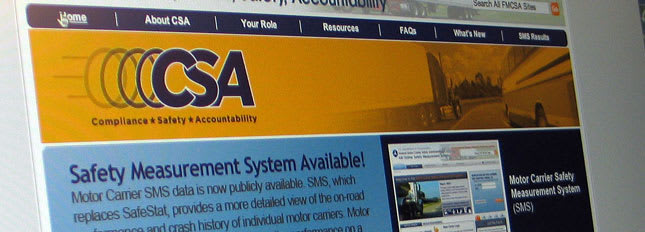
The American Trucking Associations continues to prod the Federal Motor Carrier Safety Administration to change its approach to measuring crash accountability in its CSA safety enforcement program. Yesterday, the association challenged the agency to release a study it has done on the feasibility of using police reports to gauge crash accountability.
The FMCSA told ATA in 2010 that it could not share the study because its findings were preliminary and still being reviewed. Since then ATA has renewed its request a number of times, most recently in a meeting last April, said spokesman Sean McNally in an email.
FMCSA did not respond to an email query about the study yesterday.
The issue is a particular sore point for ATA.
Under CSA, a carrier's safety performance is rated in part on the crashes it is involved in, no matter who is at fault. The agency has explained that its data shows that crashes, with or without fault, are reliable predictors of future performance.
But the agency also has agreed with ATA that there should be a way to account for fault in the data, and has done preliminary work on a way to get that done.
Then in what ATA believes was a sudden reversal, the agency last February backed away from a plan to request comments on its new approach.
Agency Administrator Anne Ferro explained at the time that safety advocacy groups raised questions about the plan that need to be answered before the agency goes forward.
The questions have to do with the uniformity and consistency of the Police Accident Reports that provide the basic accountability data, and the lack of public input into the determination of accountability.
The agency said it needs more information on how to identify carriers with the greatest risk of future crashes. Specifically, the agency wants to evaluate the uniformity and consistency of police accident reports, and to establish a process for assessing crashes in a uniform way.
It also wants a way to get public comment on the assessment, and to determine the effect of all this on its ability to identify the riskiest carriers.
The agency has not laid out a timetable for this work.
ATA President and CEO Bill Graves recently has been pushing the agency for action on this issue. Last month he said that while ATA has worked with FMCSA to improve CSA, its members are beginning to wonder if cooperation is the best approach.
Yesterday in a statement on the crash accountability study, Graves underscored the point:
"To live up to its goal to be open and transparent, FMCSA should release the results of its study, identify the specific concerns that caused it to place the planned solution on hold, and commit to a timeline for addressing this issue," he said.
Related Stories:
FMCSA Stops Plan to Determine Accountability in CSA Crash Data, 3/12/2012
Ferro Discusses CSA Changes at MATS, 3/22/2012
Schneider National Safety Guru Don Osterberg on the FMCSA's New Enforcement Program, 1/19/2012
More Drivers

EEOC Sues Texas Trucking Company Over Driver Age Limits
The agency says Trancasa USA rejected applicants over 65 and applied tougher driving-record standards to those over 60.
Read More →
Nussbaum, Roehl Announce Second Driver Pay Increase This Year
This year has seen a swath of major truck driver pay increases as freight capacity has tightened.
Read More →
From One Generation to the Next: How Mentorship Builds Safer Truck Drivers
After three decades in trucking, Harold Perry shares what he's learned about driver safety, mentorship, and helping the next generation build confidence behind the wheel.
Read More →
Truck Drivers Need More Than Another Alert
Fleets have more visibility into truck health, safety events, and driver activity than ever. The next challenge is turning all that information into useful guidance for the person who has to decide what to do next.
Read More →
FMCSA Removes 110 Truck Driver Training Schools from Certified ELDT List
Federal regulators also are targeting more than 160 additional training providers and launching a nationwide audit of third-party CDL skills testers as part of a broader crackdown on trucking fraud.
Read More →
Hours of Service Pilot Programs: FMCSA Readies for 2027 Rollout
Two pilot programs could eventually reshape hours-of-service rules, giving truck drivers options to pause their 14-hour clock or use longer split sleeper rest periods.
Read More →
Medical Cards, English Proficiency Reshape Roadcheck Violations
Medical-card violations jumped to the top of the driver out-of-service list during CVSA’s 2026 International Roadcheck, while English-language proficiency violations appeared among the leading violations for the first time.
Read More →
Driver Trust Can Make or Break the Success of Fleet Safety Technology
New Teletrac Navman research suggests that onboarding, transparency about driver data, and positive feedback can play a significant role in how commercial drivers respond to safety and coaching technology.
Read More →
EEOC Sues KLLM Over Alleged Sex Discrimination in Driver Training
KLLM is facing a federal sex-discrimination lawsuit over policies the EEOC alleges put female truck driver trainees at a disadvantage.
Read More →
FMCSA Moves to Codify English Language Requirements for Commercial Drivers
By changing regulations on English-language proficiency requirements for commercial drivers, rather than relying on a guidance memo, the FMCSA said future administrations won't be able to walk back the Trump administration's stricter enforcement with just a memo.
Read More →