





More from USDOT: FMCSA Targets 550+ ‘Sham’ CDL Schools in Nationwide Sting Operation
DOT Alleges Illinois Issued Illegal Non-Domiciled CDLs
Illinois is the latest state targeted and threatened with the loss of highway funding by the U.S. Department of Transportation in its review of states' non-domiciled CDL issuance procedures. The state is pushing back.
February 18, 2026
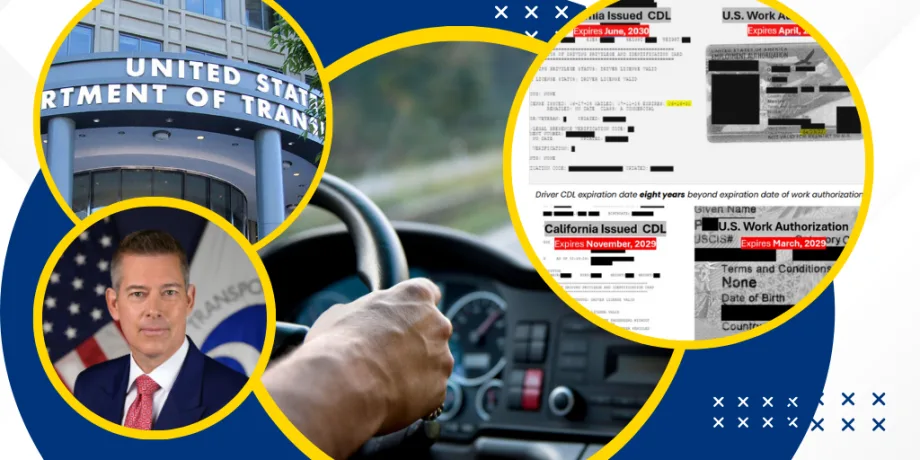
The FMCSA has said non-domiciled commercial drivers license holders were responsible for a number of fatal crashes last year.
Credit:
HDT Graphic
4 min to read
The Federal Motor Carrier Safety Administration announced that its review of Illinois’ non-domiciled commercial driver’s licenses program found nearly one in five of these licenses to have been issued illegally, according to a DOT news release. However, Illinois state officials dispute the agency's claims.
The FMCSA warned that Illinois has 30 days to come into compliance and revoke what it called illegally issued licenses or risk losing $128 million in federal highway funding.
Illinois Secretary of State Alexi Giannoulias issued a statement condemning the Trump administration’s assertions on the state’s past handling of non-domiciled CDLs.
Non-domiciled CDLs are issued to people who are legally allowed to work in the U.S. but do not permanently live in the state issuing the license. This is often foreign nationals working under temporary U.S. work authorization. However, FMCSA found problems with states issuing these licenses improperly and contends it leads to unsafe drivers on the road.
The FMCSA moved swiftly to severely limit who is eligible for non-domiciled CDLs, issuing a final rule earlier this month. The rule is effective March 16.
In issuing that rule, the agency said FMCSA identified 17 fatal crashes in 2025 caused by actions of non-domiciled CDL holders whose fitness could not be ensured and would be ineligible under this new rule.
Illinois is the latest in a long string of states that the agency has targeted in its non-domiciled CDL investigation.
In June, the Department of Transportation announced a nationwide audit of states that issue non-domiciled CDLs. FMCSA said it has found that more than 30 states have issued tens of thousands of non-domiciled CDLs in violation of federal regulations.
FMCSA Outlines Illinois Problems with Non-Domiciled CDLs
In a letter sent to Illinois Gov. J.B. Pritzker and Illinois Director of Driver Services Kevin Duesterhaus, FMCSA outlined the audit’s findings of how the state illegally issued non-domiciled CDLs to:
- Drivers whose licenses were valid long after their lawful presence in the U.S. expired.
- Drivers without Illinois first verifying the individual’s lawful presence in the U.S.
USDOT is now demanding that Illinois take the following corrective measures to avoid funding being withheld:
- Immediately pause issuance of non-domiciled CDLs.
- Identify all unexpired non-domiciled CDLs that fail to comply with FMCSA regulations.
- Revoke and reissue all noncompliant non-domiciled CDLs if they comply with the federal requirements.
- Conduct a comprehensive internal audit to identify all procedural and programming errors, training and quality assurance problems, insufficient policies and practices, and other issues that have resulted in the issuance of non-domiciled CDLs that did not meet federal rules.
Illinois Responds to Non-Domiciled CDL Investigation
The Illinois secretary of state's statement explained that according to federal guidelines, non-domiciled residents seeking a CDL must show proof of legal status in the U.S., such as an employment authorization document (EAD) or an I-94 with a valid foreign passport.
"In its letter, FMCSA fails to recognize an extension granted to EAD holders," it said.
The federal government’s policy on processing backlogged EAD renewals called for extending the validity of existing employment authorization documents, it said, and that policy existed until October 31, 2025.
Illinois had already adopted the use of the SAVE system (Systematic Alien Verification for Entitlements) to verify lawful immigration status for all non-domiciled CDL applicants before the FMCSA’s interim rule was announced last year.
However, as the Trump administration has expanded the use of the SAVE system, its shortcomings have become apparent.
Employers whose workers were swept up in immigration raids have said the SAVE system indicated that their workers were eligible for employment.
And conversely, as the administration looks to use the system to prevent non-citizen voting, agencies have found numerous cases of it inaccurately flagging people as non-citizens.
More Uncertainty for Trucking Industry
The secretary of state’s office said the state has also adopted additional safeguards to retain and validate application documents.
"The secretary of state’s office believes its CDL issuance policies and practices are substantially compliant with applicable FMCSA requirements and will not justify cutting federal highway funding," the statement said. The office intends to conduct a review of the FMCSA findings.
“Commercial driver’s licenses are the backbone of Illinois’ trucking industry and the supply chain that keeps our state moving, including the vital transportation network that supports our agriculture community,” said Matt Hart, executive director of the Illinois Trucking Association.
“The pause on the non-domicile CDL creates uncertainty for the industry that is already stretched thin and puts many in limbo. For many drivers, especially owner-operators, their CDL isn't just a credential – it's their livelihood."
Editor's Note: This article was updated February 19 to clarify Illinois' response to the FMCSA announcement.
More Drivers

Why Hiring Truck Drivers Is Getting Harder
Higher recruiting costs, a shrinking driver pool, and renewed pay competition are raising the stakes for fleets heading into 2027.
Read More →
Roehl Offers Truck Drivers $10,000 Retention Incentive
Payments begin after the first load and continue in mileage-based installments for eligible experienced drivers joining the fleet.
Read More →
Platform Science Adds Dispatch and Safety Tools
Four additions to PS Fleet help fleets monitor loads, manage driver coaching, share truck locations and adjust video system settings.
Read More →
When Language Stops the Truck: The Return of ELP Out-of-Service Orders
English language proficiency rules for commercial drivers aren’t new, but renewed out-of-service enforcement has raised the stakes. Here’s what carriers need to know before a driver reaches a roadside inspection.
Read More →
Samsara Launches Custom AI Agent Builder
Agent Studio lets fleets create AI tools for hours-of-service monitoring, reporting and driver support, including agents that communicate by phone.
Read More →
Trucker Path Expands Reserved Parking Network
Trucker Path has added close to 6,000 more truck parking spaces to its Trucker Path Reserved Parking Network with the addition of Safe Truck Parking.
Read More →
EEOC Sues Texas Trucking Company Over Driver Age Limits
The agency says Trancasa USA rejected applicants over 65 and applied tougher driving-record standards to those over 60.
Read More →
Nussbaum, Roehl Announce Second Driver Pay Increase This Year
This year has seen a swath of major truck driver pay increases as freight capacity has tightened.
Read More →
From One Generation to the Next: How Mentorship Builds Safer Truck Drivers
After three decades in trucking, Harold Perry shares what he's learned about driver safety, mentorship, and helping the next generation build confidence behind the wheel.
Read More →
Truck Drivers Need More Than Another Alert
Fleets have more visibility into truck health, safety events, and driver activity than ever. The next challenge is turning all that information into useful guidance for the person who has to decide what to do next.
Read More →