




Are We Near the Bottom of the Freight Cycle?
ACT Research reports the supply and demand dynamics in the freight market are beginning to recover. Its recent data suggests demand fundamentals improving and capacity starting to tighten may signal the industry is approaching the bottom of the freight cycle.


Supply and demand numbers indicate the freight cycle is approaching the bottom.
Source: ACT Research/Cass Information Systems/Canva
ACT Research reports the supply and demand dynamics in the freight market are beginning to recover. Its recent data suggests demand fundamentals improving and capacity starting to tighten may signal the industry is approaching the bottom of the freight cycle.
“After a long soft patch, we see the U.S. freight transportation industry on the verge of a new cycle as we begin to transition from the bottoming phase into the early phase of the freight cycle in the months to come,” Tim Denoyer, ACT Research’s vice president and senior analyst, said in the Cass Transportation Index Report April 2023.
The latest release of the ACT Freight Forecast report points out that the freight cycle is “still weak” and truckload spot rates are nearing the bottom.
Truckload Volume Index
According to the Truckload Volume Index, freight volumes dropped and national average spot rates for dry van and refrigerated loads fell for the fourth consecutive month in April, said DAT Freight & Analytics.
Van TVI was 206, down 15.5% from March and 12.3% lower year over year.
Reefer TVI fell to 154, a 16.3% decline from March and 12.5% lower year over year.
Flatbed TVI was 239, 13.7% lower compared to March but 3.5% higher year over year.
DAT also reported the national average load-to-truck ratios decreased, indicating weaker demand for truckload capacity on the spot market.
Van ratio: 1.9, down from 2.0 in March, and 3.4 in April 2022.
Reefer ratio: 2.7, down from 3.0 in March and 6.3 year over year.
Flatbed ratio: 12.1, down from 12.1 in March and 64.5 year over year.
According to DAT, this lower demand for truckload services led to a drop in national average spot van and reefer rates:
The spot van rate averaged $2.06 per mile, down 10 cents compared to March and 71 cents lower year over year.
The spot reefer rate fell 9 cents to $2.41 a mile, 72 cents lower than in April 2022.
The spot flatbed rate dipped 4 cents to $2.67 a mile, down 70 cents year over year.
Cass Freight Index
The Cass Freight Index shows shipments declined 2.4% in April when compared to the same period last year. Data within the Index includes all domestic freight modes and is derived from 36 million invoices and $44 billion in spend processed by Cass annually on behalf of its client base of hundreds of large shippers. The diversity of shippers and aggregate volume provide a statistically valid representation of North American shipping activity, according to Cass.
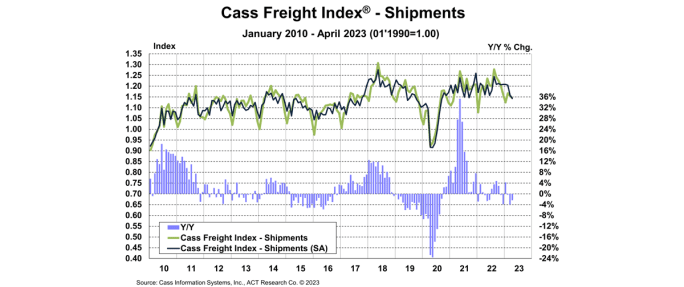
The shipments component of the Cass Freight Index fell 2.4% in April compared to the previous period last year.
Source: ACT Research/Cass Information Systems
According to the report, warm weather appears to have pulled some freight shipments into January and February instead of shipping in March and April. When seasonally adjusted, the index declined 1.3% from month to month in April, which followed a 3.8% drop in March.
“With produce season arriving late this year and the freight market likely passing the peak of the destock, freight demand is near the bottom,” said Denoyer. “With inflation easing, improving real income trends will allow for a bit more holiday spending this year, when even less destocking will mean more freight volume.”
Fleet Capacity
Regarding fleet capacity, Denoyer explained, “Interstate operating authorities are contracting at a record rate, with about 11,000 net revocations since last October, including about 1,600 net revocations in April. Total revocations were about 10,800 in April, near record levels, but grants and reinstatements are also elevated. This is beginning to tighten capacity, which will also help spot rates find the bottom and begin to rise.”
He also pointed out long-distance trucking employment is contracting, as reflected in a first-quarter decline of 8,700 jobs. Those numbers marked a 1.0% decrease; however, driver employment numbers were still up 3.0% year over year in that latest March data point. Denoyer said the series will be down on a year-over-year basis by June on its current level. Denoyer also said since trends in employment follow trends in freight rates, long-haul jobs are set to decline this year.
Denoyer concluded, “The intersection of additional volume and tightening capacity underpins our forecast for a near-term bottom in spot truckload rates. We’ve been expecting the bottom roughly around this month since we introduced 2023 spot rate forecasts 16 months ago, and we still think RoadCheck this week will help usher in a new freight cycle.”
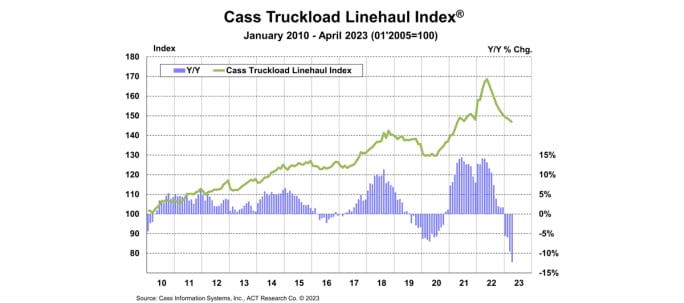
The Cass Truckload Linehaul Index fell 12.3% in April compared to last year, following declines in March.
Source: ACT Research/Cass Information Systems
More Fleet Management

How Telematics Improves Visibility, Control, and Performance in Refrigerated Fleets
Explore how telematics help refrigerated fleets improve visibility, uptime, efficiency, compliance, and cargo protection across connected cold chain operations.
Read More →
What the U.S.-Canada Trade War Means for Trucking
Escalating U.S.-Canada tariffs could disrupt cross-border freight, reduce truck volumes, raise costs, and create new uncertainty for carriers on both sides of the border.
Read More →
What Are Trucking’s Top Concerns for 2026?
The American Transportation Research Institute wants to know what's worrying trucking fleet managers, drivers, and other stakeholders in its annual Industry Issues survey.
Read More →

American Trucking Associations Looks for a New Leader
ATA President and CEO Chris Spear abruptly left his job at the association on August 21, at a pivotal time for the trucking industry.
Read More →
Public Wi-Fi Cybersecurity Risks: How Truck Drivers and Fleets Can Protect Their Data
Public Wi-Fi can expose truck drivers and fleets to credential theft, malware, and other cyber threats. Here’s how to reduce the risk on the road.
Read More →
For Nicky Cupp, Fleet Innovation Starts With Frustration
HDT Truck Fleet Innovator Nicky Cupp turns everyday pain points at Fraley & Schilling into opportunities for better technology and smarter processes.
Read More →
Adam Buttgenbach’s Approach to Electric Trucks: Start With Where They Fit
HDT Truck Fleet Innovator Adam Buttgenbach helped PepsiCo build one of North America’s largest EV fleets by focusing on where electric trucks make operational sense.
Read More →
Deen Albert: Let Automation Do the Math, People Make the Decisions
HDT Truck Fleet Innovator Deen Albert makes sure people are still at the heart of operations at Grand Island Express, even while adopting artificial intelligence tools. AI-assisted dispatch helped boost revenue 25% with the same number of trucks.
Read More →
Trimble’s New AI Agent Takes Aim at Fleet Back-Office Busywork
Arc Agent works across Trimble TMS products to automate repetitive tasks such as freight orders, maintenance, invoices, fuel costs and more.
Read More →
How HDT’s 2026 Truck Fleet Innovators Are Rethinking Fleet Operations
Meet five trucking leaders who are challenging assumptions, solving operational problems, and putting innovative ideas to work.
Read More →