





More on Rhodeworks from the HDT archives: For Whom the Bridge Is Tolled…
Appeals Court Rules in Favor of Truck-Only Tolls in Rhode Island
An appeals court ruling in favor of Rhode Island's controversial trucks-only tolling program raises the question of when the controversial Rhodeworks program will resume.
December 9, 2024
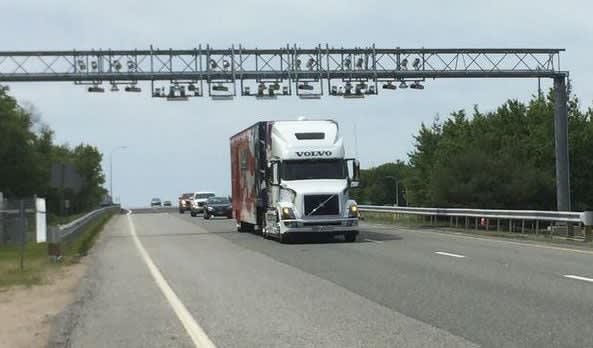
ATA's Interstate One passes under a toll gantry in Exeter on the first day of Rhode Island's truck-only tolls in 2018.
Photo: Rhode Island Trucking Association/HDT archives
4 min to read
An appeals court has ruled that Rhode Island can resume its Rhodeworks truck-only tolling program. The controversial program has been on hold since a U.S. District Judge ruled in 2022 it was unconstitutional after a lawsuit filed by the American Trucking Associations.
A timeline on reactivating the tolls is still being determined.
“The First Circuit has held that, with the exception of caps on tolls, RhodeWorks is constitutional,” said Rhode Island’s attorney general, Peter Neronha, in a statement.
The United States Court of Appeals for the First Circuit ruled that caps on tolls for in-state trucking were still unconstitutional and that these trucks would have to be tolled at the same rate as out-of-state ones.
Rhode Island Trucking Association: Is State Willing to Break Promise to State Residents?
The Rhode Island Trucking Association said reinstating the toll would mean higher prices for goods for consumers in the state.
“If Gov. McKee and the General Assembly are considering reactivating the tolls without those protective caps,” the association said in a statement, ‘they first need to consider whether they are willing to break the promise that was made to the local business community as a condition of passage of the legislation, and be candid with Rhode Island residents that these increased costs will be reflected in the price of goods, nearly all of which reach them by truck.”
Rhode Island Governor Dan McKee, in a statement, said, ”The court’s ruling allows the state to continue using a proven tool to make vital upgrades and repairs to Rhode Island’s infrastructure...
"The ruling also prevents what could have been a major clawback of tens of millions of dollars in previously collected toll funds, which would have been a significant blow to Rhode Island taxpayers.”
A Rhodeworks Truck-Toll Timeline
2015: A truck-only tolling program is proposed in the Rhode Island legislature to address the state's highway and bridge deterioration. It faces much criticism from trucking industry groups.
2015:Last-minute changes are made to the proposal before the legislation passed, including removing Class 6 and 7 vehicles from the program, and limiting tolls on individual large commercial vehicles to once per location, per day in each direction. Trucking groups still opposed it because it only target trucks, not cars, and provides a cap for in-state vehicles.
2016: After being passed in a special session of the state legislature, Rhodeworks is signed into law by then-Governor Gina Raimondo.
2017: American Trucking Associations challenges the Rhodeworks environmental report.
2018: The truck-only tolls go into effect, but are still criticized by trucking groups. Class 8 and larger trucks are required to pay a toll when they crossed under14 automated gantries on state highways and bridges.
ATA President and CEO Chris Spear says, “By pressing ahead with her ill-conceived RhodeWorks scheme, Gov. Raimondo is violating the Constitution by interfering with interstate commerce. She and her administration were warned of this repeatedly by the trucking industry and we will continue to fight these unjust tolls by any means available."
2018:Connecticut eyes its neighbor's truck-only tolls and mulls doing the same.
2018: American Trucking Associations challenges Rhodeworks in court. Over the next couple of years, the case bounces from courtroom to courtroom as a battle was waged over whether it belonged in state or federal court.
2022: A U.S. District Judge rules the Rhodeworks truck-only tolls are unconstitutional and the program is suspended.
2022: During ATA's Management Conference, Spear celebrates the victory. "We told them from the beginning they were crazy… that Rhodeworks was unconstitutional and discriminatory. … Like a lot of elected officials these days, they didn’t listen, so we took them to court.” A judge did listen, he said, and that decision sends a message to other states, “don’t mess with trucking.”
2024: A three-judge panel of the 1st U.S. Circuit Court of Appeals reinstates the Rhodeworks tolling program after an appeal by the state. U.S. Appeals Judge William Kayatta wrote, “Even were we to assume that a few Rhode Island single-unit trucks compete in some manner with a few out-of-state tractor-trailers, ATA’s argument would still fall short,” he wrote.
“The dormant Commerce Clause is not an atomic fly swatter to be wielded against any and all trivial effects on commerce.”
More Fleet Management

Sponsored•September 16, 2026
Color Match Smarter: Tools That Restore & Perform
For fleet managers and collision repair professionals keeping heavy-duty trucks on the road, getting the color right the first time isn't just about appearance — it's about efficiency, turnaround time, and bottom-line results. Discover how today's digital color tools are transforming the repair process from guesswork to precision.
Read More →
FMCSA Pauses Biennial-Update Enforcement Amid Motus Transition
Carriers whose updates were due on or after June 1 have more time, while FMCSA works to stabilize its new registration system and warns of phishing sites impersonating its new carrier registration system, Motus.
Read More →
Sponsored•September 14, 2026
2026 Blueprint for Countering Smarter Supply Chain Theft
Cargo theft is no longer just the cost of doing business. It's a multi-billion-dollar criminal enterprise exploiting vulnerabilities across your fleet, drivers, and supply chain.
Read More →


Sponsored•September 1, 2026
How Telematics Improves Visibility, Control, and Performance in Refrigerated Fleets
Explore how telematics help refrigerated fleets improve visibility, uptime, efficiency, compliance, and cargo protection across connected cold chain operations.
Read More →
What the U.S.-Canada Trade War Means for Trucking
Escalating U.S.-Canada tariffs could disrupt cross-border freight, reduce truck volumes, raise costs, and create new uncertainty for carriers on both sides of the border.
Read More →
What Are Trucking’s Top Concerns for 2026?
The American Transportation Research Institute wants to know what's worrying trucking fleet managers, drivers, and other stakeholders in its annual Industry Issues survey.
Read More →
American Trucking Associations Looks for a New Leader
ATA President and CEO Chris Spear abruptly left his job at the association on August 21, at a pivotal time for the trucking industry.
Read More →
Public Wi-Fi Cybersecurity Risks: How Truck Drivers and Fleets Can Protect Their Data
Public Wi-Fi can expose truck drivers and fleets to credential theft, malware, and other cyber threats. Here’s how to reduce the risk on the road.
Read More →
For Nicky Cupp, Fleet Innovation Starts With Frustration
HDT Truck Fleet Innovator Nicky Cupp turns everyday pain points at Fraley & Schilling into opportunities for better technology and smarter processes.
Read More →
Adam Buttgenbach’s Approach to Electric Trucks: Start With Where They Fit
HDT Truck Fleet Innovator Adam Buttgenbach helped PepsiCo build one of North America’s largest EV fleets by focusing on where electric trucks make operational sense.
Read More →