




Judge Strikes Down Rhode Island Truck-Only Tolls
Rhode Island has been ordered to stop collecting its truck-only tolls by a judge who ruled them unconstitutional.

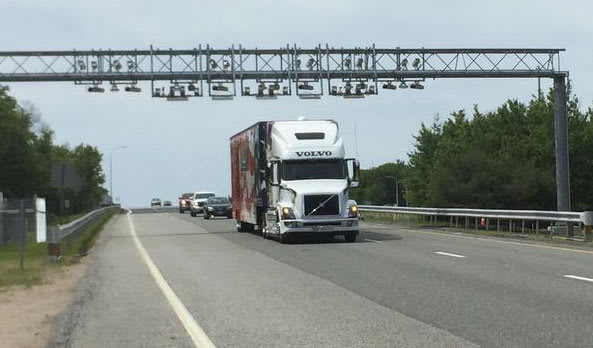
ATA's Interstate One passes under a toll gantry in Exeter on the first day of Rhode Island's truck-only tolls in 2018.
Photo: Rhode Island Trucking Association
A U.S. District Court has ruled Rhode Island’s controversial truck-only tolling plan, RhodeWorks, unconstitutional.
Trucking groups slammed the tolling plan as soon as it was proposed in 2015. Nevertheless, a modified version was signed into law in 2016, requiring 18-wheelers to pay up to $20 to cross the state traveling on Interstate 95. A single truck would be capped at paying $40 a day.
The tolls were intended to finance a 10-year plan to repair deteriorating bridges in the Ocean State; Rhode Island has the highest percentage of structurally deficient bridges in the country. The tolls, to be collected electronically via 14 gantries, were expected to bring in around $45 million a year.
In 2018, the American Trucking Associations, along with Cumberland Farms Inc., M&M Transport Services Inc., and New England Motor Freight, sued Rhode Island, arguing that the RhodeWorks plan violates the Constitution’s Commerce Clause by discriminating against out-of-state economic interests in order to favor in-state interests, and by designing the tolls in a way that does not fairly approximate motorists’ use of the roads.
Over the next couple of years, the case bounced from courtroom to courtroom as a battle was waged over whether it belonged in state or federal court.
This week, U.S. District Court Judge William E. Smith ruled the system unconstitutional and ordered the state to stop charging tractor trailers within 48 hours, according to the Providence Journal.
“Because RhodeWorks fails to fairly apportion its tolls among bridge users based on a fair approximation of their use of the bridges, was enacted with a discriminatory purpose, and is discriminatory in effect, the statute’s tolling regime is unconstitutional under the dormant Commerce Clause of the United States Constitution,” Smith wrote in the ruling.
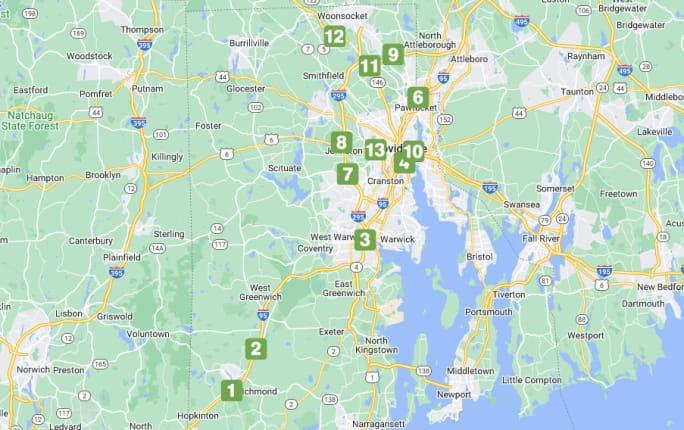
This map from the Rhodeworks website shows the location of 12 current truck-toll gantries.
Image: RhodeWorks
ATA and the state trucking association hailed the decision.
“It has been a long road to get to this point," said Rhode Island Trucking Association President Chris Maxwell, in a news releaes, “but this is a tremendous day for our industry — not just here in Rhode Island, but across the country. Had we not prevailed, these tolls would have spread across the country, and this ruling sends a strong signal to other states that trucking is not to be targeted as a piggy bank.”
ATA General Counsel Rich Pianka called it "a strong ruling that provides our industry a significant win on a critical issue. This ruling vindicates ATA’s contention that the Constitution prohibits states from tolling schemes targeted at the trucking industry, at the expense of interstate commerce.”
More Fleet Management

Color Match Smarter: Tools That Restore & Perform
For fleet managers and collision repair professionals keeping heavy-duty trucks on the road, getting the color right the first time isn't just about appearance — it's about efficiency, turnaround time, and bottom-line results. Discover how today's digital color tools are transforming the repair process from guesswork to precision.
Read More →
FMCSA Pauses Biennial-Update Enforcement Amid Motus Transition
Carriers whose updates were due on or after June 1 have more time, while FMCSA works to stabilize its new registration system and warns of phishing sites impersonating its new carrier registration system, Motus.
Read More →
2026 Blueprint for Countering Smarter Supply Chain Theft
Cargo theft is no longer just the cost of doing business. It's a multi-billion-dollar criminal enterprise exploiting vulnerabilities across your fleet, drivers, and supply chain.
Read More →


How Telematics Improves Visibility, Control, and Performance in Refrigerated Fleets
Explore how telematics help refrigerated fleets improve visibility, uptime, efficiency, compliance, and cargo protection across connected cold chain operations.
Read More →
What the U.S.-Canada Trade War Means for Trucking
Escalating U.S.-Canada tariffs could disrupt cross-border freight, reduce truck volumes, raise costs, and create new uncertainty for carriers on both sides of the border.
Read More →
What Are Trucking’s Top Concerns for 2026?
The American Transportation Research Institute wants to know what's worrying trucking fleet managers, drivers, and other stakeholders in its annual Industry Issues survey.
Read More →
American Trucking Associations Looks for a New Leader
ATA President and CEO Chris Spear abruptly left his job at the association on August 21, at a pivotal time for the trucking industry.
Read More →
Public Wi-Fi Cybersecurity Risks: How Truck Drivers and Fleets Can Protect Their Data
Public Wi-Fi can expose truck drivers and fleets to credential theft, malware, and other cyber threats. Here’s how to reduce the risk on the road.
Read More →
For Nicky Cupp, Fleet Innovation Starts With Frustration
HDT Truck Fleet Innovator Nicky Cupp turns everyday pain points at Fraley & Schilling into opportunities for better technology and smarter processes.
Read More →
Adam Buttgenbach’s Approach to Electric Trucks: Start With Where They Fit
HDT Truck Fleet Innovator Adam Buttgenbach helped PepsiCo build one of North America’s largest EV fleets by focusing on where electric trucks make operational sense.
Read More →