




ABS Accounts for 3% Crash Reduction
The use of antilock braking systems on the tractor unit has reduced the number of police-reported crashes for air-braked tractor-trailers by an estimated 3 percent, according to a recent study released by the National Highway Traffic Safety Administration
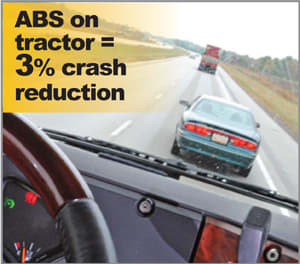
The use of antilock braking systems on the tractor unit has reduced the number of police-reported crashes for air-braked tractor-trailers by an estimated 3 percent, according to a recent study released by the National Highway Traffic Safety Administration.
However, the study points out that the amount of data available is insufficient to draw conclusions about the effect of ABS on the trailer or whether it is beneficial for only the trailer to have ABS when the tractor does not.
The research for the study is based on data from seven states and controls for the age of the tractor and the time of the crash.
The study, "The Effectiveness of ABS in Heavy Truck Tractors and Trailers," tallies almost a decade of research following the introduction of the Federal Motor Vehicle Safety Standard No. 121 regulation mandating ABS.
The mandate required ABS on all new air-braked vehicles with a GVWR of 10,000 pounds or more, including ABS on tractors manufactured on or after March 1, 1997, and air-braked semi-trailers and single-unit trucks manufactured on or after March 1, 1998.
More FIndings
Other primary findings of the report include:
* The best estimate of a reduction by ABS on the tractor unit in all levels of police-reported crashes for air-braked tractor-trailers is 3 percent. This represents a statistically significant 6-percent reduction in the crashes where ABS is assumed to be potentially influential, relative to a control group of about the same number of crashes, where ABS is likely to be irrelevant.
* In fatal crashes, there is a non-significant 2-percent reduction in crash involvement, resulting from a 4-percent reduction in crashes where ABS should be potentially influential. In this section of the study, the age of the tractor at the time of the crash was not a significant factor. Rather, external factors of urbanization, road speed, and ambient lighting are influential and are accounted for in the final estimate.
* Among the types of crashes that ABS influences, there is a large reduction in jackknives, off-road overturns, and at-fault involvement in collisions with other vehicles (except front-to-rear collisions). Counteracting are an increase in the number of involvements of hitting animals, pedestrians, or bicycles, and, only in fatal crashes, rear-ending lead vehicles in two-vehicle crashes.
Underestimate?
Two factors may cause the observed effect to be an underestimate:
1. An unknown proportion of the tractors produced prior to the 1997 ABS mandate that were voluntarily equipped with ABS.
2. An unknown proportion of tractors produced after the 1997 mandate that may have had ABS not functioning properly at the item of the crash.
The influence of other technologies that have appeared in the most recent model years are also not taken into consideration.
From the American Trucking Associations' Technology and Maintenance Council publication "Fleet Adviser." Used with permission.
More Safety & Compliance
A Camera Isn't a Safety Program. Here's What Brokers Are Screening for Now
Footage alone may not be enough to pass broker vetting processes. Here's what counts as a defensible safety program now.
Read More →
Marijuana and Trucking’s Drug-Testing Dilemma
Marijuana is getting stronger, laws are changing, and drug tests still can’t reliably establish impairment. What does that mean for truck drivers and the fleets that employ them?
Read More →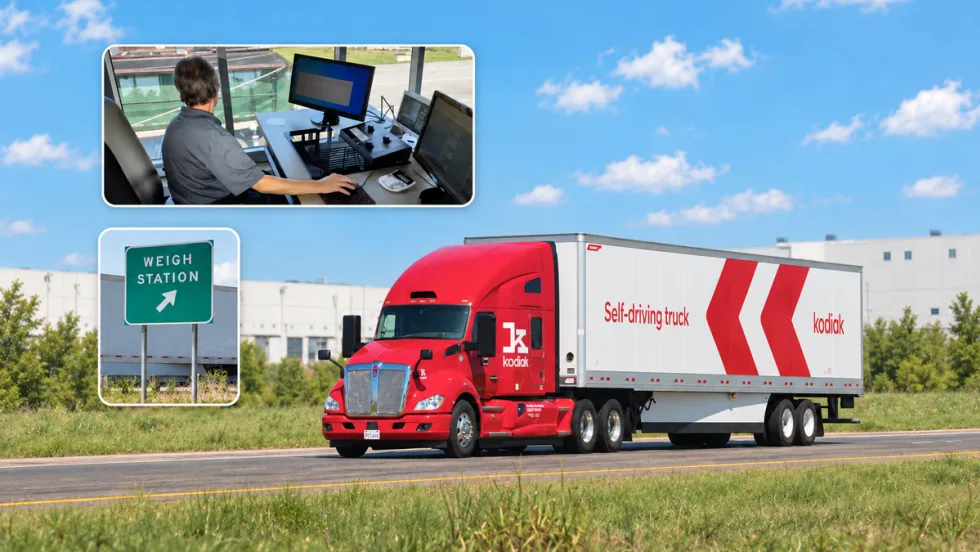
PrePass, Kodiak Connect Driverless Trucks to Roadside Enforcement
The system will allow enforcement agencies to verify Enhanced Inspection information and decide whether Kodiak’s autonomous trucks can bypass roadside screening sites.
Read More →

From One Generation to the Next: How Mentorship Builds Safer Truck Drivers
After three decades in trucking, Harold Perry shares what he's learned about driver safety, mentorship, and helping the next generation build confidence behind the wheel.
Read More →
FMCSA Pauses Biennial-Update Enforcement Amid Motus Transition
Carriers whose updates were due on or after June 1 have more time, while FMCSA works to stabilize its new registration system and warns of phishing sites impersonating its new carrier registration system, Motus.
Read More →
ZF Expands Commercial Vehicle Push in North America
ZF is expanding its North American commercial-vehicle presence with new transmission applications, electrification, trailer technology and autonomous-driving systems.
Read More →
Truck Drivers Need More Than Another Alert
Fleets have more visibility into truck health, safety events, and driver activity than ever. The next challenge is turning all that information into useful guidance for the person who has to decide what to do next.
Read More →
Tesla Wants a Self-Driving Semi. Are Cameras Enough?
Could Tesla’s camera-only autonomous driving technology work on an 80,000-pound Semi? In this commentary, HDT's Deborah Lockridge takes a look at Tesla, Cybercab, and how autonomous trucks see the road.
Read More →
What DOT’s Automated Vehicle Strategy Means for Trucking
The U.S. Department of Transportation issued a new automated-vehicle strategy that outlines plans for driverless-truck regulations, cross-state freight corridors, and federal safety standards.
Read More →
NYC Expands Speed, Pedestrian Safety Tech Across Fleet
New York City is expanding intelligent speed assistance and pedestrian-alert systems across its municipal fleet, moving the technologies from pilot programs into vehicle procurement and retrofit requirements.
Read More →