




AAPA Opts Out of Ports' Efforts to Regulate Trucking
During a meeting of its Legislative Policy Council this week, the American Association of Port Authorities said that it would not be a part of the efforts by the ports of Los Angeles, Oakland and New York-New Jersey to regulat
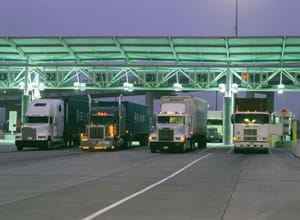
The Ports of Los Angeles, Oakland and New York and New Jersey have been trying to get more control over trucking operations at their harbors, but the AAPA wants no part of it. (Photo courtesy of the Port of Long Beach)
During a meeting of its Legislative Policy Council this week, the American Association of Port Authorities said that it would not be a part of the efforts by the ports of Los Angeles, Oakland and New York-New Jersey to regulate
truck drayage operations, according to reports by the Journal of Commerce.
The Ports of Los Angeles, Oakland and New York and New Jersey have taken action to urge Congress to intercede and change the Federal Aviation Administration Authorization Act, which prohibits states from enacting and enforcing laws that are "related to" motor carrier prices, routes, or services in order to maximize competitive forces in the trucking industry. These ports wish to have the authority to regulate trucking operations at the ports, such as security, congestion and the environment, the JOC reports.
However, the AAPA has voted to opt out of the movement, saying that the ports already have enough authority to ban older trucks, the JOC says.
The JOC reports that there are outside interests at play in the ports efforts, such as labor, environmental and community groups, looking to gain more control over trucking operations at the ports.
Susan Monteverde, vice president of government relations at AAPA, told the JOC that the ports currently can regulate the vehicle, not the carrier, and if these ports want to be have control over the way carriers do business at their harbors, the law must be altered.
In October, the Ports of Long Beach and Los Angeles celebrated the one-year anniversary of their Clean Truck programs, announcing they are on track to reduce truck-related emissions by 80 percent, two years ahead of schedule. Since inception, the programs have purged the roads of more than 2,000 polluting trucks, with more than 5,500 clean trucks in operation today.
This improvement in emissions at the ports was one of the main reasons the AAPA opted out of the efforts, Monteverde told the JOC. She said that with the emissions reductions, there was not enough reason to pursue a change in the law.
More Fleet Management

Why Private Fleets Are Taking More Freight
Private fleets are putting their own trucks on demanding customers and high-cost lanes as companies seek greater control over service, costs, and capacity.
Read More →
Color Match Smarter: Tools That Restore & Perform
For fleet managers and collision repair professionals keeping heavy-duty trucks on the road, getting the color right the first time isn't just about appearance — it's about efficiency, turnaround time, and bottom-line results. Discover how today's digital color tools are transforming the repair process from guesswork to precision.
Read More →
FMCSA Pauses Biennial-Update Enforcement Amid Motus Transition
Carriers whose updates were due on or after June 1 have more time, while FMCSA works to stabilize its new registration system and warns of phishing sites impersonating its new carrier registration system, Motus.
Read More →


2026 Blueprint for Countering Smarter Supply Chain Theft
Cargo theft is no longer just the cost of doing business. It's a multi-billion-dollar criminal enterprise exploiting vulnerabilities across your fleet, drivers, and supply chain.
Read More →
How Telematics Improves Visibility, Control, and Performance in Refrigerated Fleets
Explore how telematics help refrigerated fleets improve visibility, uptime, efficiency, compliance, and cargo protection across connected cold chain operations.
Read More →
What the U.S.-Canada Trade War Means for Trucking
Escalating U.S.-Canada tariffs could disrupt cross-border freight, reduce truck volumes, raise costs, and create new uncertainty for carriers on both sides of the border.
Read More →
What Are Trucking’s Top Concerns for 2026?
The American Transportation Research Institute wants to know what's worrying trucking fleet managers, drivers, and other stakeholders in its annual Industry Issues survey.
Read More →
American Trucking Associations Looks for a New Leader
ATA President and CEO Chris Spear abruptly left his job at the association on August 21, at a pivotal time for the trucking industry.
Read More →
Public Wi-Fi Cybersecurity Risks: How Truck Drivers and Fleets Can Protect Their Data
Public Wi-Fi can expose truck drivers and fleets to credential theft, malware, and other cyber threats. Here’s how to reduce the risk on the road.
Read More →
For Nicky Cupp, Fleet Innovation Starts With Frustration
HDT Truck Fleet Innovator Nicky Cupp turns everyday pain points at Fraley & Schilling into opportunities for better technology and smarter processes.
Read More →