




Why the Future of Logistics Needs a New Kind of Leadership
The logistics industry stands at a pivotal crossroads, and traditional ways of solving problems are no longer enough to overcome the complexities we face today, contends Brent Yeagy, president and CEO of Wabash, in this Guest Voices blog.

The logistics industry needs leaders who break traditional boundaries and embrace collective problem-solving, says Wabash's Brent Yeagy.
Image: HDT Graphic
Amid one of the longest freight recessions we’ve seen in our lifetime, the challenges facing the transportation industry are tougher than ever. The logistics industry stands at a pivotal crossroads, having evolved into a global, interconnected ecosystem marked by unprecedented complexity.
North America’s logistics sector, valued at $2 trillion, is characterized by extraordinary fragmentation. With nearly 1 million for-hire carrier companies — most of them small fleets operating fewer than six trucks — the industry struggles with systemic inefficiencies that challenge economic resilience, sustainability, and our ability to adapt to a rapidly changing world.
Addressing these challenges demands more than incremental improvements from individual companies. Traditional ways of solving problems are no longer enough to overcome the complexities we face today.
Moving the industry forward requires a bold, unified approach — one that combines strengths across the supply chain, fosters innovative thinking, and builds a connected ecosystem working toward long-term solutions.
The Power of Ecosystem Collaboration
The ecosystem approach represents a transformative strategy.
Instead of viewing business relationships through a transactional lens, forward-thinking organizations must create collaborative environments grounded in vulnerability, trust, and shared purpose.
This means convening diverse stakeholders — suppliers, customers, dealers, research partners, and even competitors — to address systemic challenges no single entity can solve alone.
Imagine the impact of improving freight efficiency by just 1%. Such a modest improvement could remove 40,000 trucks from roads while maintaining identical freight capacity, save 250 million gallons of fuel annually, and significantly reduce operating costs and environmental impacts.
Achieving this vision requires leaders who break traditional boundaries and embrace collective problem-solving.
Geopolitical shifts, nearshoring, evolving international trade, and emerging technologies are reshaping logistics faster than ever. To stay ahead, companies must reimagine not just their own operations, but also how they collaborate across the supply chain.
An Example of Collaboration in Action in Logistics
One example of this approach is Smart Crossroads, a recent collaboration between Wabash and Purdue University.
This initiative convenes transportation fleets, third-party logistics providers, retail shippers, suppliers, along with pioneers in telematics, artificial intelligence, and autonomous vehicles. The goal? To bring transparency to a fragmented logistics ecosystem and rethink how technology and collaboration can drive systemic improvements.
By creating a forum for diverse stakeholders to share insights and drive innovation, Smart Crossroads is working to address challenges ranging from data connectivity to operational inefficiencies. As we rethink how business gets done, this initiative lays the foundation for the kind of bold solutions the industry needs.
Projects like Smart Crossroads demonstrate the power of collaboration to go beyond transactional partnerships. They enable entire networks of stakeholders to co-create innovations larger than any one organization could achieve alone.
A New Type of Leadership for the Future
Leadership in this new era of ecosystem collaboration demands courage, empathy and trust. Success will come to those who can facilitate meaningful conversations, challenge outdated paradigms, and create solutions that extend far beyond their own corporate interests.
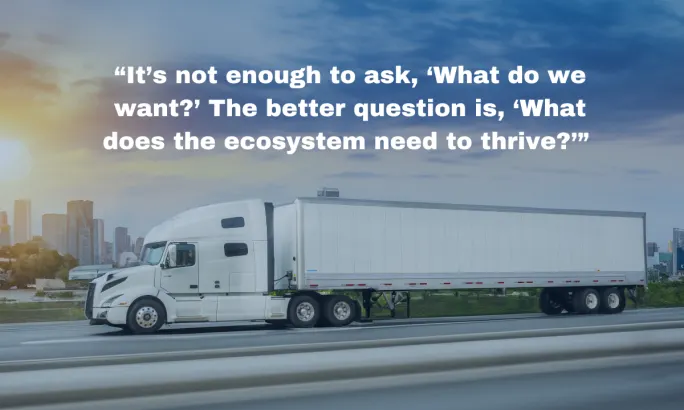
It’s not enough to ask, “What do we want?” The better question is, “What does the ecosystem need to thrive?”
By focusing on collective progress rather than short-term gains, we can create lasting solutions that strengthen the supply chain for everyone.
The path forward is not about small, incremental product improvements. It’s about rethinking how logistics ecosystems can work together to transform a fragmented, inefficient system into a responsive, sustainable, and interconnected global network.
The future of logistics belongs to the bold — those willing to convene, collaborate, and drive systemic change. By leading with vulnerability, trust, and shared purpose, we have the opportunity to fundamentally change the efficient and sustainable movement of goods.
Brent L. Yeagy has more than 25 years of experience in the automotive and commercial transportation industries. Since June 2018, he has been responsible for the strategic direction and operations of Wabash in his role as president and CEO.
This contributed guest article was authored and edited according to Heavy Duty Trucking’s editorial standards and style to provide useful information to our readers. Opinions expressed may not reflect those of HDT.
More Blog Posts

Fragmented AI: Why Trucking Must Take Security More Seriously
As AI becomes embedded throughout transportation operations, the result can be a tech environment that looks more advanced on paper, but isn't necessarily more efficient, secure, or manageable in practice.
Read More →
We've Been Thinking About Truck Uptime Backward
The truck repair operations that minimize downtime aren’t necessarily the ones with the fastest technicians. They’re the ones who have the part.
Read More →
The Real Cost of Trailer Tires: Why It's Not Just a Maintenance Problem Anymore
Tire wear isn't random. The trucking fleet with a tire program that knows which trailers, positions, and routes are punishing tires the hardest is the one that buys fewer of them.
Read More →
A New Argument for Electrification: Managing Fuel Volatility
As oil prices surge amid Middle East conflict and a blocked Strait of Hormuz, fleets are feeling the squeeze in real time. In this guest column, Geotab's Neil Cawse argues electrification is no longer just about sustainability or ROI — it’s about insulating operations from what he calls a "volatility tax."
Read More →
The Time is Now to Expand Longer Combination Vehicles [Opinion]
The reauthorization of the federal highway bill offers a rare chance to advance double 53-foot LCVs. Industry leaders shouldn’t miss it, says a longtime trailer industry professional in this Guest Voices blog post.
Read More →
The Hidden Costs of 'Free' Smart Trailer Tech Installations [Commentary]
Free installation of smart trailer technologies may sound good on paper, but you could end up paying down the road.
Read More →
Protecting Small Trucking Fleets from Scammers: Lessons from the Insurance Frontlines
Hijacked DOT numbers, fake invoices, and high-tech cargo theft are on the rise. A veteran trucking insurance broker shares how to spot trouble early — and why a trusted advisor may be your strongest defense.
Read More →
Tire Retreading Makes Sense for Trucking Fleets. H.R. 3401 Could Make It Even Smarter.
Retreaded tires offer trucking fleets cost savings, sustainability gains, and supply chain security. New legislation, H.R. 3401, could make retreads even more attractive and support U.S. jobs.
Read More →
Hydrogen Fuel Cell Trucks Are Ready for the Long Haul. Now Policymakers Must Act
Accelerating the growth of hydrogen-fuel-cell-truck adoption would help make zero-emission trucking is not only possible, but practical and profitable, argues the Center for Transportation and the Environment in this Guest Voices blog.
Read More →
A New Definition for Long-Haul Heavy-Duty Trucking
Understanding the various routes that make up long haul is important as we move through trucking’s Messy Middle — a time when fleets have a variety of powertrain solutions to choose from, writes NACFE's Mike Roeth.
Read More →