




A New Definition for Long-Haul Heavy-Duty Trucking
Understanding the various routes that make up long haul is important as we move through trucking’s Messy Middle — a time when fleets have a variety of powertrain solutions to choose from, writes NACFE's Mike Roeth.
A new definition of long haul will help in evaluating alternative fuels and drivetrains, says NACFE's Mike Roeth.
Image: HDT Graphic
The words we use to describe something influence our perceptions, understanding, even our actions.
Consider the words long haul. What image pops in your mind when you hear those words? I am guessing for most of you it is a Class 8 truck with a sleeper cab driving across the country. You probably also picture a driver who is away from home for weeks at a time sleeping in their truck and taking a shower and eating at a truck stop.
While that is one version of long haul, it is not the only one.
The North American Council for Freight Efficiency believes that long haul should include both over-the-road operations as well as longer regional haul return-to-base ones.
In addition, long-haul operations are not only completed in sleeper tractors. There is a place in long-haul trucking for day cabs. In fact, data from ACT Research shows that day cabs make up 40% of the Class 8 tractor market.
Redefining Long Haul Trucking
What defines long haul is the total number of miles a truck travels in a day — even if those miles end up with the truck back where it started.
NACFE’s definition of long haul is 500 to 600 miles, and those miles can be racked up driving 250 or 300 miles in one direction and turning around and driving those same miles back, as often happens in less-than-truckload operations.
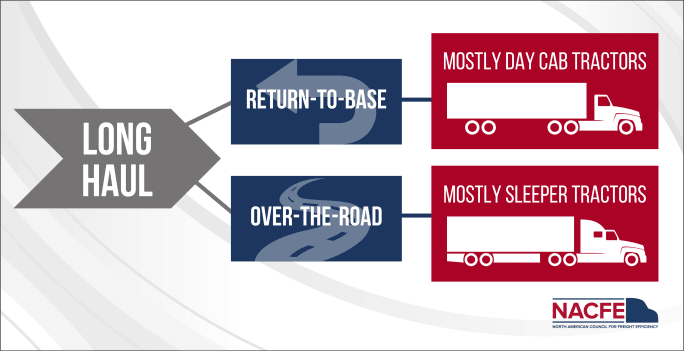
NACFE sees "long haul" in two different segments, one of which returns to base.
Source: NACFE
For comparison, we define short regional haul as less than 50 miles out and back for a total of 100 miles and medium regional haul as 100 miles out and back for a total of 200 miles.
The distinction that long haul includes out-and-back routes and not just over-the road ones might seem insignificant when you talk about diesel-powered trucks, since there is a widespread fueling network.
But understanding the various routes that make up long haul is important as we move through trucking’s Messy Middle — a time when fleets have a variety of powertrain solutions to choose from.
While there are many options, fueling and/or charging infrastructure for some of the alternative powertrain solutions is not available everywhere. That means fleets must carefully consider which routes will work for vehicles with alternative powertrains.
There’s a general belief that battery-electric trucks aren’t suitable for long-haul operations. But one thing we discovered during Run on Less – Electric Depot was that longer ranges are possible with battery-electric vehicles.
For example, one Tesla Semi deployed by PepsiCo had a range of 410 miles on a single charge. One completed 1,076 miles in a 24-hour period with several instances of opportunity charging.
Run on Less: Exploring the Messy Middle and Long Haul Trucking
NACFE's upcoming Run on Less – Messy Middle is designed to bring clarity to long-haul trucking by learning about the benefits and challenges of multiple powertrain solutions, including:
- Renewable and biodiesel
- Renewable natural gas
- Battery electric
- Hydrogen fuel cells
- Even hybrids.
However, to accurately analyze the performance of these different trucks, we need to use common language and common definitions of exactly what we mean by long haul.
Even though Class 8 long-haul trucking accounts for only 9% of the total trucking market, according to a National Renewable Energy Laboratory report, it contributes 48% of trucking’s emissions.
The trucking industry is changing, and so too must we change the language we use to define things.
NACFE believes that long-haul return-to-base operations will most likely be handled by Class 8 day cab tractors, while long-haul over-the-road operations will still be dominated by sleeper tractors.
It is important to note that for a variety of reasons, regional haul using day cabs is growing. This growth in return-to-base operations will help fleets determine where best to locate truck fueling or charging for alternative fueled vehicles.
Because of the current proliferation of powertrain solutions, and the growth in regional haul, the way we define long haul should include longer return-to-base operations as well as the more traditional over-the-road one.
About the Author: Mike Roeth is executive director of the North American Council for Freight Efficiency. He has worked in the commercial vehicle industry for more than 35 years and his specialty is brokering green truck collaborative technologies into the real world at scale. This article was authored and edited according to Heavy Duty Trucking’s editorial standards and style to provide useful information to our readers. Opinions expressed may not reflect those of HDT.
Watch Mike Roeth talk about this subject on HDT Talks Trucking:
More Blog Posts

Fragmented AI: Why Trucking Must Take Security More Seriously
As AI becomes embedded throughout transportation operations, the result can be a tech environment that looks more advanced on paper, but isn't necessarily more efficient, secure, or manageable in practice.
Read More →
We've Been Thinking About Truck Uptime Backward
The truck repair operations that minimize downtime aren’t necessarily the ones with the fastest technicians. They’re the ones who have the part.
Read More →
The Real Cost of Trailer Tires: Why It's Not Just a Maintenance Problem Anymore
Tire wear isn't random. The trucking fleet with a tire program that knows which trailers, positions, and routes are punishing tires the hardest is the one that buys fewer of them.
Read More →
A New Argument for Electrification: Managing Fuel Volatility
As oil prices surge amid Middle East conflict and a blocked Strait of Hormuz, fleets are feeling the squeeze in real time. In this guest column, Geotab's Neil Cawse argues electrification is no longer just about sustainability or ROI — it’s about insulating operations from what he calls a "volatility tax."
Read More →
The Time is Now to Expand Longer Combination Vehicles [Opinion]
The reauthorization of the federal highway bill offers a rare chance to advance double 53-foot LCVs. Industry leaders shouldn’t miss it, says a longtime trailer industry professional in this Guest Voices blog post.
Read More →
The Hidden Costs of 'Free' Smart Trailer Tech Installations [Commentary]
Free installation of smart trailer technologies may sound good on paper, but you could end up paying down the road.
Read More →
Protecting Small Trucking Fleets from Scammers: Lessons from the Insurance Frontlines
Hijacked DOT numbers, fake invoices, and high-tech cargo theft are on the rise. A veteran trucking insurance broker shares how to spot trouble early — and why a trusted advisor may be your strongest defense.
Read More →
Tire Retreading Makes Sense for Trucking Fleets. H.R. 3401 Could Make It Even Smarter.
Retreaded tires offer trucking fleets cost savings, sustainability gains, and supply chain security. New legislation, H.R. 3401, could make retreads even more attractive and support U.S. jobs.
Read More →
Hydrogen Fuel Cell Trucks Are Ready for the Long Haul. Now Policymakers Must Act
Accelerating the growth of hydrogen-fuel-cell-truck adoption would help make zero-emission trucking is not only possible, but practical and profitable, argues the Center for Transportation and the Environment in this Guest Voices blog.
Read More →
How Collaboration is Driving the Growth of Heavy-Duty EV Charging Infrastructure
To overcome the challenges of transitioning to electric medium- and heavy-duty vehicles, it will take local governments, public-private partnerships, utilities, investors, and other stakeholders working together, says the CEO of Greenlane in this guest article.
Read More →