




3 Questions Movers Get and How to Answer
This guest blog post covers frequently asked questions that household goods movers hear, with diplomatic answers moving professionals can give when there are too many unknown variables.
It's peak moving season, and movers are often faced with these questions from customers.
Image: HDT Graphic
We’re getting into peak moving season, which means moving transportation professionals from drivers to customer service representatives will act as guides, references, and problem-solvers for customers.
They must be prepared to field questions from first-time movers while working flexibly to meet customers’ individual needs and evolving expectations.
Below are three frequently asked questions household goods movers hear, along with diplomatic answers to give when there are too many unknown variables, and the growing technologies that are making these questions easier to answer.
1. How Much Does a Professional Move Cost?
Before hiring a moving company, people want to know how much it will cost. Many professionals who have been in the industry for some time will remember providing initial estimates that were based on experience but not customized. It was not until a mover or surveyor could visit a customer’s home that a true estimate could be given.
Today, customers can get accurate, personalized estimates with nothing but their smartphones. Whether conducted live with a mover or recorded, technology today allows for a video of a customer’s home to better inform the weight and volume of a move, and artificial intelligence tools are continually improving the process.
For example, Yembo.ai has released an advanced AI Workflow Companion that movers can use to enhance survey tools and provide customers with immediate and meticulous moving estimates.
Depending on the customer’s preference, this can be done through self-service options, virtual consultations, or in-person surveys. AI will then analyze video footage of customers’ belongings to ensure precise volume and item-detail assessments.
Answer: “Every move is unique, but we can begin by giving you a customized estimate for your move based on the size of your home through a survey. Do you prefer in-person, virtual, or self-guided?”
Technology-enhanced estimation tools will provide faster and more accurate estimates to ensure the relationship with the customer starts out on the right foot.
2. How Long Will a Professional Move Take?
In a society accustomed to free two-day deliveries, many people do not understand the amount of time it can take to perform a full-house move.
Even for customers who insist their move is “only a one-bedroom apartment” and they are “only moving a couple of hours away,” there are significantly more variables that come into play, especially during peak season.
According to Atlas Van Lines’ Corporate Relocation Survey, 70% of companies surveyed shared that the overall number of employees who relocated last year increased. Corporate moves often require a faster turnaround time, and customers want instant shipment updates 24 hours a day.
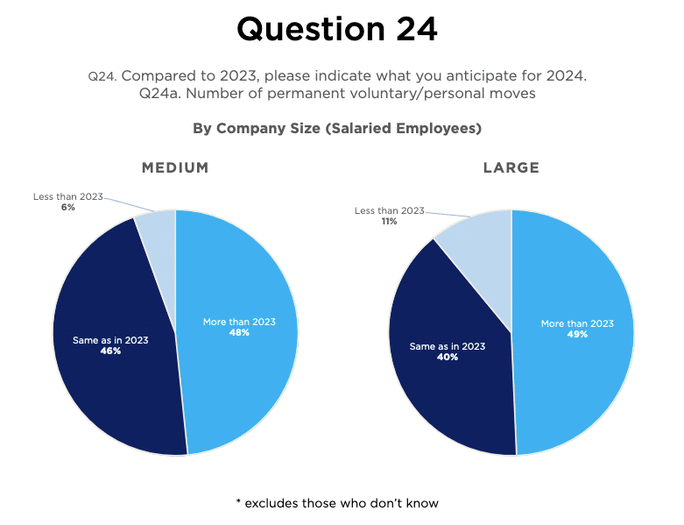
Most companies in the Atlas Van Lines survey predicted 2024 corporate moves would be the same as or higher than 2023.
Source: Atlas Van Lines
User-friendly customer portals, smartphones, and tablets make this possible. Movers can easily update their location and estimated time of arrival while customers manage the process in real time. For example, the Atlas Customer Portal is key not just for updating the physical move but also for allowing customers to communicate with their dedicated moving teams, access their documents, and even file claims if needed.
Answer: “It is our goal to get you into your new home in a timely and safe way. When we know your destination and survey your move size, we will be able to schedule a move that works best for you.”
As moving systems become more interconnected, technology will continue to improve the speed and accuracy of moves to exceed customers’ expectations.
3. How Will My Belongings be Protected and Secured?
When a cross-country move can take several weeks, customers can grow concerned with where and how long their items will be in storage. Some customers have been known to drop Bluetooth tags into their moving boxes to track their items, leading to questions of why their items are “sitting in Texas” when they are moving to California.
There have also been instances where customers want to access their items while they are in storage as if it was a self-storage unit.
Those in the transportation industry understand both trucking regulations and that drivers need and deserve time off of the road, as well as the logistics of storing shipments for days or weeks.
Much like customer portals, and sometimes even a tool within them, digital inventories are the answer to customers’ worries about the safety and security of their belongings during every step of their move.
Traditional pen-and-paper methods in most professional settings can be improved upon with technology, and nowhere is that more clearly demonstrated than with electronic inventories. Up-to-date lists with corresponding photographs ensure customers and movers see the same inventory at the same time and allow customers to digitally access and view their belongings anytime, anywhere, to confidently ensure their safe arrival.
Answer:“Our drivers often move multiple customers at a time in one shipment, meaning there can be multiple stops along the way with storage needed in between. Your belongings are separated and safely and securely stored.
"We recommend you not pack anything you think you may need, because it may be costly to access your shipment physically while in storage. With the digital inventory, you will be able to see what items you packed and know when they are on their way to your new home.”
When used effectively, technology enables efficiency for movers and satisfaction for customers throughout what can otherwise be an arduous moving process.
If your company is not using technology like this, look into why, and what kinds of tools you may be able to implement. Smoother moves make for happier customers and may even improve your bottom line.

Photo: Atlas Van Lines
About the author: Ryan McConnell is the president and COO for Atlas Van Lines. In this role, he leads the Atlas Van Lines household goods division in the U.S., which includes transportation services, corporate marketing, revenue distribution, customer service, agency development, and information technology. He has more than 25 years of transportation and logistics industry experience.
This contributed guest article was authored and edited according to Heavy Duty Trucking’s editorial standards and style to provide useful information to our readers. Opinions expressed may not reflect those of HDT.
More Blog Posts

Fragmented AI: Why Trucking Must Take Security More Seriously
As AI becomes embedded throughout transportation operations, the result can be a tech environment that looks more advanced on paper, but isn't necessarily more efficient, secure, or manageable in practice.
Read More →
We've Been Thinking About Truck Uptime Backward
The truck repair operations that minimize downtime aren’t necessarily the ones with the fastest technicians. They’re the ones who have the part.
Read More →
The Real Cost of Trailer Tires: Why It's Not Just a Maintenance Problem Anymore
Tire wear isn't random. The trucking fleet with a tire program that knows which trailers, positions, and routes are punishing tires the hardest is the one that buys fewer of them.
Read More →
A New Argument for Electrification: Managing Fuel Volatility
As oil prices surge amid Middle East conflict and a blocked Strait of Hormuz, fleets are feeling the squeeze in real time. In this guest column, Geotab's Neil Cawse argues electrification is no longer just about sustainability or ROI — it’s about insulating operations from what he calls a "volatility tax."
Read More →
The Time is Now to Expand Longer Combination Vehicles [Opinion]
The reauthorization of the federal highway bill offers a rare chance to advance double 53-foot LCVs. Industry leaders shouldn’t miss it, says a longtime trailer industry professional in this Guest Voices blog post.
Read More →
The Hidden Costs of 'Free' Smart Trailer Tech Installations [Commentary]
Free installation of smart trailer technologies may sound good on paper, but you could end up paying down the road.
Read More →
Protecting Small Trucking Fleets from Scammers: Lessons from the Insurance Frontlines
Hijacked DOT numbers, fake invoices, and high-tech cargo theft are on the rise. A veteran trucking insurance broker shares how to spot trouble early — and why a trusted advisor may be your strongest defense.
Read More →
Tire Retreading Makes Sense for Trucking Fleets. H.R. 3401 Could Make It Even Smarter.
Retreaded tires offer trucking fleets cost savings, sustainability gains, and supply chain security. New legislation, H.R. 3401, could make retreads even more attractive and support U.S. jobs.
Read More →
Hydrogen Fuel Cell Trucks Are Ready for the Long Haul. Now Policymakers Must Act
Accelerating the growth of hydrogen-fuel-cell-truck adoption would help make zero-emission trucking is not only possible, but practical and profitable, argues the Center for Transportation and the Environment in this Guest Voices blog.
Read More →
A New Definition for Long-Haul Heavy-Duty Trucking
Understanding the various routes that make up long haul is important as we move through trucking’s Messy Middle — a time when fleets have a variety of powertrain solutions to choose from, writes NACFE's Mike Roeth.
Read More →