




Why Would Semis Be Part of a Bicycle ‘Adventure’?
Each of the 1,200 riders had at least one bag that needed carrying, Senior Contributing Editor Tom Berg found.

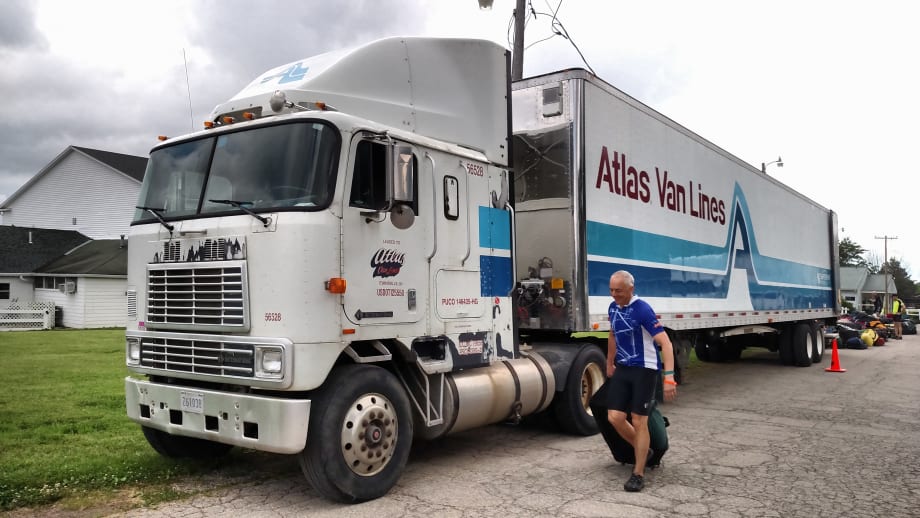
A bicyclist drags his bag toward his car at the Delaware County (Ohio) Fairgrounds. It had been aboard the trailer, which was about as old as the 1990s International cabover, an unusual sight these days.
Photos: Tom Berg
Who’d-a-thunk tractor-trailers had a role in a bicycle touring event? Anybody who’s done a lot of self-powered two-wheeling would know, especially if long distances are involved. After all, how does your luggage get from Point A to Point B, and all the points beyond? By truck. And if 1,200 riders are participating, it takes two semis to carry all the bags.
That’s how it was on the recent Great Ohio Bicycle Adventure, June 16-23 out of Delaware, Ohio. The first weekend, mobs of cyclists showed up at the county fairgrounds, across the street from my house. They unloaded their cycles from racks on cars, then set up tents for camping. The weather was unseasonably hot and humid, and included heavy rains. Some stayed in nearby motels, and I’m guessing they were the older, wiser ones.
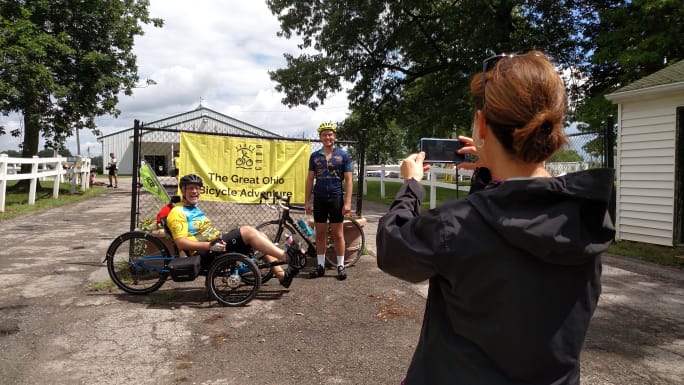
Two guys, just in from the last leg, 52 miles from Newark (Ohio) to Delaware, pose as a family member takes their picture. These people are in shape!
One thing about avid bicyclists is that they’re hardy. Mostly in their 30s and older, everyone is in shape, which is how a man or woman needs to be to pedal 50 miles or more a day. This tour went through towns outside of Columbus, taking in the scenery and sampling each town’s attractions. Starting in Delaware, they rode to London, Circleville, Lancaster, Newark and back to Delaware – seven days and about 400 miles of riding in all, with one side trip and two nights spent in two places.
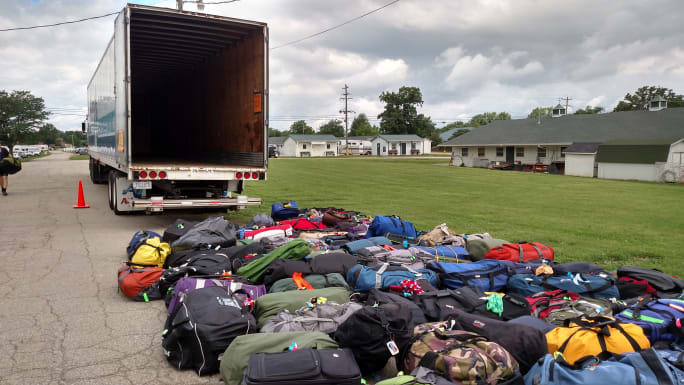
Hundreds of bags have been offloaded and await retrieval by cyclists. About 1,200 of them were on this year’s Great Ohio Bicycle Adventure, June 16-23 out of Delaware, Ohio.
That requires a lot of clothes, so each participant had a large, heavy bag. Twelve hundred riders add up to about that many bags, and these were carried in two van trailers provided by an Atlas Van Lines agent in Sandusky, up north. Every morning riders carried or dragged their bags to the semis and every evening the drivers unloaded them for retrieval by the riders.
The rigs looked about 25 years old. Tractors were ‘90s Internationals, one a cabover. I couldn’t find name plates on the trailers, or annual inspection stickers, for that matter. One had limped in with a blown tire, an outer dual that was plainly visible. The driver was strapping the mudguard away from the shredded tire, using the ICC bumper as an anchor point.
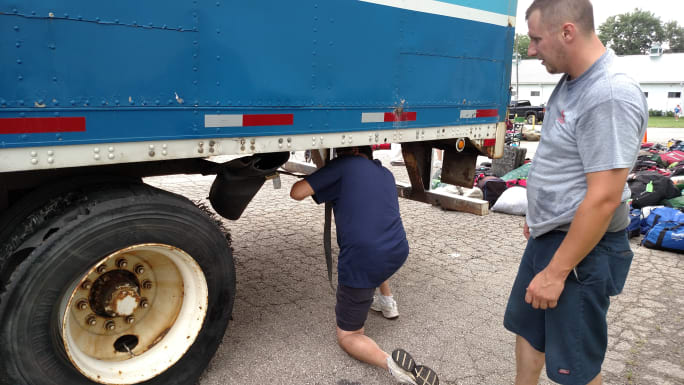
Shredded tire on the other trailer will roll home this way. Driver pulled the mudguard out of the way to keep it from being beaten to death by rubber shrapnel.
“You gonna pull it off and go home on one wheel there?” I asked the other driver, who was helping.
“We’re gonna go home this way,” he said.
“You’re not worried about throwing pieces of rubbler on the road behind you?”
“It’s thrown about all the rubber it’s going to,” he said.
Oh.
They were intent on securing the mud flap, seemed tired from unloading the bags, and it was already hot and getting hotter, so I left them alone. They soon left. I wonder if this guy got pulled over on the way home.
Cyclists streamed into the fairgrounds much of the day, many of them pausing to pose for pictures in front of a banner at the main entrance. Pictures would add to their satisfaction from covering the trek. They’re stronger people than I.
Related: Catching the Carnival’s Trailers in the Wee Hours
More Blog Posts
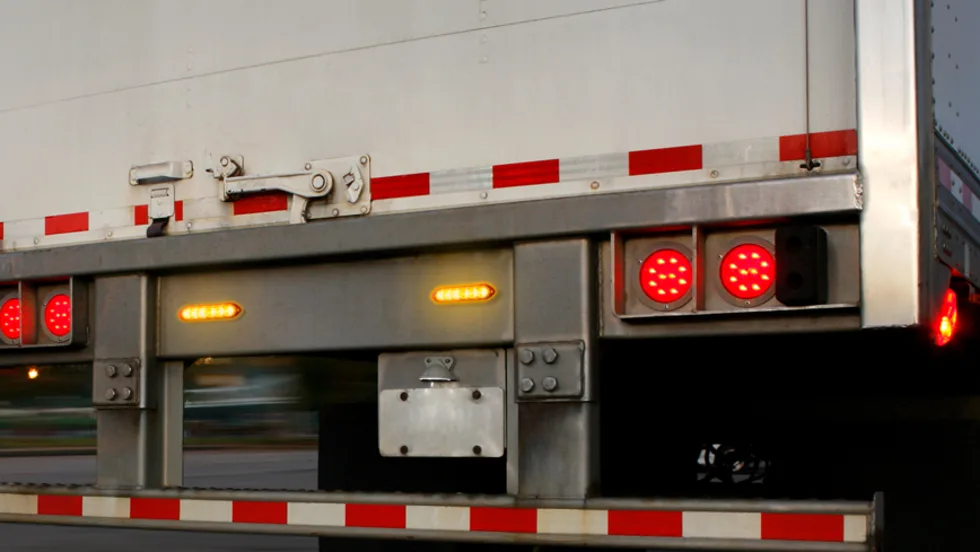
Pulsing Back-of-Trailer Lamps Aim to Prevent Crashes
Can the addition of a pulsing brake lamp on the back of a trailer prevent rear-end collisions? FMCSA seems to think so, if its exemptions are any indication.
Read More →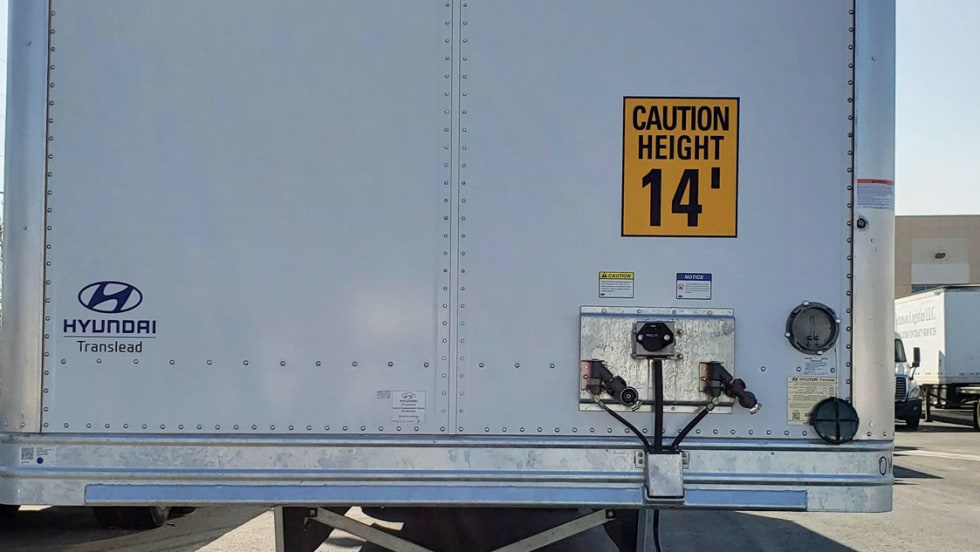
Designing a 14-Foot Trailer
Trailers are 13 feet, 6 inches high, right? Not for Hub Group, which developed a special 14-foot-high trailer spec for a dedicated customer based in California. Learn more in the Trailer Talk blog.
Read More →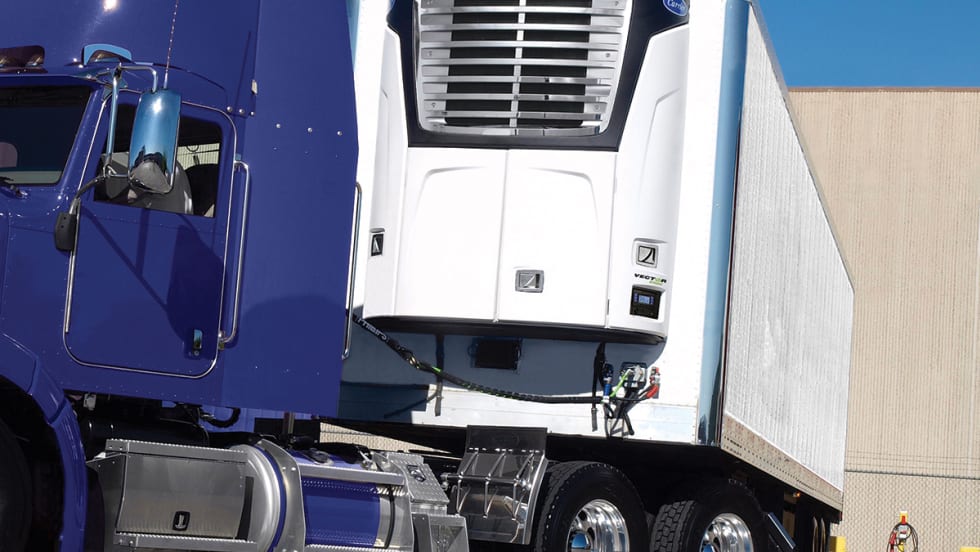
CARB Comes for Reefer Trailers
A new round of emissions control regulations decreed by the California Air Resource Board will begin affecting refrigerated trailer and TRU design and operations next year.
Read More →
5 Ways Data Analysis Maximizes the Value of Trailer Telematics
Are you getting the most out of your trailer telematics investment?
Read More →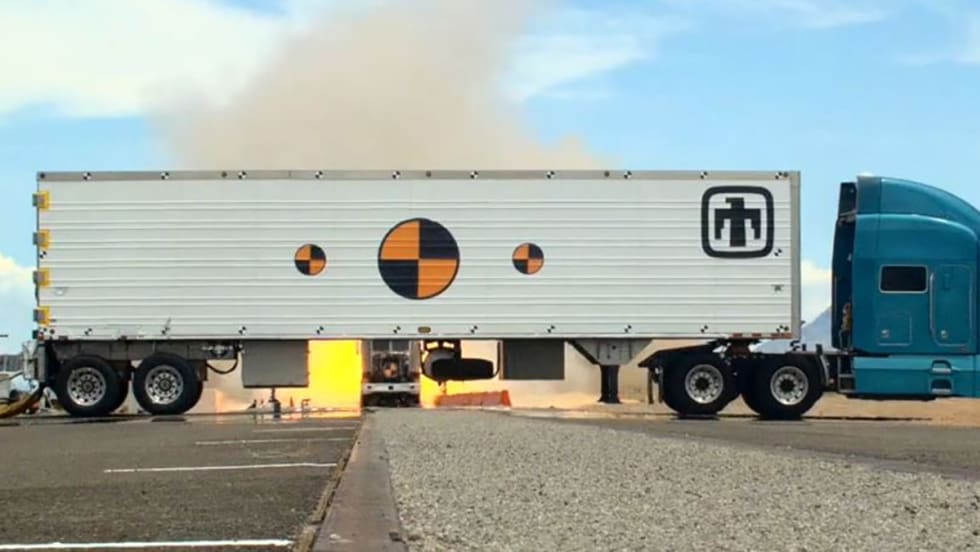
Can You Guess What's in That Trailer?
You don’t always know what’s in the trailers that pass you on the road. But some of those trailers are carrying something a little more dangerous that frozen food or new bedding…like, maybe, a nuclear weapon. But this isn’t an ordinary trailer; this is a trailer specifically made to not only carry this type of payload, but protect it at all costs.
Read More →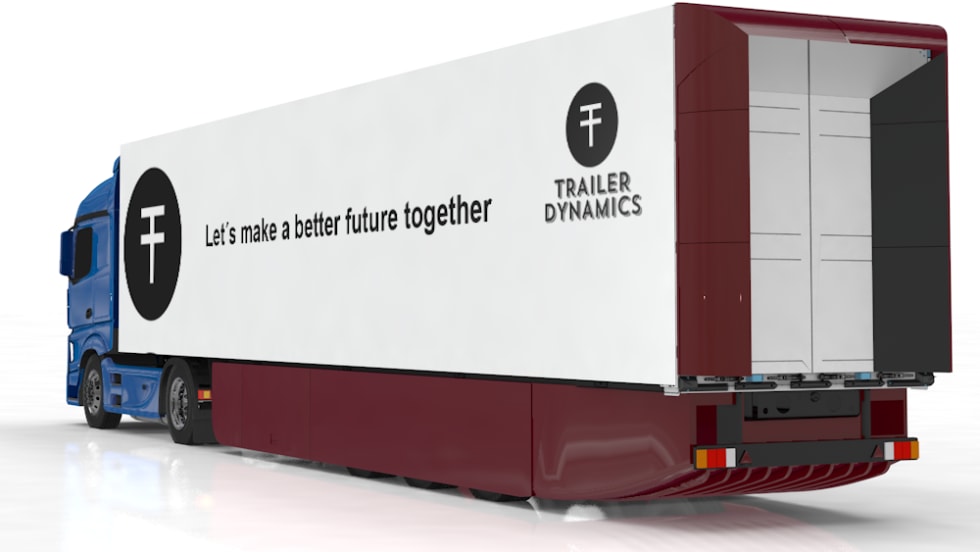
How Trailers Are Harnessing 'Free' Energy
Can trailers play a more active role in sustainable transport beyond aerodynamic add-ons or low-rolling-resistance tires? Some companies think so.
Read More →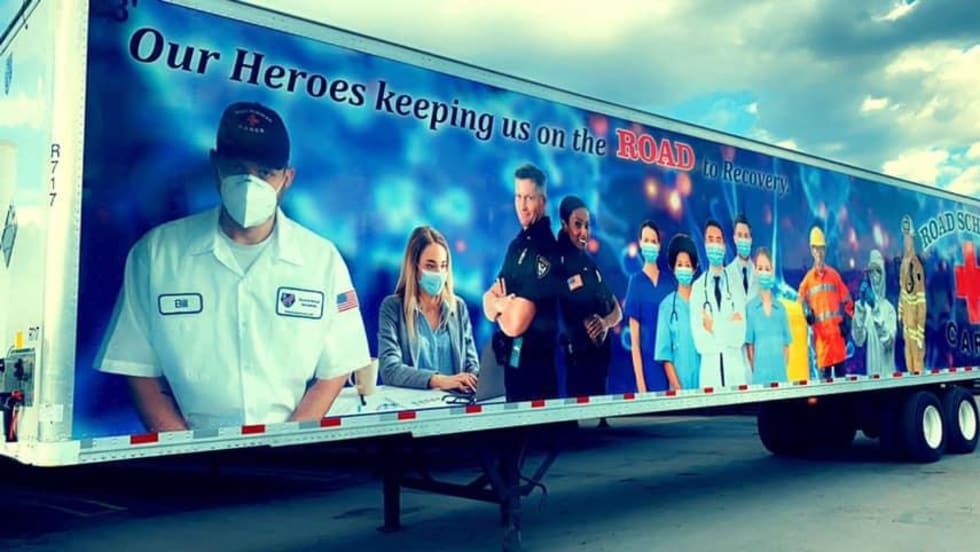
Wrapping a Trailer for COVID’s Everyday Heroes
“We don’t only deliver freight. We deliver awareness.” That’s what Jim Barrett, president and CEO of Road Scholar Transport, likes to say about the Dunmore, Pennsylvania-based carrier’s “awareness fleet.” Its latest trailer wrap honors the everyday heroes of the pandemic.
Read More →
How a Tanker Fleet is Using Unorthodox Trailer Lighting to Fight Rear-End Collisions
Groendyke Transport watched the number of rear-end collisions with its trailers rise steadily until it tried an unorthodox and then unapproved method of alerting following drivers that its trucks were applying brakes and slowing down.
Read More →
The Role Trailers are Playing in COVID-19 Funerals
In places such as New York City and Detroit, overwhelmed hospitals and mortuaries are using refrigerated trailers to store the bodies of people killed by COVID-19.
Read More →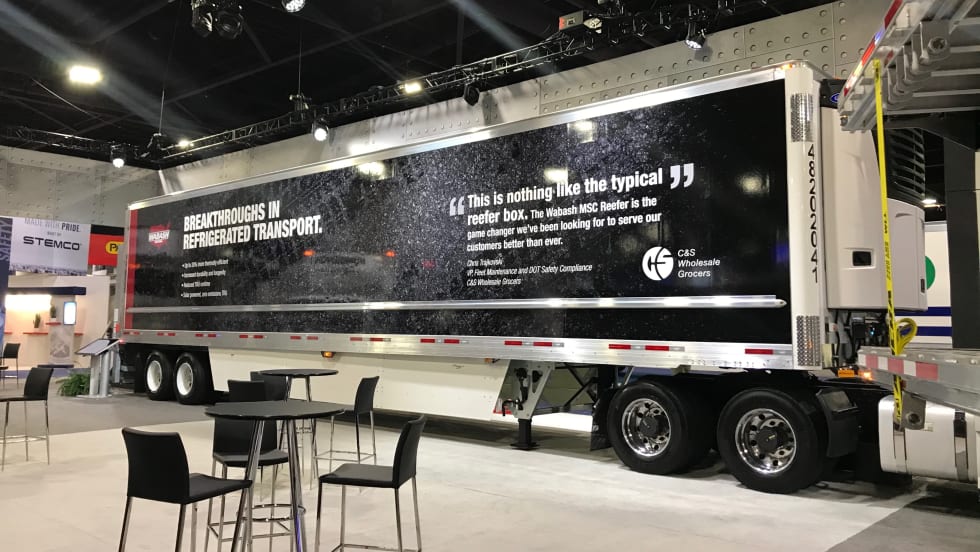
Reefer Trailer Aims to Help Reach Zero Emissions
Wabash National is partnering with C&S Wholesale Grocers to test a new type of zero-emissions refrigerated trailer.
Read More →