




The Little Engine That Did
Fans of old engines and machinery would have been thrilled to find this working, 95-year-old engine on display at the the 40th anniversary celebrations of Cummins Jamestown, N.Y.. assembly plant. It's believed to have been among the first engines ever produced by the Cummins Engine Co., hand-built by Clessie Cummins himself. Jim Park has more in his "On the Road" blog.

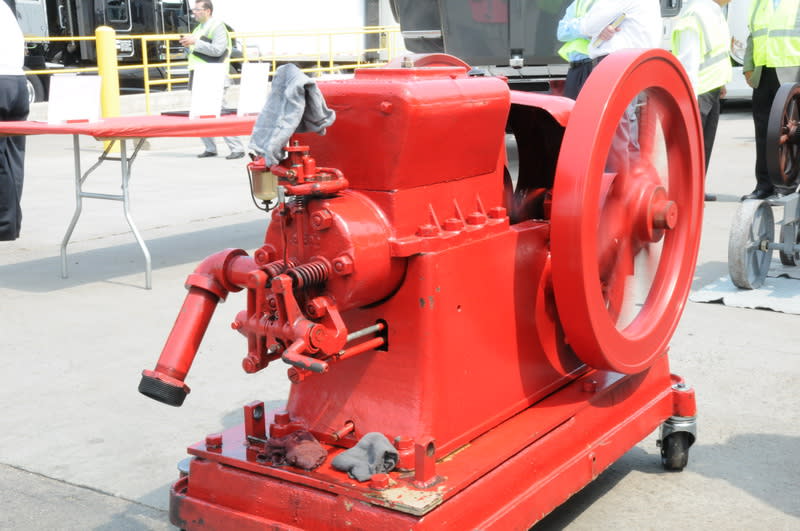
This 95-year-old Hvid engine still produces 6 horsepower at 550 rpm. It weighs 1,100 pounds, and the two flywheels weigh 375 pounds each. Photo by Jim Park
Were any of us to come across one of these in a barn or out in a field, few of us would recognize it for what it was. It's the engine that started the Cummins Engine Company. It's a not-too-distant cousin and a forerunner of the ISX engine we're familiar with today.
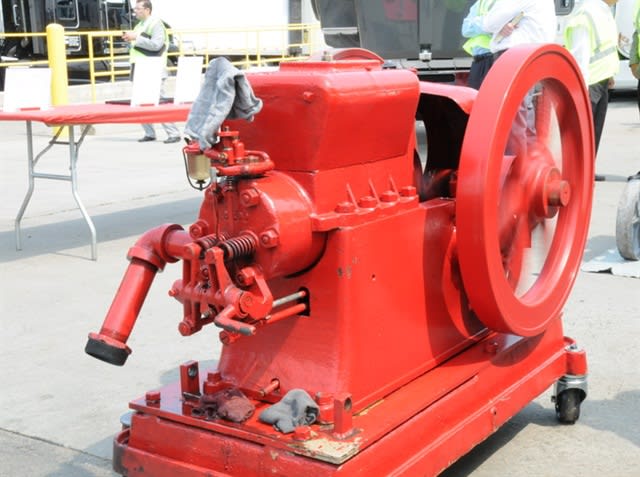
This 95-year-old Hvid engine still produces 6 horsepower at 550 rpm. It weighs 1,100 pounds, and the two flywheels weigh 375 pounds each. Photo by Jim Park
The engine was on display and working during the recent 40th anniversary celebration at the company's Jamestown, N.Y., manufacturing plant. Its proud keeper and chief technician, Randy Watts, a Combustion Performance and Emissions Tuning engineer (and self-confessed gear-head) was standing by the engine, proud as punch with a few oily rags in his hands, watching the thing blort, blort, blorting away on its little stand.
This particular engine dates back to 1919 and was probably hand-built by Clessie Cummins himself under a license from the Dutch-born engine maker, R.M. Hvid (pronounced Veed).
According to some notes from a website devoted to old engines, R.M. Hvid had developed and patented a fuel delivery system for compression-ignition engines. Rather than build engines himself, he sold licenses to use his patented fuel delivery system on engines built by others, the notes suggest. Clessie Cummins had one of those licenses, and he produced the plucky little red engine you see here.
"This isn't THE first engine, but that one would have been very similar to this one," Watts explained. "We're actually still trying to figure out which one this is. There are two different numbers on it -- on the base and on the top -- neither of them is in the location it should be, so there's some discrepancy there. I'm not sure if we'll ever know which engine was the original."
Watts says this type of engine was produced under the name Cummins Oil Engine, and this one would likely have been built within the first two months of the company becoming incorporated.
As the story goes, and it's well documented in many online accounts as well as in the book "The Diesel Odyssey of Clessie Cummins," written by Clessie's son, Lyle, Clessie had made some improvements to the original fuel delivery system for the engine and had managed to increase its output from five horsepower to six. It was then he was approached by the Sears & Roebuck Co. to manufacture fuel systems for engines it was selling to farmers through its mail order catalog.
The Hercules Engine Company of Evansville, Indiana, had been Sears & Roebuck's original producer, selling 1.5- and 3-horsepower engines under the trade name Thermoil. The engines were popular but Hercules was unable to keep up with demand. Sears & Roebuck saw Cummins' working 6-horsepower engine and offered the fledgling company a contract to produce some 4,500 of the smaller engine, to supplement Hercules' production. At the time, Cummins had a working version of only the larger engine, but had been working on plans for the smaller ones.
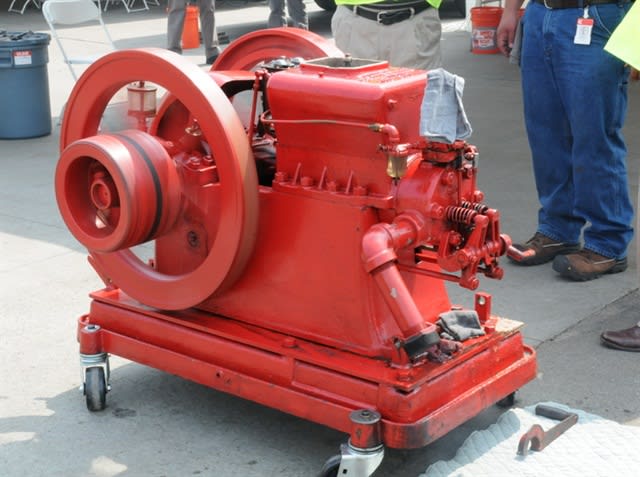
Photo by Jim Park
Watts says Cummins likely produced fewer than 100 of the 6-horsepower engines seen here when he shifted production to the smaller 1.5- and 3-horsepower models for Sears & Roebuck. The deal with Sears & Roebuck put Cummins Engines on the map, but it very nearly bankrupted the company too.
Sears & Roebuck was selling the engines on terms of "$5 down, 30 days trial, 10 months to pay." The farmers took full advantage of these terms, buying the engines on time, using them for the harvest season and then returning them for a refund. Sears & Roebuck was returning the engines to Cummins at rate of about 20% of total sales.
Cummins' sales reached a peak of $25,000 in December 1920 before collapsing to less than $5,000 in February 1921. Engines were returned to the factory faster than they were shipped.
According to Lyle Cummins, it had become a local joke around Columbus, Indiana, at the time, that the draymen hauling the engines in and out of the Cummins Engine plant were making more money on the engines than was the manufacturer.
Cummins managed to sever the relationship with Sears & Roebuck in 1923, after four years of production which netted the company a measly profit of about $9,000. Cummins, however, managed to extract from the catalog retailer the princely sum of $85,000 to cover the cost of unsold inventory and parts, proving that young Clessie was not only good at designing and building engines, but that he had a pretty good head for business too.
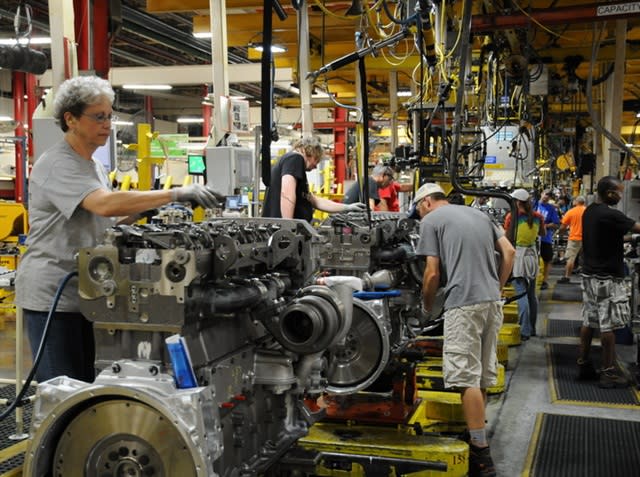
Cummins has come a long way in the 95-years since the Hivd was sold through the Sears & Roebuck mail order catalog. Photo by Jim Park
Fortunately for Clessie, and the rest of us for that matter, he had an investor and partner, former employer and life-long friend, W.G. Irwin, who saw bigger prospects beyond the Sears & Roebuck fiasco, and sustained the company financially through its difficult start-up years.
As for the engine itself, it produces 6 horsepower at 550 rpm and weighs 1,100 pounds. The two flywheels weigh 375 pounds each. Compare that to the current ISX 15, producing over 600 horsepower at just over 3,000 pounds dry weight.
While its actual service life is unknown, it was designed as a constant speed engine to operate a flat-belt pulley, so it might have run an irrigation pump or a saw mill. Watts says the engine was found on an old oil lease in southeastern Ohio, leading to the assumption that it drove a pump.
There's more information on the early Cummins Hvid-based engines at the links below, as well as in the book "The Diesel Odyssey" by Lyle Cummins.
More Blog Posts

Truck Driver’s Dilemma: Click, Twist or Swipe?
Whether 'tis safer to twist a knob or press a button than to swipe right then swipe down to scan the menu for your favorite playlist...? That's a question for the age.
Read More →
Even the Swedes are Doing Turnpike Doubles
The government doesn't seem to mind asking trucking to invest a trillion dollars toward a greener future. But they won't let us pull turnpike doubles making 30% less CO2. Which is insanity, says HDT's Jim Park in his On the Road blog.
Read More →
Is Your Recruiting Message on Point?
How does your recruiting and retention messaging compare with the reality at your company? Would your drivers agree with your own assessment? Jim Park explores those questions in his On the Road blog.
Read More →
You Can’t Blame Trucks for the Highland Rest Area Bus Crash [Commentary]
The causes of the Highland Park rest area crash go far beyond the parking shortage and the need for flexibility in hours of service — but those issues must be addressed, too, says Jim Park in his On the Road blog.
Read More →
Electric Trucks Seem Far Down the Road for Fleets Dealing with Today's Maintenance Challenges
While the push for zero-emissions trucks rings clear for regulators, advocates and even a small crowd of suppliers, ZEVs seem to have run out of steam down on Main Street, says HDT Equipment Editor Jim Park in his latest On the Road blog.
Read More →
Guinea Pigs 2.0: Can Trucking Comply with a Near Impossible NOx Reduction?
The EPA’s Final Rule on NOx reduction will be incredibly difficult if not nearly impossible for trucking to comply with. Rather than endure another round of equipment failures, downtime and loss of customer faith, industry needs to rally ‘round the OEMs and seek a solution to this wrong-headed rule.
Read More →
Is Downspeeding Bad for Brakes?
Is there a connection between downsped drivetrains and increased brake wear? There shouldn’t be. Downsped fleets seeing increased brake wear are probably not letting the technology do its job, explains HDT Equipment Editor Jim Park.
Read More →
Dig for the Gold Behind CVSA’s Out-of-Service Numbers
Published out-of-service rates don’t mean much until you dig into the why. With brake problems consistently placing in two of the top five spots, maybe we’re missing something in brake maintenance, writes HDT Equipment Editor Jim Park.
Read More →
Things That Go Poof in the Night
We’re in electric-truck heydays now. But like another famous heyday, the 1849 California Gold Rush, there will be a lot fewer winners than losers, says Jim Park in his On the Road blog.
Read More →
Do Your Truck Drivers Know How to Descend a Mountain Grade?
Where do drivers learn mountain-driving techniques? It's sure not from the typical state CDL manual. Jim Park shares what he learned following a deadly 2019 Colorado crash.
Read More →