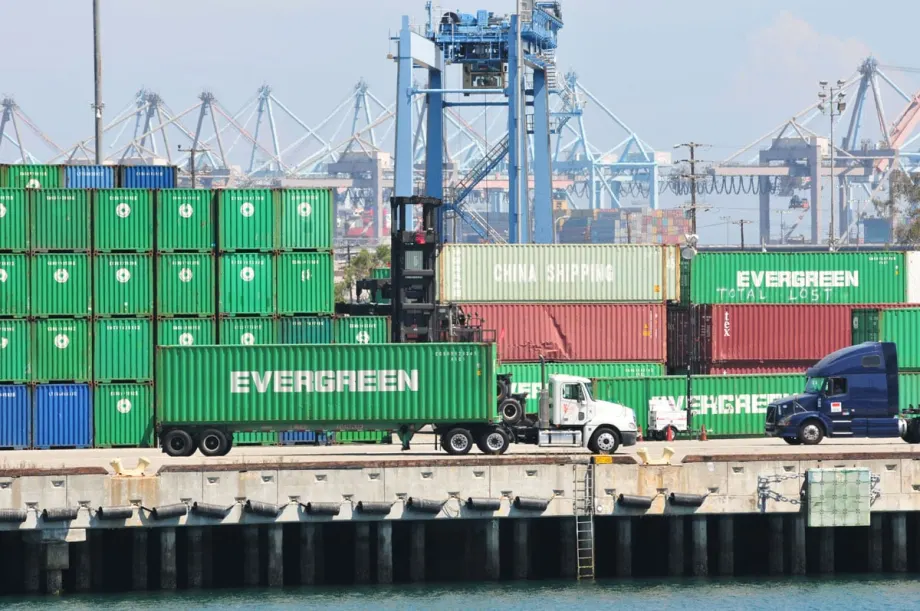
In July 2021, the U.S. Department of Commerce International Trade Administration levied a combined 221.37% tariff and countervailing duty for five years against the Chinese container chassis manufacturer CIMC Vehicles Group. The ruling effectively blocks CIMC from dumping new, low-cost chassis and chassis components into the U.S., in favor of protecting domestic chassis manufacturers.
A group of five U.S. chassis OEMs, calling themselves the Coalition of American Chassis Manufacturers (CACM), had petitioned the International Trade Commission for relief to allow for fair competition in the face of CIMC’s market dominance. At the time, CIMC had a market share of over 75% of all marine and domestic container chassis sales in the U.S. Its largest-volume year was 2018 with over 45,000 chassis imported and sold.
Since the ITC decision, a combination of inadequate North American chassis manufacturing capacity and increased cyclical demand has created a new chassis production vacuum that other manufacturers are hopeful of filling. While the CACM OEMs promised to increase their output to meet demand in response to the protective ruling, their ability to ramp up production has been hampered by current component, material and labor shortages. The result is that new chassis providers have been springing up, both domestically and internationally, in an effort to position themselves for a share of the projected 80,000-unit annual demand in 2023 and beyond.
Questions to Ask When Buying from a New Intermodal Chassis Provider
Questions that any chassis buyer should answer for themselves before buying from a new supplier include not only pricing and availability of the product, but also warranty terms, financial sustainability, comparable experience, regulatory compliance, etc. Some of these new chassis OEM entrants have experience building highway trailers for North America, but some have a more limited understanding of the necessary regulatory requirements for entering the market.
Before putting container chassis (or other trailers) on the roads of the U.S., Canada or Mexico, there are number of important safety, certification and testing criteria that need to be met by the provider, such as the National Highway Traffic Safety Administration's Federal Motor Vehicle Safety Standards, as well as from standards organizations such as the American National Standards Institute, the Truck Trailer Manufacturers Association, the Society of Automotive Engineers, and the Association of American Railroads.
“Does this new OEM chassis meet all applicable certifications and regulations?” is a question often over-looked by buyers or taken for granted. After all, most of the high-level regulations are based on the manufacturer’s self-certification of compliance… “Trust us. We read the regs and you are good to go!” (Note to reader: Caveat emptor…Let the Buyer Beware).
Only a few exceptions exist for the self-certification allowances. The most comprehensive of these is the AAR (Association of American Railroads) testing requirements for all intermodal vehicles. The AAR has a long-standing set of rigorous physical testing requirements for any trailer/chassis that interfaces with North American rail service ,as chassis often do. As such, container chassis of all types, marine and domestic, fall within the purview of the AAR testing requirements. Any trailer or chassis that might ever cross over onto North American rail property needs to meet or exceed the AAR testing requirements or face huge liability consequences in the event of failure or accident.
Potential Liability for Not Asking About Chassis Standards
By association with this rail industry requirement, the potential liability issue extends into all other operational circumstances for intermodal equipment, whether it's highway operation, port operation, or just sitting in a yard or by the side of the road awaiting service. Simply put, AAR testing is the “high bar” that every chassis brand and model must match.
To whom does this liability exposure extend other than the OEM? It is America, after all…so, everyone! The leasing company that buys them, the carrier that operates them, the dealer that sold them. With nuclear liability verdicts commonplace in freight transportation, this is a big deal. If you have any money, juries want to give it to the plaintiff. If your chassis caused a rail derailment with hazmat issues or if it is implicated in the horrific loss of life in a highway crash, expect the worst possible judgement and settlement outcome.
To help protect yourself from this excessive liability exposure is make sure the chassis you are buying comply in full with all regulatory requirements and, in particular, the AAR prescribed testing criteria.
I am confident that many “legal beagles” (of which I am not one) will contest my analysis, but why take the risk? The AAR tests are comprehensive and exhaustive regarding structural tolerance and integrity. Don’t we all want that, anyway?
Compliance with the testing criteria specified in AAR M-931 for intermodal vehicles is neither simple nor easy to satisfy. They require extensive physical testing of a full vehicle, with many of the tests requiring hundreds or thousands of repeated cycles. Computer Aided Engineering (CAE) and Finite Element Analysis (FEA) calculated results are not an acceptable alternative to the physical product testing prescribed by M-931.
Furthermore, while only self-certification of the AAR testing is technically required, OEMs that have been building container chassis for North America for years have traditionally certified their physical test results by contracting with a credible, qualified, independent engineering consultancy to oversee the testing and verify the results.
If a manufacturer tests and validates its chassis to AAR standards using only its own assessment and some video tapes to prove satisfaction of the results, in a court case, you may be asked why you didn't do a better job of making sure you were buying safe equipment — in front of a jury that is likely sympathetic to the defendant.
In conclusion, is the chassis you are buying 100% compliant with all governmental regulations as well as AAR standards? Ask your chassis provider, and make sure they have real evidence do support that claim.