




Related: Knight Keeps Drivers Covered With SmartDrive’s Video-Safety Program
Why You Should Consider Advanced Safety Systems
With all of the advancements in the past 5-10 years, there is a strong case, both financially and in terms of sheer practicality, for fleets to evaluate and spec advanced safety systems on their trucks today.
by Jack Roberts
July 25, 2016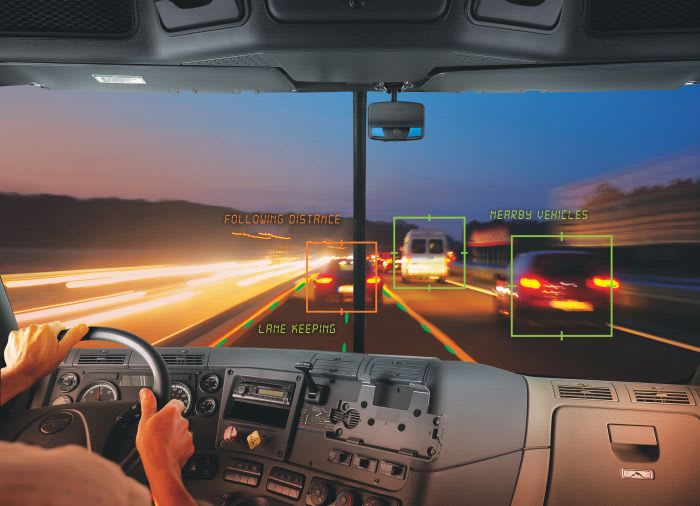
Lytx, which specializes in video-based telematics systems, says the vehicle, the driver and the environment all must be taken into account for “significant and enduring safety improvements.”
9 min to read
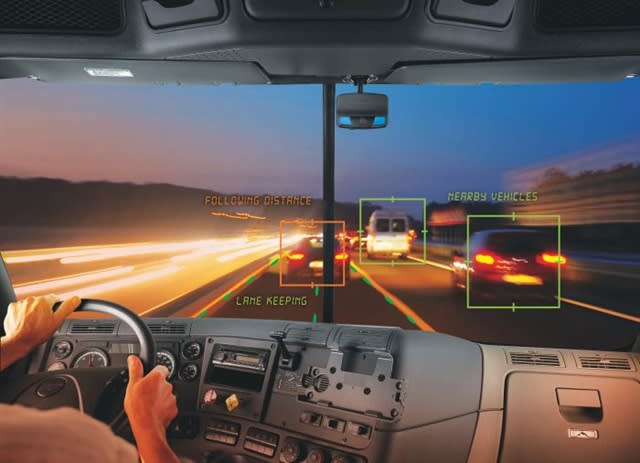
Lytx, which specializes in video-based telematics systems, says the vehicle, the driver and the environment all must be taken into account for “significant and enduring safety improvements.”
Welcome to the age of the Safe Truck. I say that for several reasons.
For starters, there is simply no way around the fact that heavy-duty commercial vehicles today are safer than ever before. Much of this is simply inherent in modern automotive design philosophy. Volvo, for example, has engineered its drivetrains to respond to the kinetic energy generated in a crash by dropping down and behind its cab interiors to reduce injury to the driver and passenger. Likewise, the company designs its cab exteriors to withstand an array of high-energy impacts while retaining their structural integrity.
At the same time, external safety systems are undergoing an impressive technological revolution in their own right. Systems such as lane departure warning, cameras, predictive cruise control and collision avoidance are all becoming more powerful and accurate thanks to the unrelenting swirl of technological advancement that we all live in today.
But perhaps more importantly, safety system providers are working closer than ever with vehicle manufacturers to integrate these systems with each other, as well as with a truck’s internal drivetrain and information systems. The result has been trucks that are more vigilant to danger than ever before, and can react faster to help a driver in an emergency.
The next evolution of vehicle safety systems will be even more impressive. In the very near future, rapidly evolving vehicle-to-vehicle (V2V) communication systems will allow similarly equipped cars and trucks to all react in a coordinated fashion to highway emergencies. They will be able to work together faster and more accurately than any group of humans ever could to mitigate or avoid injury and property damage in crashes.
And there is this: As safety systems become increasingly effective and commonplace in both passenger cars and commercial vehicles, government regulations mandating the use of these systems are only going to increase, making a powerful argument that fleets should get ahead of the adoption curve today.
“We anticipate that some of these safety systems will eventually be required by regulation,” says Wade Long, director of product marketing for Volvo Trucks. “Forward collision warning systems and automated emergency braking systems are likely to be among the first systems mandated, although it is difficult at the moment to say when, exactly, that will happen.”
Taken as a whole, these reasons make a strong case, both financially and in terms of sheer practicality, for fleets to evaluate and spec advanced safety systems on their trucks today.
“Safety systems have come a long way in the last 5 to 10 years and the technology is proven,” says Kurt Swihart, Kenworth marketing director. “Take a closer look at these technologies and think broadly about how these systems can help manage overall risk, not for an individual truck necessarily, but across the entire fleet.”
And then there’s the specter of litigation to consider.
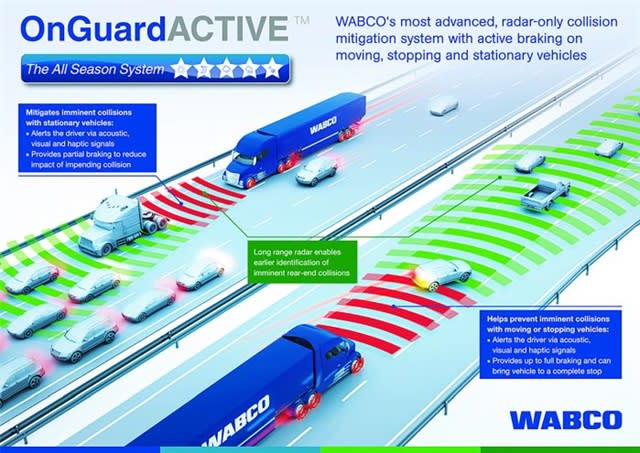
Meritor Wabco says heavy-duty truck fleets using its OnGuard collision mitigation system have reported a 65% to 87% reduction in accidents, resulting in an up to 89% reduction in accident costs compared to vehicles without OnGuard.Photo: Meritor Wabco
Taking on the truck-chasers
You’ve heard of ambulance-chasers — lawyers who seek out accident victims to encourage them to sue for damages. There’s a related breed who specialize in targeting trucking companies.
The grim reality is the motoring public doesn’t realize that many fleets use sophisticated safety systems. Truck-chasing lawyers prey on stereotypes and fears of big trucks and can easily entice a motorist involved in a truck accident into a lawsuit.
Michael Hostetter is an Atlanta-based attorney whose firm, Nall and Miller, specializes in defending fleets from lawsuits resulting from roadway accidents. He told me he always breathes easier when his client fleet has safety systems spec’d on its vehicles. Still, he acknowledges that many fleets today are hesitant to spec safety equipment for a variety of reasons. “I have clients who complain about the cost of these systems,” he says. “But they never complain about their effectiveness.”
Hostetter says some fleets worry that systems such as event recorders or cameras will prove they’re at fault in an accident — a concern he dismisses out of hand. “If the telemetry or video evidence shows your driver is at fault, you’re already responsible,” he explains. “But even if you are at fault, you can often come out ahead in the long run, simply by moving directly to a settlement phase and avoiding the time, expense and uncertain outcome in a drawn-out courtroom battle.”
Which leads Hostetter to an important point: Cost for this equipment can be high. And many fleet managers feel they have a hard time justifying that expense. After all, how do you quantify events that never happen?
The ROI question can be a tough one for fleets. Ryan Laskey, VP commercial vehicle engineering and quality for Dana, notes that there are many metrics beyond return on investment that can be used to quantify the value of a safety system. He suggests that fleet managers who need to talk to a CEO or chief financial officer to make the case for spec’ing a safety system in a new truck demonstrate overall safety system value through measurements such as a reduction in downtime or fewer accidents per million miles.
“The fact is, you will save money in legal costs and settlements using these systems,” Hostetter contends. “Electronic log books are a prime example: All the data shows that logbook violations and associated costs declined dramatically for early ELD adopters. It’s exactly the same with safety equipment.”
Here, the statistics are clear, says Jon Morrison, president, Americas, for Wabco. His company carefully tracks safety figures compiled by the National Highway Transportation Safety Administration, which prove the effectiveness of fleet investments in safety.
“NHTSA is projecting that the new ruling on mandated electronic stability control systems will prevent as many as 1,759 crashes, 649 injuries and 49 fatalities each year,” Morrison says. “And Wabco’s own research confirms this. In terms of collision mitigation systems, heavy-duty truck fleets using our OnGuard collision mitigation system have reported a 65% to 87% reduction in accidents, resulting in an up to 89% reduction in accident costs compared to vehicles without OnGuard, with a payback in just two years.”
Hostetter says a new problem is emerging for fleets that decline to spec safety equipment: The perception that the fleet is unconcerned with the safety of the motoring public. “As more people experience the technology in their personal vehicles, they begin to develop an expectation those systems are present on all vehicles.”
The lawyer says a shrewd plaintiff attorney can use the omission of safety equipment to paint a picture of a fleet that knew said equipment was available, but was too cheap or uncaring to spec it. “I’ve seen fleets really get beaten up in court over omitting safety systems,” he notes. “A jury starts out prejudiced against trucking companies. You certainly don’t want to reinforce that negative image by playing into a plaintiff attorney’s hand.”

Vehicle-to-vehicle technology, such as that used in Daimler’s recent demonstration of autonomous platooning technology in Europe, will further enhance high-tech safety systems.Photo: Daimler Trucks
Building blocks and integration
Today, the “take rate” on safety equipment for new trucks is around 30% and growing, says Charles Hilton, director of engineering for International Trucks. Hilton says that today, safety system suppliers and OEMs are working closer together than ever before with advanced engineering concepts and pre-planned technical roadmaps to ensure these systems grow in their capability while creating a common feel across all makes and models of trucks.
“The earlier we become involved with the safety system experts, the easier integration becomes,” he says. “It’s a natural progression. When you think about how ABS (antilock braking systems) work with collision mitigation systems, you can see how each piece of safety is a building block that can be used to construct a complete and powerful suite of systems all working as one.”
According to Kelly Gedert, powertrain and components marketing manager for Daimler Trucks North America, Daimler is already moving toward total safety system integration. Gedert notes that the Detroit Assurance suite of safety systems is fully integrated with Detroit engines and transmissions, as well as the truck’s braking system and dashboard, to enhance driver safety by mitigating collisions. The full integration results in smoother and more fuel-efficient speed and braking transitions.
Integration can take place not only among the systems on the truck, but also with telematics systems and back-office fleet management software.
Pete Allen, executive vice president at MiX Telematics, says driver monitoring is another safety technology approach that is increasingly popular with fleets. He says his company has created a fully integrated, seamless video and fleet management system that gives the user one portal, one algorithm for triggered events, one install, and one solution.
“Today, our customers experience the full integration of hours of service (fatigue), driver behavior (in-vehicle feedback and driver profiling based on risk) and integrated video (coaching and subrogation),” Allen says. “We can see a future where things like cell phone usage monitoring to avoid distracted driving, collision avoidance systems to avoid crashes, and fatigue monitoring systems that track driver eye movement or brain waves become fully integrated into a telematics fleet management solution.”
The more actionable intelligence that drivers and fleet managers have, the more overall fleet safety increases, he says. That point is echoed by Kara Kerker, executive vice president and chief marketing officer for Lytx, which specializes in video-based telematics systems.
“The key to optimizing integrated safety and performance systems beyond preventing collisions in real time includes extracting data to better understand when and why the risk of the collision existed in the first place,” Kerker says. “There is a dynamic between the vehicle, the driver and the environment, and all three must be taken into account for significant and enduring safety improvements to occur.”
Kerker says her company sees collisions where drivers are using active safety systems as a crutch. Assuming the system alone will prevent a collision, they become vulnerable to distractions ranging from cell phone use to reading newspapers. She believes further system integration will help offset this problem.
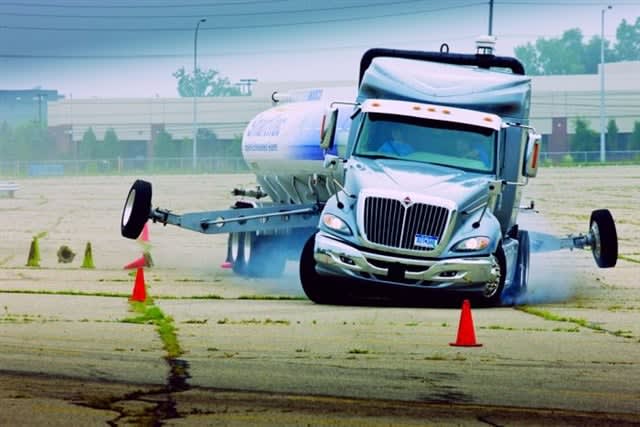
Roll stability control is an example of how safety systems build on other technologies.
Looking ahead
“Wider acceptance and adoption of safety systems is going to continue as a trend in the industry,” says DTNA’s Gedert. “We will continue to see additional active safety system features rolled out each year. Pedestrian recognition [just announced on Mercedes trucks in Europe], cross-traffic recognition and blind spot recognition are a few examples that are in the future roadmap for safety technology. We are in an exciting time in the industry as today’s safety technology sets the ground work for tomorrow’s autonomous vehicle.”
Kerker says V2V communications are poised to take vehicle safety even further. “Where safety gaps exist for most of the trucking industry today is going that last mile to improve driver behavior within the context of increasingly automated safety technology,” she explains. “That’s why vehicle efficiency and safety will soon be inextricably linked. Our next-gen telematics brings all the engine control module sources of data together, from fuel to maintenance status, and combines it with video to generate a 360-degree picture of vehicle and driver performance, from safety to fuel economy to overall operation efficiency.”
Jeff Walker, product director for Eaton, says V2V systems have the potential to improve safety technology by knitting together individual vehicle safety measures into a more connected universe. While this will increase the onboard technical complexity, and require additional data processing assets as well as definition and adoption of standards, he thinks that overall, V2V can help the industry to maintain and even increase safety even as it implements measures to increase efficiency and reduce costs, such as platooning.

An example of how safety systems are becoming more integrated, Wabco’s OnLane lane departure warning system features a high-resolution camera integrated with a SmartDrive video-based driver performance management system.Photo: Wabco
“It is important to understand that these advanced systems are designed to ‘assist’ the driver, not ‘replace’ the driver,” Walker says. “As these integrated systems become more prevalent, their ability to support drivers with such things as automated transmissions, adaptive cruise control, automatic braking and other integrated solutions, will lead to safer vehicles in the future.”
It seems clear that vehicle safety systems are not only increasing in power, but are also becoming seen as a “must have” spec for fleets today. And as safety equipment becomes more commonplace, the reality is that it is also becoming more expected by the government, insurance companies, legal experts and the motoring public. Fleets that ignore those expectations will soon do so at their peril.
Subscribe to Our Newsletter
More Safety & Compliance
More Trailer Data Through the Same Seven-Way [Video]
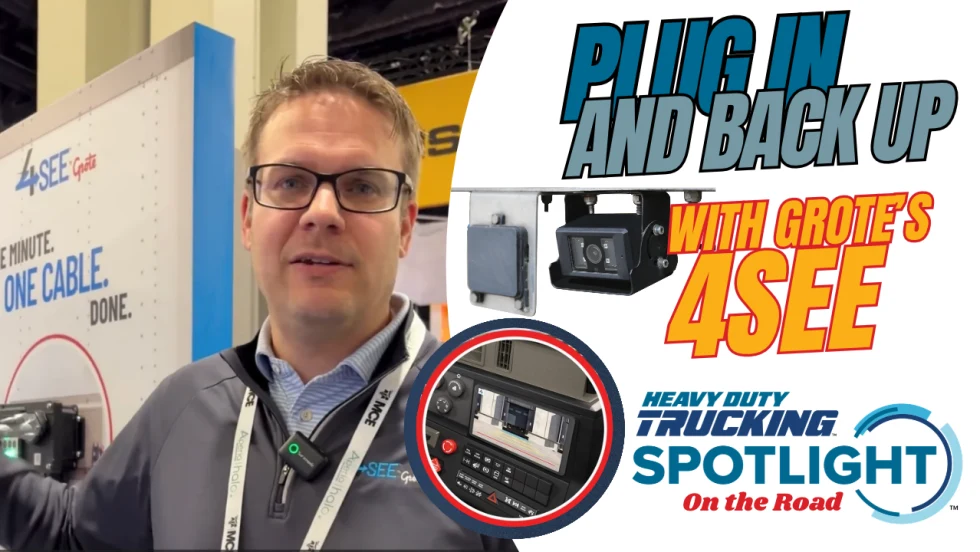
Can trucking’s standard seven-way connector handle more cameras and trailer data? Grote’s Adam Slade shows HDT how the company is using new technology with its 4See trailer system, not only to add a new backup camera but also to expand other capabilities — without adding another connection.
Read More →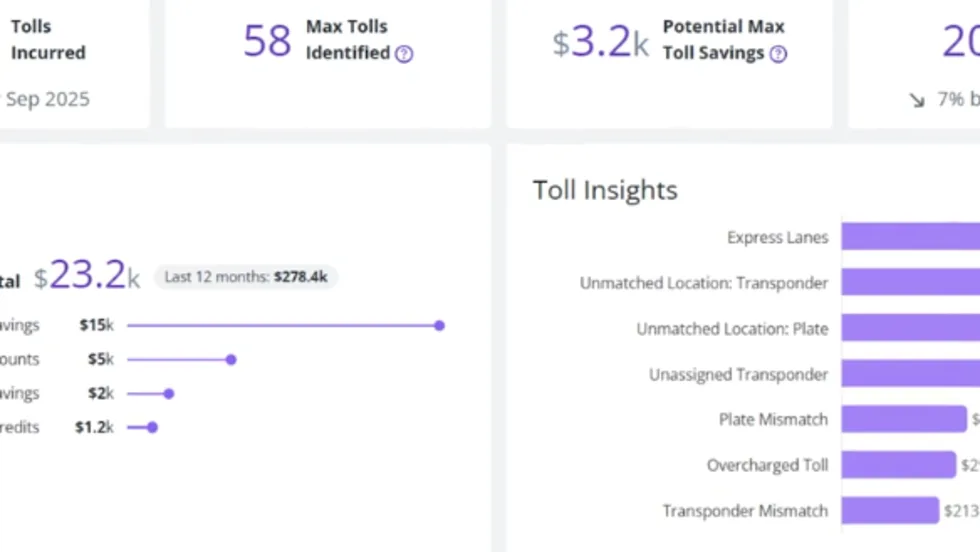
PrePass Intelligence Mines Fleet Bypass, Toll and Safety Data
PrePass Intelligence helps fleets measure bypass savings, flag potential toll overcharges, and spot suspicious transactions by combining data from separate systems.
Read More →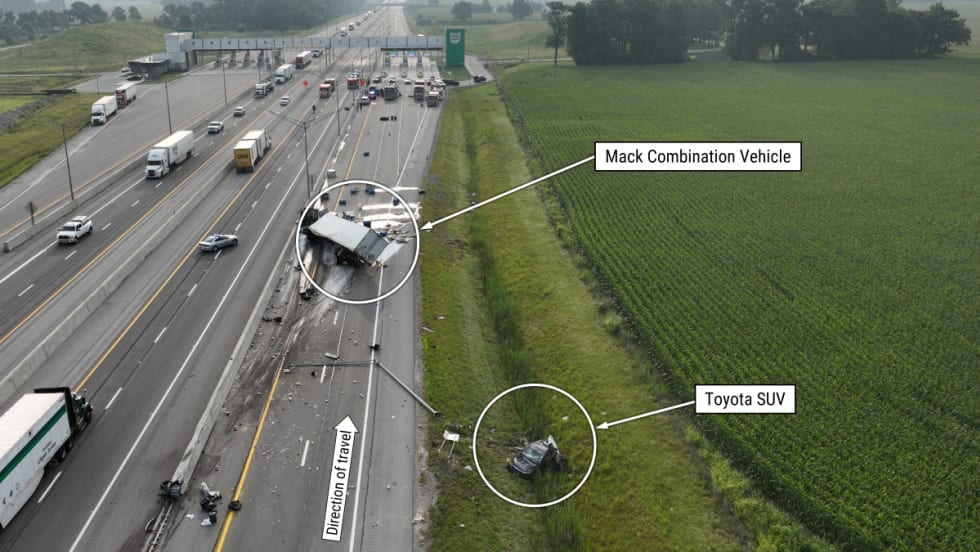
Fatal Crash Exposes Toll Plaza Risks
An NTSB investigation found that last-minute lane changes and large speed differences at an Ohio toll plaza created a hazard the truck driver couldn't avoid in time.
Read More →

When Language Stops the Truck: The Return of ELP Out-of-Service Orders
English language proficiency rules for commercial drivers aren’t new, but renewed out-of-service enforcement has raised the stakes. Here’s what carriers need to know before a driver reaches a roadside inspection.
Read More →
Sponsored•October 6, 2026
A Camera Isn't a Safety Program. Here's What Brokers Are Screening for Now
Footage alone may not be enough to pass broker vetting processes. Here's what counts as a defensible safety program now.
Read More →
Marijuana and Trucking’s Drug-Testing Dilemma
Marijuana is getting stronger, laws are changing, and drug tests still can’t reliably establish impairment. What does that mean for truck drivers and the fleets that employ them?
Read More →
PrePass, Kodiak Connect Driverless Trucks to Roadside Enforcement
The system will allow enforcement agencies to verify Enhanced Inspection information and decide whether Kodiak’s autonomous trucks can bypass roadside screening sites.
Read More →
From One Generation to the Next: How Mentorship Builds Safer Truck Drivers
After three decades in trucking, Harold Perry shares what he's learned about driver safety, mentorship, and helping the next generation build confidence behind the wheel.
Read More →
FMCSA Pauses Biennial-Update Enforcement Amid Motus Transition
Carriers whose updates were due on or after June 1 have more time, while FMCSA works to stabilize its new registration system and warns of phishing sites impersonating its new carrier registration system, Motus.
Read More →
ZF Expands Commercial Vehicle Push in North America
ZF is expanding its North American commercial-vehicle presence with new transmission applications, electrification, trailer technology and autonomous-driving systems.
Read More →