Why U.S. Xpress Uses Automated Manual Transmissions
Automated manual transmissions rule the roost at U.S. Xpress today. Out of some 7,000 U.S. Xpress trucks running today, the fleet is down to just 16 “legacy” models still equipped with manual transmissions.
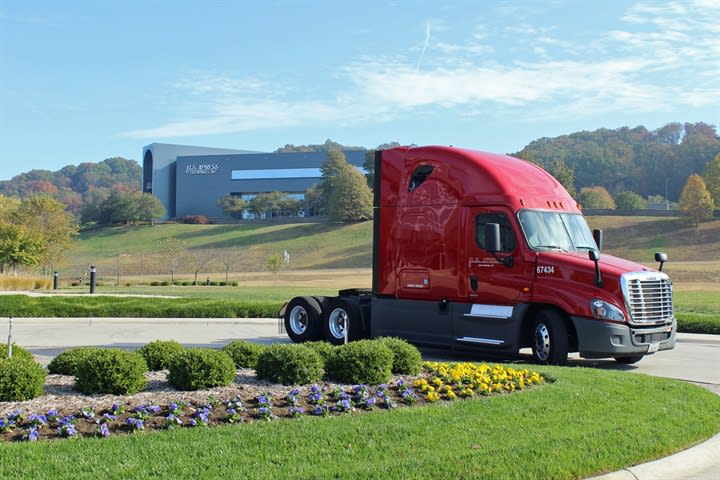
Out of 7,000 U.S. Xpress tractors running on the road today, only 16 “legacy” units are still equipped with manual transmissions.Photo: Jack Roberts
2 min to read
Out of 7,000 U.S. Xpress tractors running on the road today, only 16 “legacy” units are still equipped with manual transmissions. Photo: Jack Roberts
Automated manual transmissions rule the roost at U.S. Xpress today. During an event in early November to the fleet’s headquarters in Chattanooga, Tennessee, senior vice president of maintenance Gerald “Gerry” Mead noted that out of some 7,000 U.S. Xpress trucks running today, he’s down to just 16 “legacy” models still equipped with manual transmissions.
“Our last tractor buy was 100% AMTs,” Mead explained. “And at this point, we just can’t see a valid reason to spec a manual transmission – or even an application that would absolutely demand one.”
Ad Loading...
Mead noted that early versions of the latest-generation of AMTs suffered through some relatively minor teething problems (usually centered on the shifter). Overall, however, he said the integration into U.S. Xpress’ fleet has been mostly painless, with the shift toward nearly 100% AMT specs happening far faster than he imagined it would a few years back.
U.S. Xpress specs its AMTs with some unique (and secret) algorithms to meet the fleet’s performance and efficiency requirements. While the units have delivered in a big way on fuel economy, they’ve paid off in other ways as well.
“The drivers love them, so they help with recruiting and retention,” Mead said. “And our maintenance costs are way down. Everyone talks about no longer replacing clutches and greater brake life. And we’re seeing those things, too. But we’re also seeing reduced overall maintenance costs and greater overall vehicle durability because AMTs don’t shake, rattle and vibrate the truck as much when they get going. And reduced vibration is always a good thing from a maintenance point of view.”
Mead noted that manual transmissions are increasingly becoming the “brains” of a truck, coordinating and controlling almost every driving and safety system on the vehicle. “We’re in a new age of trucking,” he said. “And I think soon, fleets that aren’t running AMTs just won’t be able to compete with fleets that are.”
Fleet Snapshot
Who: U.S. Xpress
Where: Chattanooga, Tennessee
Fleet: 7,000 tractors, 19,000 trailers
Operations: National/international truckload and intermodal from 11 terminals covering the East Coast, Great Lakes, Midwest and Texas.
Fun fact: In the summer of 2010, the fleet purchased its 50,000th Freightliner truck, a Cascadia 72-inch raised roof sleeper model with a Detroit DD15 engine.
Challenge: Continuously pushing the envelope on vehicle efficiency
The companies also said they plan to coordinate deployment planning across priority freight corridors and define routes and operational design domains for U.S. commercial service while laying the groundwork for expansion into key European markets.
Previous Star Nation events have included driver challenges, exclusive access to Daimler Truck North America facilities and hands-on experiences with the latest Western Star X-Series lineup.
Safety, uptime, and insurance costs directly impact profitability. This eBook looks at how fleet software is evolving to deliver real ROI through proactive maintenance, AI-powered video telematics, and real-time driver coaching. Learn how fleets are reducing crashes, defending claims, and using integrated data to make smarter operational decisions.
Fleet software is getting more sophisticated and effective than ever, tying big data models together to transform maintenance, safety, and the value of your existing tech stack. Fleet technology upgrades are undoubtedly an investment, but updated technology can offer a much higher return. Read how upgrading your fleet technology can increase the return on your investment.
Freightliner’s fifth-generation Cascadia earned a 2025 Red Dot Design Award for its aerodynamic design and functional updates developed through close collaboration between designers and engineers.