



FLEET SNAPSHOT
Who: DDA Transport
Where:Londonderry, New Hampshire
Fleet: About 100 Class 8 and 60 medium-duty
Operations: USPS contractor
Fun Fact: DDA started out in the truck and trailer repair business
Challenge: Alternative fuel adoption
 MENU
MENU SEARCH
DDA Transport recognized the importance of reducing its carbon footprint, but it needed a solution that wouldn’t burden the company with infrastructure constraints or costly maintenance.
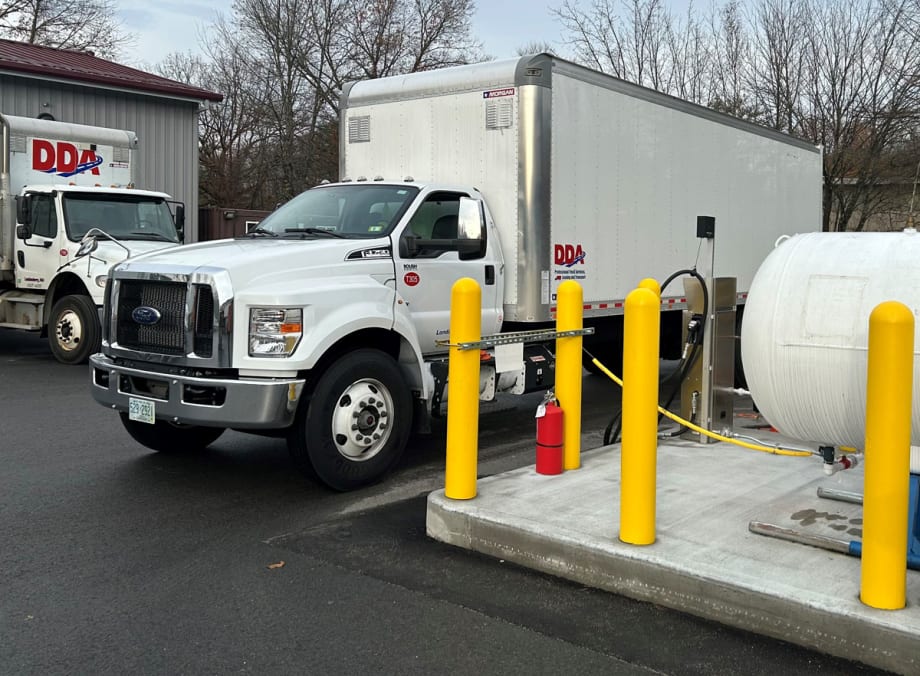
Working with Roush CleanTech, DDA Transport put six new Ford F750 straight trucks powered by propane autogas into its New Hampshire U.S. postal fleet last August.
Photo: DDA Transport
A major factor in the adoption of alternative fuels is location. For DDA Transport, its New England operations limited its options.
DDA’s primary business is as a postal contractor, transporting local mail in medium-duty straight trucks and linehaul mail between postal distribution centers in New Hampshire and Vermont.
“The Post Office, and the government in general, is trying to push for alternative energy,” says DDA President Dwayne Andreasen. “Obviously everybody’s going that route, electric vehicles or alternative fuels, trying to slow global warming.”
The company recognized the importance of reducing its carbon footprint, but it needed a solution that wouldn’t burden the company with infrastructure constraints or costly maintenance.
“As we looked at the entire market, the only thing we felt was viable in New England was converting some of our straight trucks to alternative fuels,” Andreasen says.
DDA looked into compressed natural gas, battery-electric, and propane autogas options.
“Electric kind of ruled itself out just because it didn’t meet our needs; we do probably 300 miles a day with most of our trucks and couldn’t get that range, and the infrastructure to recharge them isn’t there,” he explains.
Looking at CNG, he said, infrastructure was also a problem, as well as modifications that would be required to its shop to do the repair and maintenance on the trucks.
“So we looked at the propane autogas, and certainly it’s been kind of tried and proven in the school bus industry. It gave us the close to zero emissions we were looking for, it gave us the reliability we were looking for.”
Working with Roush CleanTech, DDA put six new Ford F-750 straight trucks powered by propane autogas into its New Hampshire U.S. postal fleet last August.
“So far we love them,” Andreasen says. “The drivers like them. The neighbors around our truck yard like them, because they’re quiet when they start at 3 in the morning.”
And fueling infrastructure?
“The propane autogas people literally set up our own fueling station provided at almost zero cost from the propane company,” he says.
DDA worked with Ferrellgas to install an onsite propane station.
“We need onsite fueling because our trucks run on very strict schedules and are typically running from the early morning hours until the late evening,” he explains.
Ferrellgas not only provided the fuel but also worked out a cost-effective solution by incorporating a fueling station into a long-term fuel contract.
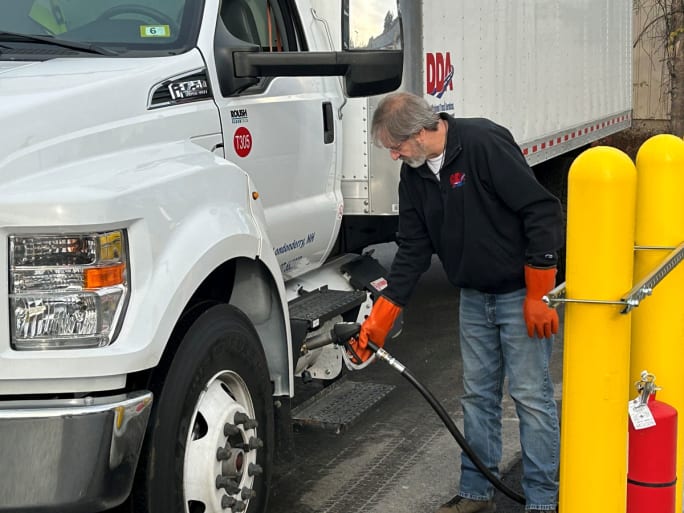
DDA worked with Ferrellgas to install an onsite propane fueling station.
Photo: DDA Transport
DDA, anticipates saving $25,000 on fuel spending and an additional $15,000 in maintenance and uptime costs for each truck annually compared to diesel models.
Andreasen projects a two-year payback on the propane trucks. CNG would have meant a six- to seven-year payback.
“If I can’t pay that truck back within four years, it just doesn’t make much sense.”
DDA is focusing on its straight trucks for now. It will likely be a while before it’s able to find a good fit for an alternative for the Class 8 trucks, he says. The charging/fueling infrastructure issues that made electric trucks and natural gas not a good fit for his medium-duty trucks are even more true for heavy-duty trucks.
The company’s goal is to achieve a 50/50 mix between diesel and propane autogas within the next few years.
Asked for advice he would give other fleets regarding adopting propane autogas, Andreasen said, “I would tell them really look into it, do your homework as far as what your needs are, what your routes are. But literally, just start talking to propane people.”

Volvo’s updated D13 promises lower emissions without sacrificing performance or fuel economy. Take a closer look at what changed inside the engine in this HDT Spotlight video.
Read More →
Energy Vision estimates fleets could recover the higher purchase price of an RNG-fueled Class 8 tractor in 1.3 to 2.8 years under current fuel-price scenarios.
Read More →
Calstart is now Catalyst Mobility, reflecting the nonprofit’s growing national role in clean transportation, including zero-emission trucks, infrastructure and incentive programs.
Read More →
Average U.S. diesel prices have climbed to nearly $6 a gallon, surpassing the 2022 record as tight refinery capacity and Middle East disruptions keep fuel costs elevated.
Read More →
Fuel delivery depends on more than what happens at the injector. For fleet, maintenance and technical professionals, looking at the full path from pump to injector can provide useful context for understanding engine performance.
Read More →
The Port Authority of New York and New Jersey announced millions in incentives for zero-emission drayage trucks, yard tractors, and new charging hubs near the port.
Read More →
Why do battery-electric Class 8 trucks remain so expensive? A California bill headed to Gov. Gavin Newsom would give fleets and state agencies more visibility into what manufacturers charge.
Read More →
Detroit isn’t starting from scratch to meet EPA 2027 diesel emissions standards. Its Gen 6 DD13 and DD15 engines keep much of today’s platform while updating the fuel and aftertreatment systems.
Read More →
California, Oregon, Washington, British Columbia and Baja California are coordinating plans for truck charging and hydrogen fueling from Canada to Mexico.
Read More →
Learn more about Kenworth's T880E battery-electric vocational truck at the Paccar Technical Center, including its range, applications, upfitting considerations, and PTO options, in this HDT Spotlight video.
Read More →