




When Must Truckers Complete a Driver Vehicle Inspection Report?
A common misconception about driver vehicle inspection reports for truckers and other commercial drivers is that one is required at every pre-trip inspection.

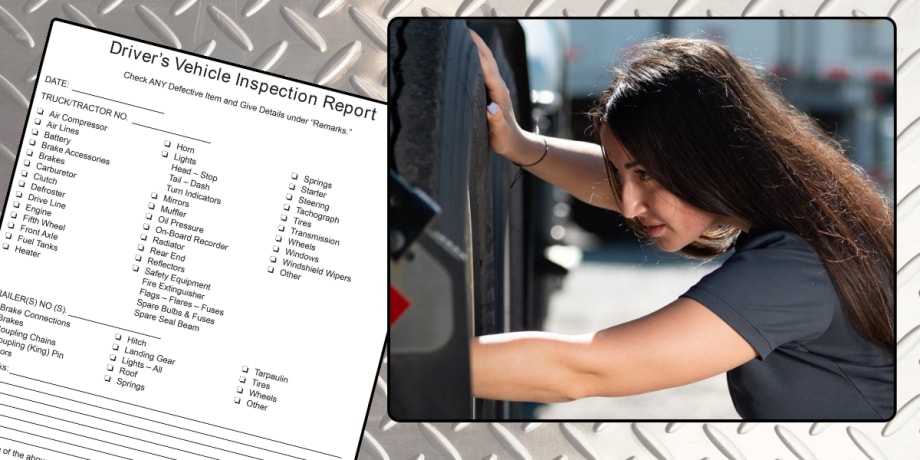
There's a misconception about when drivers need to turn in DVIRs.
Image: HDT
A common misconception about driver vehicle inspection reports for truckers and other commercial drivers is that one is required at every pre-trip inspection.
How often must a walk-around pre-trip inspection be conducted? Before every trip.
How often is a post-trip inspection required to be performed? After every trip.
When Does a Driver Have to Turn in a DVIR?
“There’s a lot of confusion in the industry,” says Tom Bray, a business advisor with J.J. Keller. “The driver needs to do a pre-trip — they have to be satisfied the vehicle’s in good operating condition before they drive it. That’s the bottom line. There’s no report required.
“If there's something wrong with the vehicle, the driver needs to get in touch with you and say, hey, this needs to be fixed before I can drive it.”
If a driver discovers a safety-related defect during the pre-trip inspection, while there may not be a federal requirement to file a DVIR, Bray says, you still need a process in place for how the driver reports it. If he’s in the yard, does he head to the maintenance shop? If drivers are on the road when they find something, do they know who to call or message to work with to get that fixed?
Post-Trip Inspections and DVIRs
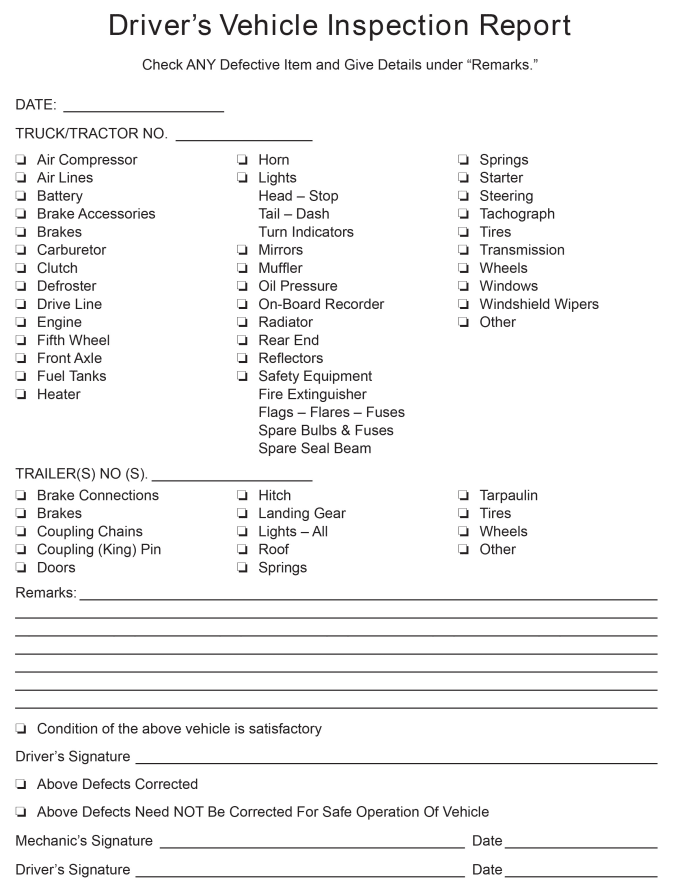
A sample driver vehicle inspection report from FMCSA.
Source: FMCSA
It’s at the end of the day, during the post-trip inspection, that finding a defect triggers the legal requirement from the Federal Motor Carrier Safety Administration to file a DVIR.
“At the end of the day, the driver does a post-trip, which can be as simple as a quick walk around,” Bray says. “But at that point, that's where the driver needs to submit a report to the company saying, ‘I have this defect on the vehicle.’ That's what's required in the regulations. If there's a defect on the vehicle, the company has to be notified, the driver has to complete a DVIR and submit it.
Some companies choose to have the driver submit a daily DVIR, defects or not, and that’s allowed in the regulations — it’s just not required by the FMCSA.
The Importance of the Post-Trip Inspection
“Everybody talks about the pre-trip,” says Michael Dominguez, VP of business operations, procurement and fleet management for Transervice Logistics.
But, he says, the post-trip inspection is actually more important.
“If I do a post-trip inspection flawlessly, and I catch everything, and I have a maintenance shop or provider that now can have from 5:00 in the afternoon to 7:00 in the morning to repair it, the chances of me running a real tight ship is greater because now I've got extra time for the maintenance to get done.
“We like to shift the emphasis to the post-trip, because the pre-trip is then automatic. I've already done my post-trip, I've done all the repairs, my pre-trip is a whiz, I'm just making sure that everything is signed off on.”
He says he learned this from one of the first DOT officers he had come in to help train drivers.
“If we put a tremendous amount of effort on the post-trip when it's back at the yard, when I have a technician that can take the next two hours fixing it, It changes the results tremendously.
“So everybody talks about the pre-trip. They know there's a post trip, but the emphasis really needs to be reversed. The post-trip needs to be the best.”
DVIRs and Lighter-Duty Commercial Vehicles
Another point of confusion about driver vehicle inspections and DVIRs, Bray says, is in lighter vehicles.
“The requirement applies to anything 10,001 pounds or more that you're using in interstate commerce. And there's a lot of people in that 10,001 to 26,000 pound category who don't think it applies to them, because their drivers don't have to have a CDL. So they don't have to know how to do inspections, because they’re not taking a test on it.”
More Safety & Compliance

From One Generation to the Next: How Mentorship Builds Safer Truck Drivers
After three decades in trucking, Harold Perry shares what he's learned about driver safety, mentorship, and helping the next generation build confidence behind the wheel.
Read More →
FMCSA Pauses Biennial-Update Enforcement Amid Motus Transition
Carriers whose updates were due on or after June 1 have more time, while FMCSA works to stabilize its new registration system and warns of phishing sites impersonating its new carrier registration system, Motus.
Read More →
ZF Expands Commercial Vehicle Push in North America
ZF is expanding its North American commercial-vehicle presence with new transmission applications, electrification, trailer technology and autonomous-driving systems.
Read More →
Truck Drivers Need More Than Another Alert
Fleets have more visibility into truck health, safety events, and driver activity than ever. The next challenge is turning all that information into useful guidance for the person who has to decide what to do next.
Read More →
Tesla Wants a Self-Driving Semi. Are Cameras Enough?
Could Tesla’s camera-only autonomous driving technology work on an 80,000-pound Semi? In this commentary, HDT's Deborah Lockridge takes a look at Tesla, Cybercab, and how autonomous trucks see the road.
Read More →
What DOT’s Automated Vehicle Strategy Means for Trucking
The U.S. Department of Transportation issued a new automated-vehicle strategy that outlines plans for driverless-truck regulations, cross-state freight corridors, and federal safety standards.
Read More →
NYC Expands Speed, Pedestrian Safety Tech Across Fleet
New York City is expanding intelligent speed assistance and pedestrian-alert systems across its municipal fleet, moving the technologies from pilot programs into vehicle procurement and retrofit requirements.
Read More →
FMCSA Removes 110 Truck Driver Training Schools from Certified ELDT List
Federal regulators also are targeting more than 160 additional training providers and launching a nationwide audit of third-party CDL skills testers as part of a broader crackdown on trucking fraud.
Read More →
Beyond DOT Compliance: What Makes a Trucking Fleet Truly Safe?
A trucking fleet can follow every rule and still make unsafe decisions. The real test comes when safety conflicts with freight, productivity, or cost.
Read More →
Hours of Service Pilot Programs: FMCSA Readies for 2027 Rollout
Two pilot programs could eventually reshape hours-of-service rules, giving truck drivers options to pause their 14-hour clock or use longer split sleeper rest periods.
Read More →