




What's this Cold Weather Doing to Your Tire Pressure? (updated)
Here's one more reason to fear the dreaded Arctic Vortex: It plays havoc with tire pressure. If you're based in North Dakota and your trucks never travel too far south or west, there's hardly anything to worry about. San Diego-based fleets running up into the Midwest and the Dakotas or vice versa could have a problem.

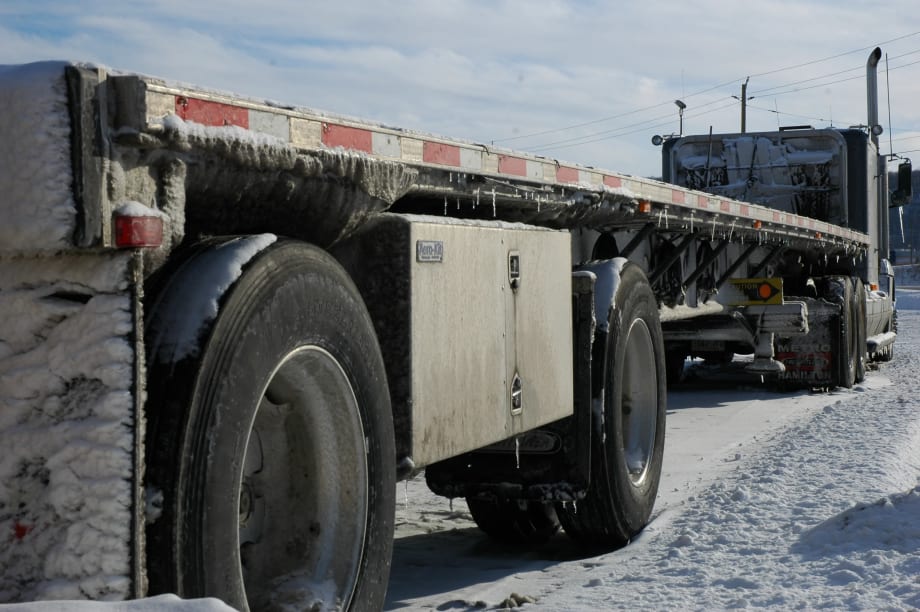
Big changes in ambient temperature will affect tire inflation pressure. (Photo by Jim Park)
Big changes in ambient temperature will affect tire inflation pressure. (Photo by Jim Park)
Here's one more reason to fear the dreaded Arctic Vortex: It plays havoc with tire pressure. If you're based in North Dakota and your trucks never travel too far south or west, there's hardly anything to worry about. San Diego-based fleets running up into the Midwest and the Dakotas or vice versa could have a problem.
This is nothing new.
French physicist Jacques Alexandre Cesar Charles concluded in 1787 that if the pressure of a gas remains constant, the volume of the gas will increase as the temperature increases. If the temperature decreases, the gas takes up less space. Succinctly expressed: V1/T1 = V2/T2.
In language we can understand, a given volume of air will expand or contract as its temperature increases or decreases. In truck tire terms, for every 10-degree change in air temperature, tire inflation pressure will change by 1-2 psi (up with higher temperatures and down with lower).
After this story appeared online, we were provided hard data taken from actual in-service tires that suggests the pressure differential due to a temperature change could be as much as 3 psi. Data accumulated by Aperia Technologies, Inc. in the course of field testing its soon-to-be-released passive tire inflation system, called Halo (watch for it sometime in March), found that a temperature drop from 65 degrees to 2 degrees Fahrenheit over two days produced an drop in inflation pressure of 15 psi.
"We saw pressures drop on our test tires from 110 psi to 95 psi as the ambient temperature dropped 63 degrees," says Ryan Holtan, director of Finance & Operations at Aperia. "That's a 2.4 psi drop for every 10 degrees."
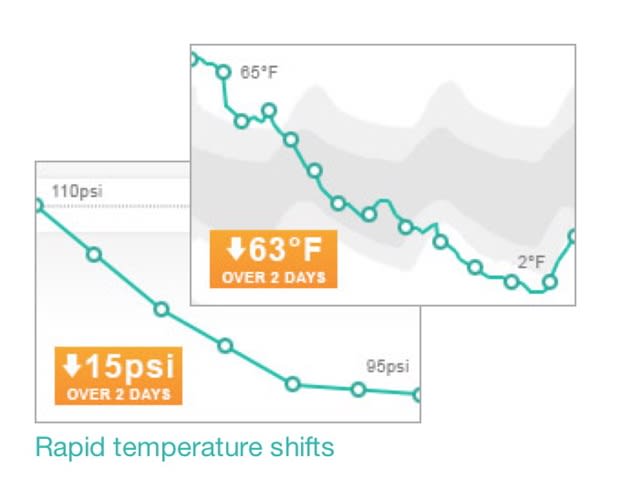
(Graphic courtesy of Aperia Technologies)
While the Aperia test tires started at 110 psi, imagine where you'd be if your tires were just 90 psi to begin with?
A tire that leaves San Diego at 100 psi at 70° F will likely be closer to 85 psi by the time it gets to Bismark, ND at 0°. (Or, following the recent findings from Aperia, the tires might be as low as 65 psi.) Conversely, a tire that leaves frigid Bismark at 100 psi could be pressured up to 125 psi a few days later upon arriving in balmy San Diego.
Is that something you need to worry about? Yes and no.
Tires perform a couple of functions. First, a tire is a containment device for a volume of air that supports the weight of the load. It's not the tire that holds up the load, but the air inside it. Second, the tread patch on the road is all that keeps your truck from sailing into the great beyond on the first corner in comes to. A mere 18 square feet or so of rubber is all that keeps you on the straight and narrow. Overinflating the tire dramatically can reduce the contact patch. Underinflating the tire can increase the contact patch, and more importantly for truckers, increase the rolling resistance of the tire.
Load and pressure
Tire manufacturers' Load & Inflation tables help users determine the ideal inflation pressure for a given load on a tire. They recommend inflating a tire for the maximum load a tire will carry. Generalizing a little, most of the inflation tables suggest inflating a drive or trailer tires to between 75 and 80 psi in order to support the individual tire load in a tandem axle group, or about 4,250 pounds.
Most fleets inflate drive and trailer tires to 100 psi. According to Peggy Fisher, president of Tire Stamp, this gives fleets a margin for error.
"Ask yourself, how good is your tire maintenance? Can I afford to lose a few psi without risking a tire failure? How many pressures do you want me to remember? she asks. "For those reasons and others it's simply safer and more convenient to run a higher pressure than what is absolutely required by the heaviest load you're likely to put on the axle and tire."
As well, there's limit to how much pressure you can run in a tire at its cold inflation state -- that is before the tire begins its day's work, not the ambient temperature. A tire's maximum inflation pressure can be found stamped onto the sidewall, and can vary from tire to tire. The rim will also have a maximum (not to exceed) inflation rating. If your cold inflation pressure in Bismark is 100 psi, it might be as high as 110 psi to 115 psi when you get to San Diego. Depending on the tire and the inflation pressure when you start, you could be getting close to the maximum.
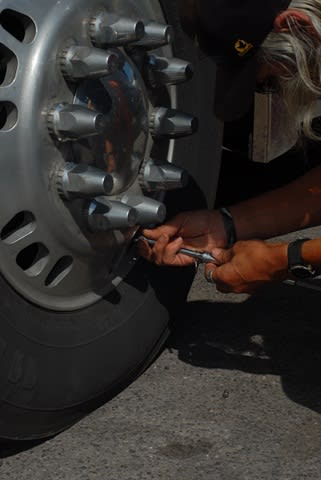
Drivers have a role in maintaining correct inflation pressure. Make sure they know the fleet's recommended inflation pressures. (Photo by Jim Park)
Fisher notes that while fleets running 100 or so psi in a dual tire are safely above the tires' maximum load limit as per the inflation tables, under-inflated really doesn't begin to affect tire condition until it drops below the load and inflation table recommendations for a given load. However, she notes, "Erring on the side of caution is standard industry practice. If my desired tire pressure was 100 psi, I'd be concerned it the tire was found below 90 psi."
That's all fine and dandy with drive and trailer tires where there is a buffer of about 20 psi between the recommended inflation pressure (75-80 psi) versus the 100 psi that most fleets use. It's more critical on steer tires.
Steer Tires and Temperature
On a fully loaded steer axle (12,000 pounds), each tire would be supporting a 6,000-pound load. To get that minimum inflation pressure, Goodyear's tables recommend 105 psi for a tire load of 6,225 pounds. Bridgestone, on the other hand, calls for 110 psi for a maximum tire load of 6,175 pounds.
If you're starting out in San Diego with 105 psi in your steer tires at 70 degrees Fahrenheit, your tires might be at 90 psi in Bismark. That would put you 15 psi underinflated, or looking at it another way, that tire could be overloaded by as much as 1,000 pounds depending on the tire size, as per the inflation tables.
Remember, it's not the tire that supports the load, but the air inside it. And as per Charles' Law, as the temperature decreases, so does the volume of air inside the tire. That causes a drop in pressure as well, which means the tire cannot support as much weight.
Where the Rubber Meets the Road
And now, finally, to the second reason we need to be cognizant of these temperature and pressure variations. The shape of the tread patch changes with fluctuations in temperature, which can lead to irregular tire wear and possibly changes in traction.
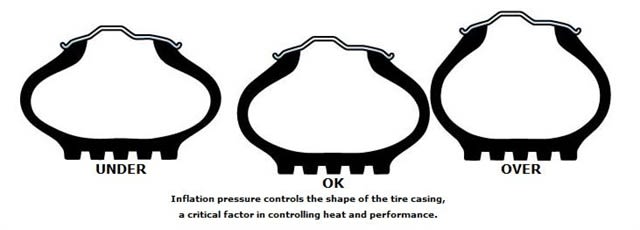
The shape of the casing and the tread contact patch change with inflation pressure -- and temperature. (image courtesy of Bridgestone)
Obviously you don't want to inhibit traction during the winter, and while the change will be minimal, it could be an issue on ice or hard packed snow. Conversely, a soft tire will place more tread on the road, increasing rolling resistance and possibly risking sidewall damage due to the increased flexing of the sidewall.
Neither situation is where you want to be.
Here's something else to consider. These scenarios assume you're starting out with ideal tire pressure. When was the last time you checked your tire pressure? We normally see a drop in temperature over the winter, even in places like Phoenix, Houston and San Diego. You may be running a deficit to begin with.
Bridgestone has a great article on this subject in its "Ask the Tire Doctor" archive called "Do We Need Altimeters and Thermometers to Set Tire Pressure?" It's well worth a read.
In the article, Bridgestone recommends adjusting tire pressure where extreme temperature variations exist.
" ... adjust to the correct inflation pressure when the tires are 'cold.' That’s because what you’re adjusting with inflation pressure is the shape of the tires. That doesn’t have as much to do with temperature. Inflation pressure controls the shape of the tire casing, a critical factor in controlling heat and performance. While temperature fluctuations can have a significant influence on inflation pressures, frequent checking and adjustment of inflation can cancel any negative effects."
Various tire pressure maintenance systems and some automatic tire inflation systems can monitor tire pressure and temperature in real time and in the case of the later, can deflate a tire that is over-pressured.
Drivers can also play a role in helping to maintain correct inflation pressure when temperatures fluctuate widely, if you can convince them to spend 30 minutes out in the cold with a tire gauge.
More Maintenance

Color Match Smarter: Tools That Restore & Perform
For fleet managers and collision repair professionals keeping heavy-duty trucks on the road, getting the color right the first time isn't just about appearance — it's about efficiency, turnaround time, and bottom-line results. Discover how today's digital color tools are transforming the repair process from guesswork to precision.
Read More →
Wrong Repair Prompts Recall of Freightliner, Western Star 4x2 Trucks
DTNA is recalling more than 2,400 trucks that received an incompatible software fix instead of the hardware repair required to address brake valve corrosion.
Read More →
Truck Drivers Need More Than Another Alert
Fleets have more visibility into truck health, safety events, and driver activity than ever. The next challenge is turning all that information into useful guidance for the person who has to decide what to do next.
Read More →
The Maintenance Checks Trucking Fleets Should Prioritize Before Fall Freight Picks Up
Making it through August isn’t the same as being ready for the next several months of operation. Find out what systems may have suffered from summer heat and need to be checked out before fall.
Read More →
What Three Fleets Are Doing Differently When Buying Truck Parts in 2026
With freight improving but costs still climbing, fleet maintenance executives explain how they're balancing price, quality, and supplier relationships.
Read More →
Paccar Recalls 2027 Trucks Built This Summer for Possible Electrical Problem
The nearly 6,000 Kenworth and Peterbilt trucks in the recall could potentially lose engine power, among other things.
Read More →
Will API PC-12 Oil Change Trucking Fleet Maintenance?
The new API PC-12 heavy-duty engine oil category reflects the changing demands of modern diesel engines. But fleets like Foodliner are looking to getting their own data before making decisions on adopting the new oils and questions such as extending oil drain intervals.
Read More →
Brake Safety Week to Focus on Drums and Rotors
Commercial vehicle inspectors are focusing on truck brakes during CVSA's Brake Safety Week, August 23-29.
Read More →Possible Battery-Cable Fires Prompt Recall of 15,000+ International MV and HV Trucks
On the recalled vehicles, manufacturing variations can cause the battery interconnect cable to contact the auxiliary stud and hold down the bracket.
Read More →
Rush, MCT Team Up to Grow Refrigeration Service Network
The joint venture will operate MCT's network of Carrier Transicold dealerships and mobile service locations, with the companies promising greater service capacity and uptime for refrigerated fleets.
Read More →