





Related:Economic Growth Ahead at Trend Level, Says Economist at Aftermarket Event
What Will Earnings Look Like for Fleets This Year?
With our 2019 economics and truck volume forecast in place, where should that take us in terms of earnings, and where are we in the course of the earnings cycle for truckers? Commentary from the February issue of Heavy Duty Trucking magazine.
February 1, 2019
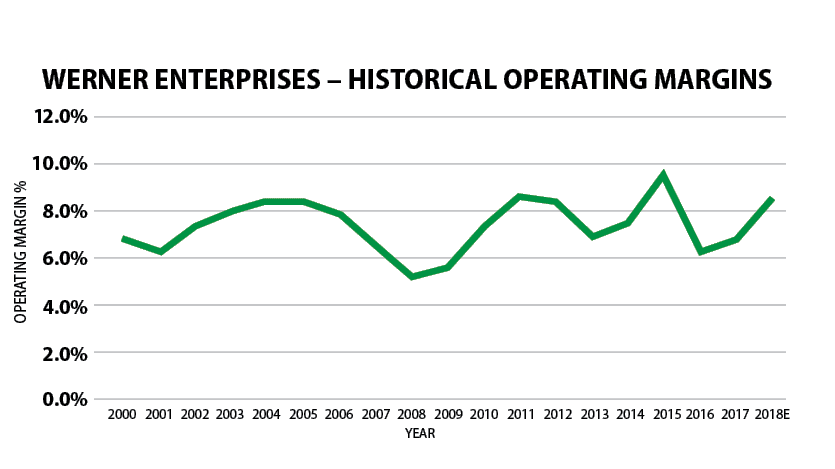
Since 2000, Werner’s operating margins have stayed in a consistent 6% to 9% range, with the majority of a cycle in the 6.5%-8.5% range.
Source: Company reports, Tahoe Ventures estimates
3 min to read
With our 2019 economics and truck volume forecast in place, where should that take us in terms of earnings, and where are we in the course of the earnings cycle for truckers?
Recent data has shown some slowing of economic growth. The Institute for Supply Management’s Purchasing Managers’ Index reported in January dropped to 54.1 from 59.3. Consumer confidence has slowed from a reading of 136.4 to 128.1. The three-month/10-year yield curve (which uses the difference between 10-year and three-month U.S. Treasury rates to calculate the probability of a recession) is currently around 35 basis points – almost flat. It’s normally about 200 basis points when healthy, and negative if the economy is at risk of recession.
Remember, in our forecast last month, we anticipated much of this “normalization” of growth expectations. While both the ISM and consumer confidence measures are sentiment indexes and do have predictive value, freight volumes and traffic continue to be strong. These lower readings could reflect concerns about stock market volatility and investor fears. As we noted last month, we expect the economy to slow to a more sustainable growth rate of around 2.5% GDP this year, where we spent much of the decade prior to 2016.
To explore the health of the trucking industry and what expectations are for 2019-2020, let’s look at where truck industry operator margins are right now, and where they might go. To simplify the analysis, let’s look at one large representative trucker – Werner Enterprises. Werner is a large truck fleet with about 7,800 trucks. It historically has grown organically, so acquisition-related costs don’t tend to cloud comparisons, and the company tends to be fairly consistent in terms of its margins over the course of a cycle.
Since 2000, Werner’s operating margins have stayed in a consistent 6% to 9% range, with the majority of a cycle in the 6.5%-8.5% range. Analyst expectations point toward an 8.6% operating profit margin for this year. (We look at margins all-in with fuel surcharges, versus the company’s reported results, which exclude fuel surcharges in calculating operating margins). Based on our expectations for a 3.5% truck freight growth level in 2019, and our expectations that the industry adds about 3% net capacity, we are looking for truck rates to be 2-3% higher by the end of 2019 than they were at the end of 2018. And they could even see an average for the year closer to 4%-5%, because we expect contract rates to begin the year in the 8-10% range. This would imply 6-8% revenue growth (the consensus of Wall Street analysts is 6.9%).
With all that in mind, and with declining fuel prices (the Energy Information Administration’s weekly on-highway diesel price index declined to $3.013/gallon for the week of Jan. 7), truck margins should be stronger for Werner in 2019. In fact, that is what Wall Street analysts are forecasting for Werner, according to Factset, which projects a 50 basis point (half a percentage point) improvement in Werner’s operating margin, implying an operating profit margin over 9% – the high end of the company’s historical range.
What does all this mean for fleet managers? While we expect some moderation in equipment orders because much of the order book for 2019 is filled, and uncertainty has increased regarding 2020 growth expectations, profit margins in the trucking industry should be healthy – near prior cycle peak levels. That means fleets should be a position to support continued buying of equipment, at least in the first part of the year. We look for truck OEMs to begin to enforce penalties for cancellations soon, which could thin out some of the order book as well.
Jeff Kauffman has been a recognized transportation authority for almost 30 years, most notably heading freight transportation research for Merrill Lynch. Currently he is managing director for Loop Capital Markets and also heads Tahoe Ventures, a transportation consulting company. He can be reached at jkauffman@truckinginfo.com.
Subscribe to Our Newsletter
More Fleet Management

Why Private Fleets Are Taking More Freight
Private fleets are putting their own trucks on demanding customers and high-cost lanes as companies seek greater control over service, costs, and capacity.
Read More →
Sponsored•September 16, 2026
Color Match Smarter: Tools That Restore & Perform
For fleet managers and collision repair professionals keeping heavy-duty trucks on the road, getting the color right the first time isn't just about appearance — it's about efficiency, turnaround time, and bottom-line results. Discover how today's digital color tools are transforming the repair process from guesswork to precision.
Read More →
FMCSA Pauses Biennial-Update Enforcement Amid Motus Transition
Carriers whose updates were due on or after June 1 have more time, while FMCSA works to stabilize its new registration system and warns of phishing sites impersonating its new carrier registration system, Motus.
Read More →


Sponsored•September 14, 2026
2026 Blueprint for Countering Smarter Supply Chain Theft
Cargo theft is no longer just the cost of doing business. It's a multi-billion-dollar criminal enterprise exploiting vulnerabilities across your fleet, drivers, and supply chain.
Read More →
Sponsored•September 1, 2026
How Telematics Improves Visibility, Control, and Performance in Refrigerated Fleets
Explore how telematics help refrigerated fleets improve visibility, uptime, efficiency, compliance, and cargo protection across connected cold chain operations.
Read More →
What the U.S.-Canada Trade War Means for Trucking
Escalating U.S.-Canada tariffs could disrupt cross-border freight, reduce truck volumes, raise costs, and create new uncertainty for carriers on both sides of the border.
Read More →
What Are Trucking’s Top Concerns for 2026?
The American Transportation Research Institute wants to know what's worrying trucking fleet managers, drivers, and other stakeholders in its annual Industry Issues survey.
Read More →
American Trucking Associations Looks for a New Leader
ATA President and CEO Chris Spear abruptly left his job at the association on August 21, at a pivotal time for the trucking industry.
Read More →
Public Wi-Fi Cybersecurity Risks: How Truck Drivers and Fleets Can Protect Their Data
Public Wi-Fi can expose truck drivers and fleets to credential theft, malware, and other cyber threats. Here’s how to reduce the risk on the road.
Read More →
For Nicky Cupp, Fleet Innovation Starts With Frustration
HDT Truck Fleet Innovator Nicky Cupp turns everyday pain points at Fraley & Schilling into opportunities for better technology and smarter processes.
Read More →