





Related: Challenging (Not Necessarily Bad) Year Predicted for Trucking Activity
Economic Growth Ahead at Trend Level, Says Economist at Aftermarket Event
Bill Strauss, senior economist and economic advisor at Federal Reserve Bank of Chicago, told aftermarket suppliers that the U.S. economy is likely to keep expanding the next couple of years, albeit at a more-typical pace.
January 31, 2019
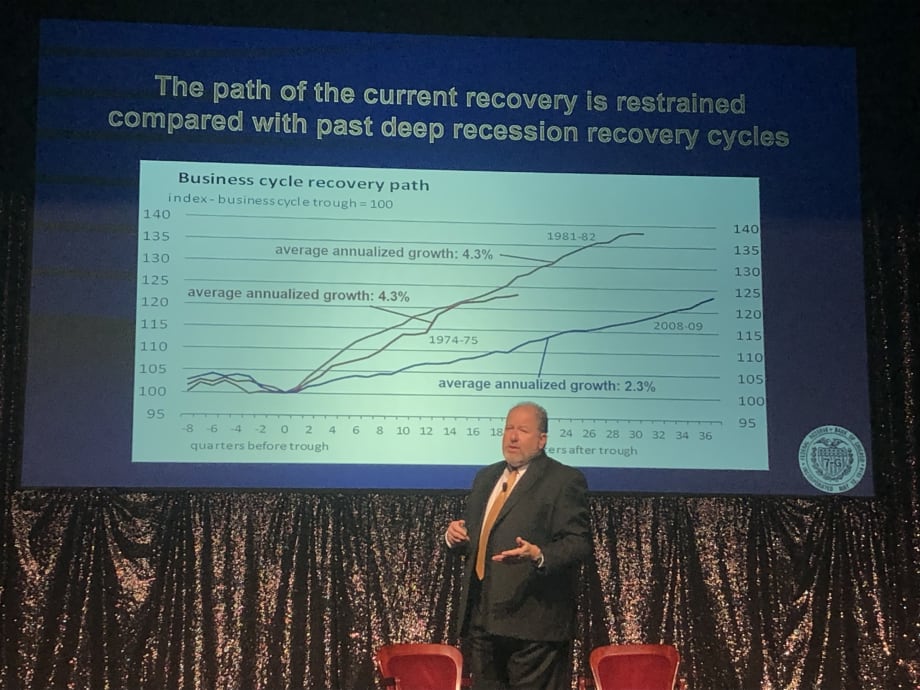
Slow and steady: The economic recovery may have been more restrained than historically, but it's also on its way to setting a record for the longest economic expansion in the country's history.
Photo by John G. Smith (courtesy Today's Trucking)
3 min to read
If Bill Strauss, senior economist and economic advisor at Federal Reserve Bank of Chicago, is correct, the U.S. economy will keep expanding the next couple of years, albeit at a more-typical pace.
Speaking at Heavy Duty Aftermarket Dialogue in Las Vegas Jan. 28, Strauss said the economy should expand at a pace somewhat above trend in 2019 and be at around trend in both 2020 and 2021. In addition, he said, Blue Chip, a group of 50 non-federal economists, also expects a slowing path for economic growth over the next two years.
Strauss reviewed what happened in 2018:
Gross Domestic Product expanded by 3% over 2017.
Employment levels increased by more than 2.6 million jobs in 2018
Unemployment has fallen to 3.9%. For 2019, Blue Chip anticipates unemployment edging down in 2019, but going higher in 2020, but still remaining below 4%.
Wages and benefits are increasing at a very slow rate, but Strauss believes that may be changing and that there will be a pick up on both wages and benefits.
The Blue Chip forecast projects a continuing deterioration in the balance of trade.
He said the impressive 3% growth in 2018 was the result of “the sugar high” from tax reform. In fact. this expansion period has lasted 9.5 years so far, and Strauss says if the economy continues to expand through the middle of the year, we will set a new record for the longest expansion.
Strauss explained that the path of the current recovery is restrained when compared to the deep recession recovery cycles of the past.
He also believes that the probability of a recession is the next six months has eased. He explained that economies do not just run out of steam, but rather, “you get a negative economic shock that causes people to forestall making investment or making a purchase.”
Given the recent volatility of the stock market, Strauss spent a few minutes explaining why economists care about what happens in the stock market. “It is a forward indicator. You buy a stock because of its future value.” He added that the stock market is an over-predictor of recession, so is not the best indicator of when one will occur.
Other things Strauss expects to see this year and beyond include:
Employment will rise moderately and the unemployment rate will continue to remain low through 2021. Unemployment numbers have not been this low since 1969. “Unemployment will remain low through 2021 at below 4%,” he said. In addition, business will be bidding for the talent they need and we will see wages rising.
Inflation will be at the Federal Reserve’s inflation target of 2% through 2021. The Blue Chip says inflation will remain flat too.
Vehicle sales are expected to be lower this year and into 2020.
Trucking activity should remain solid.
Manufacturing output is expected to increase at a slower pace.
There will be a gradual recovery in the housing sector.
Industrial production is forecast to rise at a slower pace this year and moderate further in 2020.
The Federal Funds Rate is expected to be at the top of the neutral range by the end of the year and then move slightly above neutral in 2020 and 2021.
In essence, Strauss said he is looking at a very decent year, with no real risk for U.S. economy, and he next year at HDAD he expects to be celebrating the fact that we have had a record number of years of expansion.
Looking out further, Strauss said 2020 could be suggestive of the economy going into recession. “But I am not saying at the end of 2020 that we will see the wheels of cart fall off.”
More Fleet Management

Kodiak Lines Up Fleets for Driverless Trucking
An agreement for 75 trucks, a new Texas freight lane, and progress on safety validation move Kodiak closer to its planned driverless highway launch.
Read More →
ITS Logistics Settles Religious Harassment Case
The Nevada-based logistics firm agreed to pay more than $396,000 to settle a religious harassment charge involving an employee's Jewish identity.
Read More →
Your Trucks Are Busy. That Doesn’t Mean They’re Winning.
High utilization doesn’t always mean strong margins. Looking beyond the current load can help fleets make better dispatch decisions and get more value from each truck’s time.
Read More →
Why This Trucking Recovery Is Different
Freight demand remains sluggish, but rising costs and tougher enforcement have taken enough capacity out of the market to change the outlook for motor carriers.
Read More →
Platform Science Adds Dispatch and Safety Tools
Four additions to PS Fleet help fleets monitor loads, manage driver coaching, share truck locations and adjust video system settings.
Read More →
PrePass Intelligence Mines Fleet Bypass, Toll and Safety Data
PrePass Intelligence helps fleets measure bypass savings, flag potential toll overcharges, and spot suspicious transactions by combining data from separate systems.
Read More →
Motive Adds AI Agents for Fleet Operations
New tools automate follow-up on fleet data, from maintenance work orders to driver alerts, with two-way voice conversations planned for later this year.
Read More →
Can You Beat Our Trucking Trivia Challenge?
Test your truck knowledge with 19 trivia questions from Heavy Duty Trucking Exchange. Can you keep up with the fleet pros?
Read More →
BeyondTrucks Adds Rules Checks to Dispatch
New Compatibility Engine checks driver qualifications, equipment requirements and fleet policies before loads are dispatched.
Read More →
Diesel Prices Hijack Trucking’s Worry List
ATRI’s annual survey finds cautious optimism about freight, but diesel costs, litigation, and insurance continue to squeeze fleets. Drivers have different priorities on several issues.
Read More →