




What Happens to Trucking When Interest Rates (Finally) Rise?
One day the Federal Reserve will raise interest rates – perhaps as early as this fall. But what will this mean for trucking?

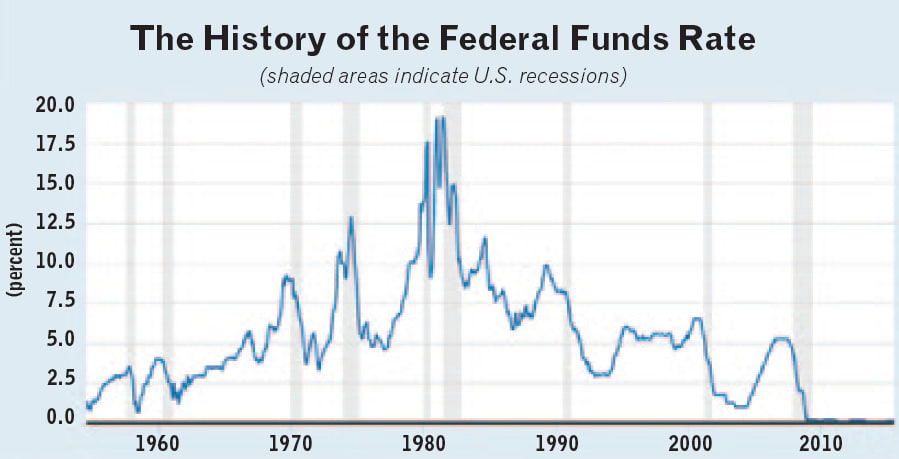
Source: Federal Reserve Bank of St. Louis
Source: Federal Reserve Bank of St. Louis
It didn’t happen in September, but one day the Federal Reserve will raise interest rates – perhaps as early as this fall, with Federal Reserve Chair Janet Yellen saying in a late September speech that a rate hike “sometime this year” would likely be appropriate.
But what will this mean for trucking?
We’re talking about the Federal Funds Rate, the rate banks charge each other to borrow money overnight. This essentially sets the basis for all other borrowing across the country, and is currently between 0% and 0.25%.
A single, isolated rate increase would have little impact on trucking, according to Jim Meil, industry analysis at the commercial vehicle analysis firm ACT Research and former chief economist with Eaton. The focus is what will follow the first rate hike in nearly a decade.
“The pattern in the past has been for the Federal Reserve to launch a series of rate increases, usually to combat inflation,” he says. “This would raise the cost of capital” – the interest rates used in borrowing money to fund new equipment and facilities.
Typically, this means a quarter point increase here and maybe even a half percent jump there, rather than all at once.
“Too many interest rate hikes in an already slow economy will roll over freight markets and damage fleet finances faster than would occur in a healthier economic environment where freight growth and trucker profitability were strong,” says Kenny Vieth, ACT senior partner and general manager.
Vieth believes just a 1% cumulative increase could spell trouble for some. “There is a tendency, when rates rise, for banks to constrain extending loans to smaller, riskier, less credit-worthy and less financially stable trucking companies.”
Higher interest rates also affect other economic sectors that either generate freight movements or are direct users of trucks, including construction, manufacturing and retail and wholesale trade. Additionally, big-ticket consumer purchases, such as autos, are affected by rate hikes.
But this doesn’t mean interest rates increases are all bad.
“While this could cause a small bump in the road, it will also help the economy get on track for a more sustainable and robust recovery, which in the long term will be a good thing for the industry,” says Sandeep Kar, global vice president of automotive and transportation researcher for market researcher and consultancy firm Frost & Sullivan.
He said smart carriers have been benefiting from cheaper capital, driven by low interest, for quite a while, and they know higher interest rates are on the horizon.
Ultimately, the Fed does need to put some daylight between monetary policy and 0%, Veith says, so the next time the economy goes south there is some ammunition for the Fed’s monetary policy cannon.
“Sometimes we need to remind ourselves that zero interest rates are supposed to represent ‘extraordinary’ policy,” he says. “But the Fed is quite aware that it has now been in place for seven years, risking that it becomes ‘everyday’ policy.”
More Fleet Management

Color Match Smarter: Tools That Restore & Perform
For fleet managers and collision repair professionals keeping heavy-duty trucks on the road, getting the color right the first time isn't just about appearance — it's about efficiency, turnaround time, and bottom-line results. Discover how today's digital color tools are transforming the repair process from guesswork to precision.
Read More →
FMCSA Pauses Biennial-Update Enforcement Amid Motus Transition
Carriers whose updates were due on or after June 1 have more time, while FMCSA works to stabilize its new registration system and warns of phishing sites impersonating its new carrier registration system, Motus.
Read More →
2026 Blueprint for Countering Smarter Supply Chain Theft
Cargo theft is no longer just the cost of doing business. It's a multi-billion-dollar criminal enterprise exploiting vulnerabilities across your fleet, drivers, and supply chain.
Read More →


How Telematics Improves Visibility, Control, and Performance in Refrigerated Fleets
Explore how telematics help refrigerated fleets improve visibility, uptime, efficiency, compliance, and cargo protection across connected cold chain operations.
Read More →
What the U.S.-Canada Trade War Means for Trucking
Escalating U.S.-Canada tariffs could disrupt cross-border freight, reduce truck volumes, raise costs, and create new uncertainty for carriers on both sides of the border.
Read More →
What Are Trucking’s Top Concerns for 2026?
The American Transportation Research Institute wants to know what's worrying trucking fleet managers, drivers, and other stakeholders in its annual Industry Issues survey.
Read More →
American Trucking Associations Looks for a New Leader
ATA President and CEO Chris Spear abruptly left his job at the association on August 21, at a pivotal time for the trucking industry.
Read More →
Public Wi-Fi Cybersecurity Risks: How Truck Drivers and Fleets Can Protect Their Data
Public Wi-Fi can expose truck drivers and fleets to credential theft, malware, and other cyber threats. Here’s how to reduce the risk on the road.
Read More →
For Nicky Cupp, Fleet Innovation Starts With Frustration
HDT Truck Fleet Innovator Nicky Cupp turns everyday pain points at Fraley & Schilling into opportunities for better technology and smarter processes.
Read More →
Adam Buttgenbach’s Approach to Electric Trucks: Start With Where They Fit
HDT Truck Fleet Innovator Adam Buttgenbach helped PepsiCo build one of North America’s largest EV fleets by focusing on where electric trucks make operational sense.
Read More →