




What Data Mining Can Teach You About Your Fleet
Fleet managers can learn new things about their operations by analyzing everything from accidents to wait times.



Operations managers at Averitt Express of Cookeville, Tenn., sat up and took notice when they learned a surprising fact after they began analyzing their driver retention data a few years ago.
“We were finding that drivers with an accident, regardless of the severity, were three times more likely to leave us than any other driver,” says David Broyles, truckload operations manager. “We couldn’t figure out why, so we looked at the process.”
They discovered that a driver who had an accident was getting a canned message over the mobile communications system, informing the driver he/she had lost X number of points and had three days to appeal by calling a number.
“We were being very impersonal,” Broyles says.
They changed their policy, so after an accident, the driver manager called the driver and went over what the review team had found, reassuring the driver he or she had a chance to improve. After one year, the likelihood of a driver in an accident leaving dropped to less than two times that of other drivers.
Southeastern Freight Lines, Lexingon, S.C., uses data analytics to evaluate pickup and delivery routes, according to Braxton Vick, senior vice president corporate planning and development.
The company began looking at customer-specific data. “We are able to tell exactly what our pickup and delivery costs are at each specific account.”
If they identify a customer that takes a lot of time, they can go to that customer and try to figure out a solution. “All this information coming in allows us to properly cost our freight and to reduce loading and unloading times at some customers.”
These are just two examples of how fleets can learn things they didn’t know by mining and analyzing the data from their own databases. While Averitt is using predictive modeling to improve safety and driver performance and Southeastern is improving its routes, other companies are using these techniques to improve operational efficiencies, maintenance practices and customer service.
Analytics & data mining defined
Jonathon Durkee, vice president product marketing of Fleetmatics, offers three levels of how businesses make use of the data they collect.
1. Classic business intelligence: charts, graphs, tables and reports marking certain performance indicators over time.
2. Data mining, where “you apply some advanced analytical/statistical techniques to the data to unlock additional insight for a customer from their data.”
3. “Big data,” or looking at data from across industries to find patterns.
Data mining can refer to “two somewhat different things,” according to Steve Pembridge, data architect with TMW Systems’ optimization group. There is the technical discipline of creating statistical tools that comb through very large datasets looking for patterns that might not be apparent. Government entities and large companies with large consumer profiles might use these kinds of techniques.
A more general meaning, which most fleet managers are talking about, is exploring the data a company collects to learn more about what the business looks like. “There are lots of sources of data, and one of the things about data mining is to get a big chunk of data and explore it,” Pemridge says.
Fleets generate a lot of data, but “data doesn’t give you information,” says Josh Botnen, product manager with DriveCam. “Fleets don’t necessarily want more data, they want the ability to extract more insight. They want to find that gold nugget of information that helps make the decisions that need to be made.”
Where do you find the data?
Before you can unearth a golden nugget or two of information, you need data. For most fleets, that means “looking at every piece of data from every system, from everyone who has access to a computer to do their job,” says Ken Weinberg, vice president Carrier Logistics Inc.
“In terms of all of the data we are collecting, you are looking at the entire scope from planning to fleet telematics to work order management,” says Mark Wallin, vice president product marketing with Telogis.
Fleets have put a lot of technology in place, and “one of the things that technology does very well is collect a lot of data,” Pembridge says.
Fleets have enormous amounts of trip data available from their trucking management and maintenance systems, plus information from any mobile communication systems they use, such as GPS, speed and engine data. Add to that data from any on-board sensors such as cargo temperature monitors, tire pressure monitors, safety devices, etc., and there is plenty of data.
“You need a rich set of data” for analysis purposes, and telematics provides that, Durkee says. “Of course data mining was around before telematics, but for a lot of companies telematics provided their first glimpse.”
For predictive modeling, the data needs extend even further. Averitt began using predictive models from Fleet Risk Management to better identify drivers likely to have an accident. The models look at all operational data the company collects, plus much more. “Fleet Risk uses all the data we have available on drivers,” Broyles says. “Everything from W2s to driving history, information from the Tenstreet automated recruiting tool, to sleep patterns.”
In order to extract useful information from a database, you have to have useful data to work with.
Automate as much of your data collection process as possible. A logical question to ask: Is it worth spending money on clerical people to input data so I can analyze it?
“If you have good technology, say you’re using handhelds to collect delivery data, barcodes to track shipments, the data is automatically stored as part of the work flow,” says Ben Wiesen, vice president of products and services with Carrier Logistics. “Make sure there is only one version of the truth in the data.”
Thomas Fansler, president of Vusion, a division of PeopleNet, said he likes to say, “love your data and it will love you.”
Making sense of it all
For most fleets, getting data is not a problem. Organizing it in a meaningful way is. That’s where transportation management systems, fleet management and mobile communications systems come in.
Fleets can collect a “myriad of information,” says Angela Shue, vice president sales with Cadec. “But the conundrum for them becomes: ‘What do I do with the information? How do I tie it together and create meaningful actionable items that I can use to improve overall efficiency?’”
“Telematics can give you a lot of information, but it’s pretty raw,” Durkee says. Telematics systems transmit snapshots in time or “rollups of information collected since the last transmission. The analytic services telematics providers offer is to take those messages, those individual bits and paint a picture of something a little more digestible.”
Shue says providers such as Cadec consolidate the data a fleet collects in data warehouses, which brings information from various sources into one place for analysis.
These types of companies can give the typical business person the capability to analyze and make sense of their data.
You don’t know what you don’t know
In a nutshell, data mining “is extracting information from a database to create new information you didn’t already know,” Wiesen says. The first step is to collect all the data you can.
While there is some concern about being overwhelmed with data, managers should not restrict the data they collect. “One of the characteristics of data mining is that a lot of times, we don’t know what we don’t know,” Pembridge says. For instance, one of the biggest questions in trucking is how to find, recruit and retain good drivers.
“It’s a big problem for companies, and I’m not aware of anyone who has found an answer to those questions. I would not want to restrict the data I look at, because we might find the answer in some unexpected places.”
For Averitt Express, that means collecting driver retention data. Broyles says the company is considering adding a retention module to the predictive modeling tools. “Since we have our own school, we feel there is enough data out there to help us know which type of students will be the best hire.” By automating many of the recruiting and retention processes, it adds more data, he said. “The more you have in your database, the better your models will be.”
More Fleet Management

How MFA Helps Protect Trucking Fleets
Multi-factor authentication adds protection when passwords are stolen. Here’s how it works and where fleets should start.
Read More →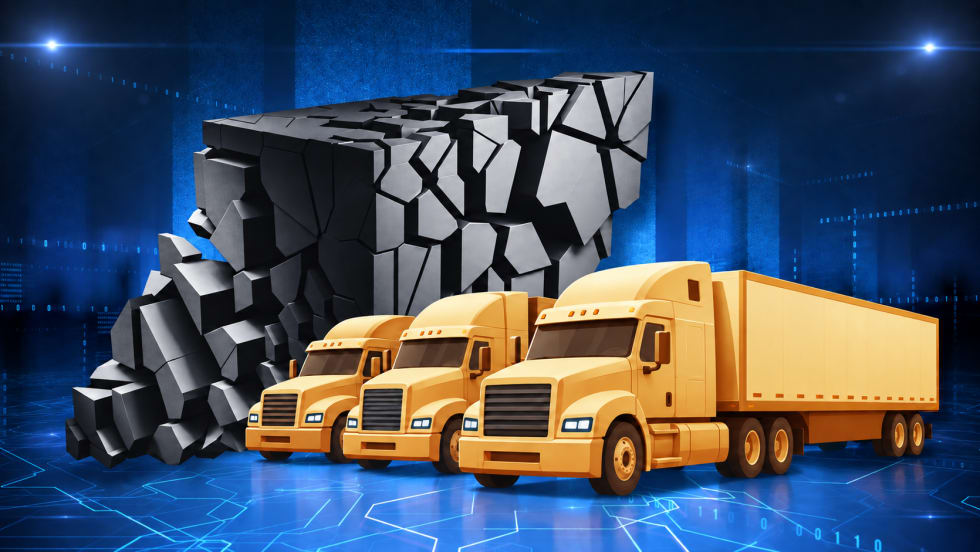
How Better Freight Data Helps Trucking Teams Get Ahead of Disruption
Trucking and logistics teams have plenty of data. The problem is getting the right information in front of the right people soon enough to act. Better-connected data can help teams spot trouble earlier and make smarter decisions before small problems become big ones.
Read More →
Trimble: Taking Artificial Intelligence in Trucking Beyond Faster Tasks
At Insight 2026, Trimble executives argued that fleets may need to redesign workflows to get more from AI as it introduced new products and enhancements. AI’s value will depend on how fleets combine automation with their people's knowledge.
Read More →
Build a bulletproof fleet: Uniting ELDs and dash cams for total compliance
An ELD can prove compliance, but it cannot always prove what happened on the road. Discover how uniting accurate ELD data with AI-powered dash cam video can help your fleet strengthen compliance, defend against liability, protect drivers and reduce operational costs.
Read More →
Nominations Open for HDT Emerging Leaders
Heavy Duty Trucking is looking for accomplished trucking fleet professionals under 40 who are making an impact and helping lead the industry forward.
Read More →
Why Private Fleets Are Taking More Freight
Private fleets are putting their own trucks on demanding customers and high-cost lanes as companies seek greater control over service, costs, and capacity.
Read More →
Color Match Smarter: Tools That Restore & Perform
For fleet managers and collision repair professionals keeping heavy-duty trucks on the road, getting the color right the first time isn't just about appearance — it's about efficiency, turnaround time, and bottom-line results. Discover how today's digital color tools are transforming the repair process from guesswork to precision.
Read More →
FMCSA Pauses Biennial-Update Enforcement Amid Motus Transition
Carriers whose updates were due on or after June 1 have more time, while FMCSA works to stabilize its new registration system and warns of phishing sites impersonating its new carrier registration system, Motus.
Read More →
2026 Blueprint for Countering Smarter Supply Chain Theft
Cargo theft is no longer just the cost of doing business. It's a multi-billion-dollar criminal enterprise exploiting vulnerabilities across your fleet, drivers, and supply chain.
Read More →
What the U.S.-Canada Trade War Means for Trucking
Escalating U.S.-Canada tariffs could disrupt cross-border freight, reduce truck volumes, raise costs, and create new uncertainty for carriers on both sides of the border.
Read More →