Test Drive: Western Star’s Head-Turning Workhorse Hits the Highway
More than a new truck, the Western Star 49X signals a new way forward for Daimler’s vocational lineup. HDT Senior Editor Jack Roberts gets behind the wheel on and off the pavement in this test drive.
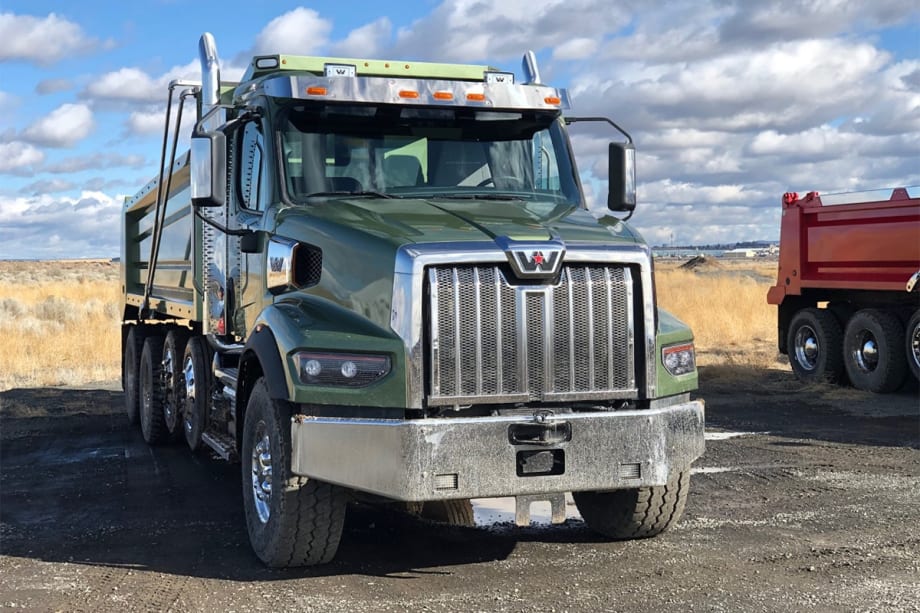
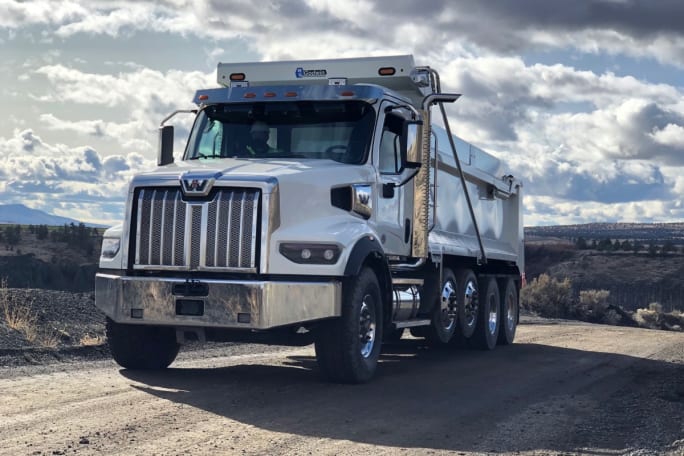
Western Star’s new 49X Class 8 truck showcases DTNA’s vision for a new take on its vocational product line.
Photo: Jack Roberts
8 min to read
Daimler executives weren’t happy.
Ad Loading...
You’d think they would be, given that the company’s North American trucks division is riding a Class 8 on-highway market share wave that would be the envy of any global corporation.
But market share domination comes at a cost. And in the case of Daimler Trucks North America, that price was, in the words of one engineer, an unacceptable showing in the vocational side of the Class 8 market.
Ad Loading...
“Our goal is to be the market share leader in the North American trucking industry,” says Tim Piete, lead engineer, DTNA. “And to do that, it was clear that we needed to up our vocational game considerably.”
The result, announced in late September, is the all-new Western Star 49X Class 8 vocational truck – a truck that Piete, who served as the lead design engineer on the six-year project, says is a major step forward in terms of how DTNA will approach the North American vocational truck market in the future.
“We will be bringing a lot of the lessons we’ve learned from our hugely successful on-highway side of the business to our vocational products. This will include major technology upgrades on our vocational trucks, including enhanced Level 2 autonomous vehicle systems and our Detroit Assurance active safety system as key tools to help enhance driver safety, jobsite safety, and fleet productivity.”
From the ground up, the new 49X was designed to make life easier for both fleets and the men and women who drive them. This includes high-tech new features such as the global debut of the DT12 Vocational Series automated transmission, the aforementioned addition of the Detroit Assurance Safety System, and a driver-friendly automated pre-trip inspection system to quickly and accurately confirm lighting on the vehicle.
But the 49X is also chock-full of more low-tech enhancements as well, reflecting the type of work these trucks will do in the real world. This includes a new, single-channel, splayed frame rail design, a new, safety-focused cab entry/egress system, an upfitter-friendly body design for easy wiring and hose routing, triple-sealed cab doors to keep heat and cool air in and water out, as well as a new optimized roof design that keeps the overall truck profile as low as possible while still providing plenty of headroom for drivers in hardhats getting into the cab.
Ad Loading...
Taken as a whole, the new 49X is a smart blend of cutting-edge new technology combined with common-sense design cues taken from decades of hard lessons learned on jobsites across North America. At DTNA’s Truck Proving Grounds outside of Madras, Oregon, in mid-November, I was able to take several examples of the new truck out on both on-road and off-road courses to see for myself what the company’s Class 8 vocational truck future looks like.
At the heart of the Western Star 49X is the all-new DT12 Vocational Series automated transmission, which is equally at home on an Interstate highway or powering its way up a steep quarry access road.
Photo: Jack Roberts
Safer, Simpler, and Stunning
Western Stars have always been statement trucks. Their appearance, styling and creature comforts have always been a key selling point for fleets that want a truck that works hard but stands apart from the crowd.
Knowing this, Western Star designers stuck with long-standing tradition and customer expectations when it came to the 49X’s exterior look. The truck has a solid, broad-shouldered stance that exudes confidence both standing still and rolling down the highway. And it’s a Western Star, so you know there’s chrome. Lots of chrome, in fact. The truck features a massive chrome grill with metal brightwork trim, as well as tasteful chrome accents on the side hood assembly and cab. All of this flashy trim is the icing on top of eye-popping paint schemes, including brilliant red and white palettes and a striking olive green that was my personal favorite. In short, the 49X is a truck that commands attention.
On the side of the cab, the metalwork has safety-focused purpose. Slips and falls are the second most common jobsite injury. Few mundane, repetitive tasks are as fraught with danger as climbing in and out of a muddy, wet truck cab on a crowded, noisy jobsite.
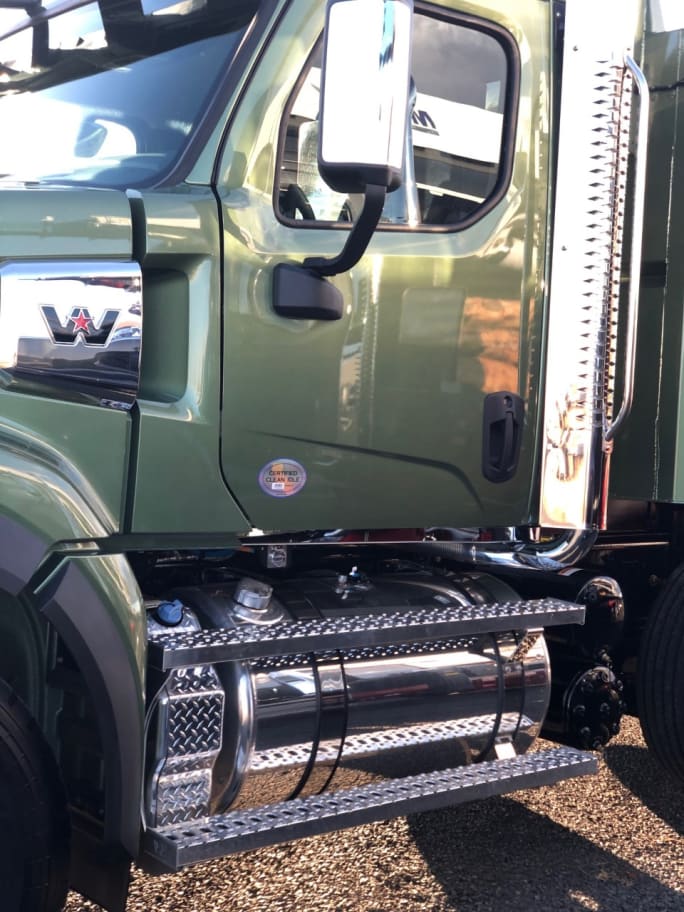
Understanding this, Western Star designers opted to move away from “ladder” style cab access, to a wider, more secure, “stairstep” cab entry and egress system. This elegant design flows seamlessly into the truck’s side profile and is bolstered by sturdy, reinforced handrails and grab-handles that extend all the way up to the rear-view mirror brackets. Those brackets, by the way, deliver an astonishing absence of vibration, even in off-road driving, and can double as grab-handles in a pinch. Even the map pockets at the base of each cab door feature an aluminum subframe capable of holding up to 300 pounds if needed. It’s not high tech, but it’s a change that drivers will appreciate. I know I (and my middle-aged knees) did.
Ad Loading...
Once I was up in the cab and settled behind the steering wheel, the 49X continued to impress. The cab is well-lit thanks to the massive front and side windows. According to Piete, Western Star moved away from a split front windshield to improve wiper performance in inclement weather. But the overall effect is downright cheery, thanks to all the sunlight streaming in, particularly if you’re in the day cab model with Western Star’s new three-piece rear window configuration behind you.
If you’re an old-school driver, you’ll probably notice the 49X’s vastly simplified dash layout and instrument cluster. In large part, Piete says, this is a natural evolution given the massive leaps in visual display systems and vehicle-driver interface technology over the past decade. Although the jumbo-jet-style array of endless dials, switches and gauges has been replaced by a much cleaner instrument display and dash layout, drivers will find the 49X information center to be nearly infinitely customizable. With a few simple clicks, they can easily select which gauges or readouts are most important to them and set them in a prioritized manner on the dash. The large rocker switches, down and to the right of the driver, are within safe, easy reach and can easily be manipulated, even with heavy work gloves on.
Not all the enhancements on the new 49X are high-tech. A new cab entry/egress system, for example, features large, wide, staircase style steps and ample handholds to make climbing in and out of the truck safer and simpler.
Photo: Jack Roberts
Help When You Need it. Full Control When You Don’t.
On the long oval track at the center of the Madras proving grounds, I found myself in a truck that feels utterly at home on the open road. Class 8 powertrains and truck cabs have been getting progressively quieter for years, and the gains made by all the truck makers and powertrain suppliers have been stunning. That said, the 49X may well be the quietest Class 8 truck I’ve ever driven. And that’s especially impressive given this is a vocational truck and not a long-haul highway tractor.
The lack of ambient noise, either from the road surface below or the powerful DD12 and DD16 diesels up front, is remarkable. And the truck handling characteristics are outstanding, both at cruise speed or when negotiating a jagged, muddy, gravel track.
Even with all that bright high desert sunshine streaming into the cab, the dash display on the 49X was crisp and clear enough to read at a quick glance. All the ergonomic steering wheel and seating adjustment controls are simple and accurate enough to get comfortable and ready to drive with minimum fuss.
Ad Loading...
Thanks to the modern Level 2 autonomous driver-assist systems on the 49X, the driver has a lot of help going down the road. But traditionalists need not fret. For the most part, these control systems work quietly behind the scenes, only stepping up when certain situations demand it.
That said, Western Star engineers also clearly understand that, at times, even the most well-intentioned ADAS features can become a distraction or even a safety threat in certain situations. That’s why they’ve given drivers a great deal of control over how, when, and where these systems come to life and lend a hand.
For example, every driver knows there are simply times that due to road conditions or other extenuating circumstances, you have no choice but to ride the center line on the highway. The last thing you want is to have your lane-keeping assistance system blaring warnings at you for something you’re doing on purpose. In that instance, Piete showed me how the driver can temporarily disengage that aspect of the Detroit Assurance system with a quick flip of a toggle switch. Doing so will disable the system for 15 minutes – or indefinitely if the truck stays under 51 mph to help drivers focus in construction zones or other constricted driving conditions.
And while we’re on the topic of technologies that may be new to vocational drivers, there are a ton of new features packed into the DT12 Vocational Series automated transmission. These systems, while simple to use, aren’t necessarily intuitive to initiate. Drivers will need to read the manual or get some coaching to get the most out of this remarkable gearbox. Still, this is a transmission that absolutely shines on both the pavement and in the mud. On the open road, the DT12 pulls as smoothly as any Cascadia I’ve driven. The integrated engine brake is a massive help rolling down a steep mountain grade with 125,000 pounds of construction machinery on the flatbed pushing hard on the steer axle. That same transmission can easily be put into “Rock Free” mode to give drivers complete control over the clutch and help a stuck 49X power its way out of even deep, muddy, jobsite potholes.
If DTNA was seeking to make a statement with the launch of the Western Star 49X, it seems they’ve accomplished its mission. This is as modern a Class 8 vocational work truck as there is on the planet today. Yet it still retains the styling cues and the sense of purpose that put a small, scrappy, West Coast Canadian truck-builder on the map decades ago. Without question, the 49X is a driver’s truck. But it’s also a smart and safe truck, which North American truck operators will find highly productive in even the toughest vocational applications.
Ad Loading...
Editor's Note: Corrected Nov. 17, 9:45 a.m. EST, with the correct name of the "Rock Free" transmission feature and correct autonomous technology level (Level 2)
Volvo’s updated D13 promises lower emissions without sacrificing performance or fuel economy. Take a closer look at what changed inside the engine in this HDT Spotlight video.
The Michelin X Multi Energy D2 is a regional haul drive tire engineered to help fleets improve fuel efficiency, durability and traction in demanding stop-and-go operations.
ZF is expanding its North American commercial-vehicle presence with new transmission applications, electrification, trailer technology and autonomous-driving systems.
Could Tesla’s camera-only autonomous driving technology work on an 80,000-pound Semi? In this commentary, HDT's Deborah Lockridge takes a look at Tesla, Cybercab, and how autonomous trucks see the road.
The U.S. Department of Transportation issued a new automated-vehicle strategy that outlines plans for driverless-truck regulations, cross-state freight corridors, and federal safety standards.
The Port Authority of New York and New Jersey announced millions in incentives for zero-emission drayage trucks, yard tractors, and new charging hubs near the port.
The National Highway Traffic Safety Administration says it lacks authority to regulate medium- and heavy-duty truck engines separately from complete vehicles, but the existing standards have not yet been eliminated.
Detroit isn’t starting from scratch to meet EPA 2027 diesel emissions standards. Its Gen 6 DD13 and DD15 engines keep much of today’s platform while updating the fuel and aftertreatment systems.