




We Try Out Latest Electric, Hybrid Models at Hybrid Truck Users Forum
The Hybrid Truck Users Forum's 10th annual meeting in late September in Dearborn, Mich., featured a ride and drive of electric and hybrid trucks

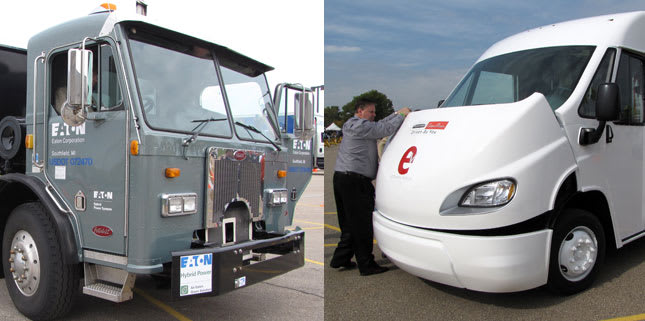
Ride and drive featured a Peterbilt 320 with Eaton's latest Hydraulic Launch Assist system (left), and all-electric walk-in van introduced by FCCC and Morgan Olson, right. (Photos by Tom Berg)
The Hybrid Truck Users Forum's 10th annual meeting in late September in Dearborn, Mich., featured a ride and drive of electric and hybrid trucks.
It began with a parade of about 40 demonstration trucks and buses through area streets and into a parking lot set aside for the event. They were made available for examination by attendees, and many could be driven or at least ridden in. Some, like electric-drive heavy road tractors, were intriguing, but not close to manufacture. Others, like Eaton Corp.'s diesel-electric hybrid system, have been in production by various truck builders for three to five years. And there were several trucks that included new and refined hybrid products.
FCCC-Morgan Olson MT-EV adds new style
Walk up to the "next-generation" all-electric walk-in van produced by Freightliner Custom Chassis Corp. and Morgan Olson and your eyes are grabbed by its bulbous nose and steeply sloped hood and windshield. Both are there to reduce air drag and cut energy use while the van is underway. Every bit of savings helps to extend the MT-EV's limited range - about 100 miles, according to FCCC. But that's enough for many inner city routes.
While it's sitting still, stair-like steps on the right side of the cab allow the driver to move out of the truck to make package deliveries and hop back in. This is what differentiates a walk-in van from panel-type cargo vans as far as the driver's concerned, and it's a real time saver. Electric propulsion from Enova sets this one apart from those powered by gasoline or diesel engines, or even hybrids using partly electric or hydraulic powertrains.
Further setting the MT-EV apart is that it's a designed- and made-in-the-USA electric truck. Competitors' e-vans, while assembled in the U.S., are based on European models, FCCC managers note.
Is the MT-EV better? It is in its walk-in setup (the steps in Navistar's eStar take up room in its body, while Smith's Newton is a low-cab-forward truck with an entirely separate body that the driver has to walk around to).
Does the MT-EV (for electric vehicle) drive better? Not that I could discern. It seems somewhat slower off the line than the others, which makes it less fun, but that's not the point of a delivery truck, is it? MT-EV is quiet except for a slight whine as it accelerates, and of course it emits no pollutants. And what happens on that score at the power plant that makes the energy that recharges the batteries overnight is the utility company's concern.
Its Morgan Olson body has about 700 cubic feet of volume, so it's smaller than some vans while larger than others. Entry into the body is through a center door from the cab, just as walk-in-van drivers are accustomed to. That's an advantage over having to get out and walk around to a rear or side door, and it's another thing that saves driver time on a multi-stop route. The more stops a route has, the more valuable the walk-in van becomes.
The more stops, the better for range, as well, because regenerative braking recharges the Tesla batteries under the floor. No electric vehicle should spend any appreciable amount of time on a freeway, because highway speeds quickly drain the batteries. Longer routes are better served by hybrid diesel-electric, straight diesel or gasoline engines, or natural gas power.
For those not into futuristic styling, FCCC already offers an all-electric chassis for more traditional bodies. As with the MT-EV, charging the batteries from a 220/240-volt circuit takes six to eight hours.
Eaton's 'blended' HLA adopted by Pete, CCC
Peterbilt Motors and Crane Carrier Corp. showed trash collection models fitted with an improved Eaton Hydraulic Launch Assist drive system. The HLA moved more smoothly off the line without the strong, kick-in-the-pants performance of early versions. And it does a better job of blending both types of braking - hydraulic regenerative and foundation - according to reps of both truck makers.
Compared to the prototype HLA that I drove two years ago at the Seattle HTUF meeting, the latest Peterbilt 320 with HLA takes off more slowly and smoothly. The HLA system now unleashes propulsion more gradually to save fuel but no longer will break axle differentials with 2,500 pounds-feet of right-now torque as that earlier system did in testing. Peterbilt has sold HLA-equipped 320s to a number of customers, including sanitation departments in Denver and Grand Rapids, so the concept is catching on.
CCC's version of the hydraulic hybrid was in one of its latest vehicles, the Low-Entry Tilt (LET) 2. As its name suggests, the cab's floor is just a step up from the pavement, the cab tilts forward for easy access to the powertrain, and this is its second version of the model.
The HLA in this chassis behaved the same - smoothly and unaggressively. The Cummins diesel seemed to work more often than I recall from other drives in trucks with HLAs, but there was no body and thus no load on the chassis, so regenerative braking wasn't as strong and hydraulic pressure didn't build as high.
New York City is testing several types of hybrid systems, including electric and hydraulic with straight diesel and natural-gas engines, in CCC chassis, It will later decide which type to standardize on.
The demo LET2 also had a new "60/40" Ridewell single-drive axle setup using a self-steering tag axle. This 6x2 system works with less tire scuffing in tight turns, like residential cul de sacs. But it doesn't have the traction of a twin-screw tandem, so is better assigned to routes where the trash is left at a transfer station rather than a landfill.
From the December 2010 issue of Heavy Duty Trucking magazine.
More Fuel Smarts

New California Law Could Shed Light on Electric Truck Prices
Why do battery-electric Class 8 trucks remain so expensive? A California bill signed by Gov. Gavin Newsom would give fleets and state agencies more visibility into what manufacturers charge.
Read More →
How Volvo Updated Its D13 for EPA 2027 [Watch]
Volvo’s updated D13 promises lower emissions without sacrificing performance or fuel economy. Take a closer look at what changed inside the engine in this HDT Spotlight video.
Read More →
Diesel Price Spike Shortens Payback for Natural Gas Trucks, Report Says
Energy Vision estimates fleets could recover the higher purchase price of an RNG-fueled Class 8 tractor in 1.3 to 2.8 years under current fuel-price scenarios.
Read More →

Calstart Becomes Catalyst Mobility, Reflecting Broader Focus
Calstart is now Catalyst Mobility, reflecting the nonprofit’s growing national role in clean transportation, including zero-emission trucks, infrastructure and incentive programs.
Read More →
Record Diesel Prices Squeeze Trucking Fleets
Average U.S. diesel prices have climbed to nearly $6 a gallon, surpassing the 2022 record as tight refinery capacity and Middle East disruptions keep fuel costs elevated.
Read More →
How Fuel Delivery Shapes Engine Performance
Fuel delivery depends on more than what happens at the injector. For fleet, maintenance and technical professionals, looking at the full path from pump to injector can provide useful context for understanding engine performance.
Read More →
East Coast Port Launches $45M Electric Truck Push
The Port Authority of New York and New Jersey announced millions in incentives for zero-emission drayage trucks, yard tractors, and new charging hubs near the port.
Read More →
Detroit Opens Orders for EPA 2027 Engines
Detroit isn’t starting from scratch to meet EPA 2027 diesel emissions standards. Its Gen 6 DD13 and DD15 engines keep much of today’s platform while updating the fuel and aftertreatment systems.
Read More →
Zero-Emission Truck Corridor Planned for West Coast
California, Oregon, Washington, British Columbia and Baja California are coordinating plans for truck charging and hydrogen fueling from Canada to Mexico.
Read More →
A Closer Look at Kenworth’s Electric T880E Vocational Truck [Video]
Learn more about Kenworth's T880E battery-electric vocational truck at the Paccar Technical Center, including its range, applications, upfitting considerations, and PTO options, in this HDT Spotlight video.
Read More →