





Dig Deeper: How Do Autonomous Trucks “See” the World?
Waymo to Test Freightliner Redundant Autonomous Truck on Texas Highways
Waymo said it it’s ready to begin publicly testing what it says is the first redundant autonomous Class 8 trucking platform on public freeways.
August 23, 2022

Look for the Freightliner Cascadia redundant truck platform with Waymo Driver in the next few weeks on Texas highways.
Photo: Waymo
6 min to read
Waymo said it it’s ready to begin publicly testing what it says is the first redundant autonomous Class 8 trucking platform on public freeways.
In 2020, Waymo partnered with Daimler Truck to develop a redundant, level-4-autonomous-ready truck platform powered by the Waymo Driver. In the coming weeks, the company will begin testing these autonomous Freightliner Cascadias on public freeways across Dallas and Phoenix. The testing will make use of Waymo's recently opened trucking facility in Dallas, a transfer hub that is an early endpoint of its driverless route. According to officials, it's the first custom-designed hub of this type designed for deploying autonomous trucks.
Waymo and Daimler Truck North America shared some insights with reporters in a virtual briefing Aug. 23, including the fact that these redundant systems will need more power and add some weight to the trucks.
Why Redundancy is a Must for Autonomous Trucks
While there are quite a few other self-driving-truck companies that are developing autonomous technology, Waymo and Daimler say every autonomous truck needs backup systems to ensure safe operation without a human behind the wheel. That’s going to be a must to deploy operations at scale, according to company officials.
“If you’re going to do anything with even remotely reasonable scale, this is something you have to address, so this partnership became absolutely critical,” said Boris Sofman, Waymo’s head of engineering for trucking.
“Daimler brings the technology, manufacturing, testing and validation capabilities that no autonomous-vehicle company out there has,” said Jason DiGrande, engineering lead for Waymo’s OEM program.
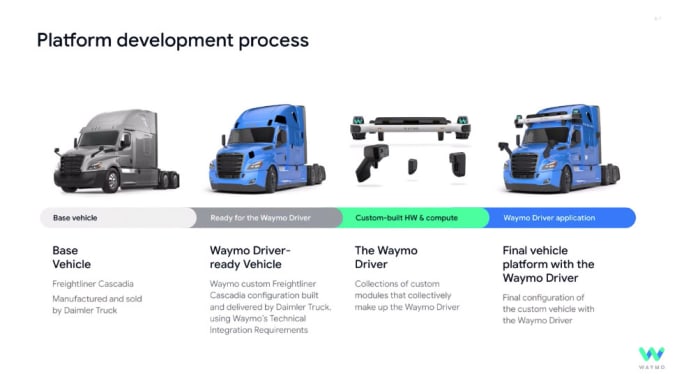
Waymo has been working with Daimler to develop a truck with redundant features to integrate with its autonomous Waymo Driver.
Photo: Waymo
To provide a truck ready for the Waymo Driver to be installed, Daimler Truck had to meet more than 1,500 Waymo Functional Requirements. Those affect both hardware and software, including:
Backup computing
Redundant power systems
Redundant steering
Redundant braking
Redundant inertial measurement systems for vehicle positioning
Cybersecurity
Fail-safe and fail-operational
Suman Narayanan, director of engineering at Daimler Truck North America, explained that “at Daimler truck globally, we’ve always relied on a playbook, a commercial vehicle development system. Our partnership with Waymo has given us a unique opportunity to evolve the process to accommodate emerging technology.
“We are developing a robust, realizable and scalable redundant vehicle platform.”
Redundant Systems
For instance, the truck has two electronic brake controllers to ensure brake performance in case the primary system fails. The steering system, similarly, has two servo motors allowing lateral control in case of an electronic or hydraulic failure.
High-speed redundant CAN bus communication provides uninterrupted, high-integrity, secure communications to the electronic control units needed. And there’s a redundant low-voltage power net that will store and provide power to critical ECUs (such as the braking and steering systems) if needed.
A new Electronic Park Brake gives the autonomous driving system the ability to apply and release truck and trailer park brakes with CAN signals. If there’s a malfunction, the system will use the electronic braking system to pneumatically activate the parking brake.
All those electronics and redundant systems require more power.
“One of the key things about [automated driving systems] is we’re all realizing the amount of power the computers and sensors need,” said DTNA’s Narayanan. “We needed to reinvent how we can generate the power for this system. We will generate more power at a higher voltage with a new 48V alternator, but the vehicle still remains at a 12V architecture.”
To compensate in case the alternator is no longer able to generate power, battery storage, monitored by individual battery monitoring sensors, has been increased by 50%.
“We understand the magnitude of what we have undertaken,” Narayanana said. “This is big. This requires us to tackle one challenge at a time. … we’re navigating through these challenges and tackling one step at a time.”

Waymo sensors monitor traffic around a truck on the Houston-to-Dallas route.
Photo: Waymo
The Waymo Driver
Even though cars and trucks have different driving characteristics, Waymo said its extensive experience in developing and deploying self-driving cars is a boon to autonomous truck development as well.
Using the same system for both allows the company to invest in developing solutions for unique challenges, such as the different vehicle dynamics and shape of the truck compared to cars.
Sensors are customized to deal with the shape of the truck. A combination of lidar, cameras and radar are meant to be redundant and complement each other, providing the Waymo Driver an overlapping “view” of the world around it.
There are two fifth-generation lidar sensors on the truck, plus additional lidar for near-range perception. Cameras can detect out to about a kilometer (1000 meters), allowing the Waymo Driver to preemptively be defensive, such as changing lanes for a vehicle stopped on a shoulder.

Fifth-generation lidar sensors.
Photo: Waymo
Next-generation radar is particularly effective dealing with weather conditions such as rain and fog.
In many cases, according to Waymo, the sensors and cameras can detect problems sooner than the human eye can, especially at night or in bad weather.
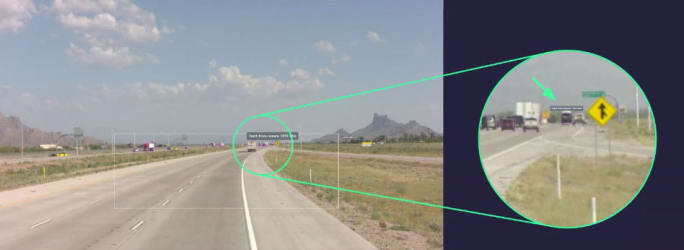
Waymo officials say its cameras and sensors sometimes can identify obstacles before a human driver.
Photo: Waymo
“This is our fifth-generation Waymo driver,” Sofman said, which has powered both its cars and its trucks. “We think of ourselves as building the driver, not the vehicle, and find partnerships like we have with Daimler.”
He pointed out that Waymo has trucks outfitted with the Waymo Driver operate every single day across the Dallas-to-Houston route and others, albeit with a safety driver behind the wheel. Generating a lot of miles on the road is critical to training the system so it knows what to do, whether faced with a common situation such as a car on the shoulder, or something more unusual like a barbecue grill falling out of the back of a pickup truck at 65 mph ahead of the truck.
“We have quite a repository of interesting examples,” Sofman said. “You have to be able to deal with these sort of choices.”
Daimler Truck North America’s High Desert Proving Grounds in Madras, Oregon, will play an important part in testing and validation of the autonomous-ready Cascadia.
Waymo’s DiGrande cited as an example “shaker testing,” simulated vibration test where four weeks of testing are equal to 1 million real world miles. “How’s everything going to hold up with the additional mass and weight we’re adding? That equals about 10 months of testing at the proving grounds.” And before deploying software onto the base vehicle, for steering, brakes, low voltage system, a series of electric test benches have been built to test them before deploying them on the truck.
Waymo's Path Forward
Waymo is looking ahead to the next steps in commercializing its autonomous Driver. Today, said Sofman, Waymo owns and operates a test fleet of Cascadia trucks, putting a lot of miles on the road, both for development and to make its safety case.
Waymo has been working with Daimler to develop a truck with redundant features to integrate with its autonomous Waymo Driver.
Photo: Waymo
“In parallel, we’re building relationships with customers that will run pilots, so we get to learn the operational best practices we need to be able to execute and learn how our product matches what customers expect.”
Next comes early fully autonomous deployment with no human driver in the cab.
“Then as we start to scale commercial deployment, we go from a Waymo-owned and -operated fleet to one where a customer would purchase a truck from Daimler that would have a Waymo Driver.”
Eventually, Sofman explained, with enough scale, the full build of the truck would happen at the Daimler factory, with Waymo supplying the Waymo Driver components.
“At the moment, the trucks we’ve built that will be hitting the road were built in our Waymo Detroit facility,” said DiGrande, with Freightliner shipping the Waymo-ready truck to its facility for installation of the Waymo Driver system.
Other partnerships include J.B. Hunt, Uber Freight, CH Robinson, and Ryder, which is helping to develop the “ecosystem” for these trucks.
Subscribe to Our Newsletter
More Equipment

How Volvo Updated Its D13 for EPA 2027 [Watch]
Volvo’s updated D13 promises lower emissions without sacrificing performance or fuel economy. Take a closer look at what changed inside the engine in this HDT Spotlight video.
Read More →
Michelin Tire Improves Efficiency and Durability for Regional Fleets
The Michelin X Multi Energy D2 is a regional haul drive tire engineered to help fleets improve fuel efficiency, durability and traction in demanding stop-and-go operations.
Read More →
ZF Expands Commercial Vehicle Push in North America
ZF is expanding its North American commercial-vehicle presence with new transmission applications, electrification, trailer technology and autonomous-driving systems.
Read More →
Tesla Wants a Self-Driving Semi. Are Cameras Enough?
Could Tesla’s camera-only autonomous driving technology work on an 80,000-pound Semi? In this commentary, HDT's Deborah Lockridge takes a look at Tesla, Cybercab, and how autonomous trucks see the road.
Read More →
Kodiak: Driverless Long-Haul Truck Launch on Track for 2026
Kodiak AI says its driverless long-haul safety case is 93% complete and it remains on track to begin commercial operations by year-end 2026.
Read More →
What DOT’s Automated Vehicle Strategy Means for Trucking
The U.S. Department of Transportation issued a new automated-vehicle strategy that outlines plans for driverless-truck regulations, cross-state freight corridors, and federal safety standards.
Read More →
East Coast Port Launches $45M Electric Truck Push
The Port Authority of New York and New Jersey announced millions in incentives for zero-emission drayage trucks, yard tractors, and new charging hubs near the port.
Read More →
PlusAI Going Public to Fund Autonomous Truck Launch
A SPAC deal could provide PlusAI with up to $300 million as it works toward a 2027 commercial launch of factory-built autonomous trucks.
Read More →
NHTSA Moves to Rewrite Truck Fuel-Economy Rules
The National Highway Traffic Safety Administration says it lacks authority to regulate medium- and heavy-duty truck engines separately from complete vehicles, but the existing standards have not yet been eliminated.
Read More →
Detroit Opens Orders for EPA 2027 Engines
Detroit isn’t starting from scratch to meet EPA 2027 diesel emissions standards. Its Gen 6 DD13 and DD15 engines keep much of today’s platform while updating the fuel and aftertreatment systems.
Read More →