




'Virtual' Vertical Integration?
Three weeks after the Mid-America Trucking Show, while I munch on very small, very rich chocolate eggs that were left on my desk by some generous rabbit, I find myself at the keyboard pondering a few things I learned and heard in Louisville. And one in particular
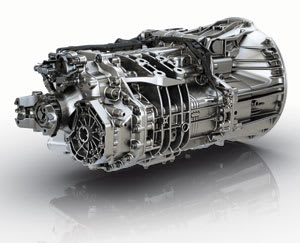
Can so-called virtual vertical integration work as well as vertical integration done with components all built by the same company, like this Detroit transmission, designed to work with Detroit engines and axles?
Three weeks after the Mid-America Trucking Show, while I munch on very small, very rich chocolate eggs that were left on my desk by some generous rabbit, I find myself at the keyboard pondering a few things I learned and heard in Louisville. And one in particular.
The festivities began, as usual, with a very fine dinner hosted for some members of the press contingent by the good folks of Cummins. We've previously reported on the Cummins Westport 15-liter natural gas engine in development for release in 2014, as well as the ISX12 G that we'll see next year.
I've also covered the advanced waste-heat expander prototype shown off by Cummins Turbo Technologies. The latter gizmo is very interesting - not least because it's surprisingly small, not more than a foot long.
But what intrigued me most at that dinner was the mention of a concept dubbed "virtual vertical integration" by one of the Cummins speakers -- as opposed to simply "vertical" integration as practiced by the likes of Daimler and most of the other OEMs to one extent or another.
It arose in the context of a discussion about the future of an independent company such as Cummins in a truck-making world increasingly given to deriving major components from in-house sources. It became one of the themes of the entire show, and I asked all and sundry what they thought about this "virtual" idea. Predictably, I got two answers.
Don't, by the way, fret about the future of Cummins. It's never done better, achieving spectacular performance in offshore markets these days where about half of its income is generated. Its engines can be found all over the place here in North America too, though not always branded in red.
In fact, the largest single group of people within trucking is made up of those who wish they'd bought Cummins' stock 10 to 15 years ago when it seemed down and almost out. That group includes a lot of the company's employees, executives included. I'd be rich if I'd acted on my instincts a dozen years ago in spite of seeing dozens of empty offices at company headquarters in Columbus, Ind.
One of the key questions in this mix has to do with how well an independent component can mesh with others, especially in electronic terms. For its part, Cummins thinks it's perfectly possible to engineer its engines so that they mate "perfectly" with an Eaton or Allison or whatever other transmission electronically -- and with the truck at large.
Will all such companies share details of their proprietary software so that a "perfect" conjunction is achieved? Of course, said one Eaton rep in response to my question. Frankly, I'm not so sure, but that's just gut feeling. It may not matter.
The opposite situation, of course, is evident in Volvo's XE13 integrated powertrain and the new Mack Super Econodyne equivalent. Both capitalize on intimate knowledge of in-house componentry to provide customers with improvements in fuel economy to the tune of 3% or more. I'm sure it's much more complicated, but essentially that result is achieved by dropping engine speed to what would have, at one time, been seen as impossible levels.
The low-speed Econodyne engine comes out of the 1960s, notes Dave McKenna, Mack director of powertrain sales. "Historically, we've insisted on gearing fast, running slow. Now, we've designed a completely integrated system to run efficiently at 450 rpm above idle speed when before it was 700 to 800 rpm above idle speed."
Honestly, whether all software details are shared or not, I don't see why a similar trick couldn't be pulled off by independent component makers working together with an OEM. Why not?
"Impossible," said Andreas Renschler, head of Daimler Trucks and member of the Board of Management of Daimler AG, when I asked him that question over lunch during the show. He meant that maximum efficiency and performance can only be achieved if a truck and all its major components are designed together from the start and optimized to work together. In his typically emphatic way, he was pretty firm about this.
"It's an approach you can follow," he said, meaning the "virtual" route, "but you will never achieve the same kind of optimization."
Not coincidentally, Daimler Trucks North America used the Mid-America show to launch the Detroit transmission, thus completing its integrated powertrain offering, all from in-house sources, including Detroit axles and heavy-duty engines. Part of a long-established global plan, development of these powertrain products has been an international effort, with resources drawn from all of Daimler's capabilities around the world. It's the way of Daimler's future and of many others as well.
Rolf Lockwood is VP of editorial at Newcom Business Media (publishers of Today's Trucking), and HDT contributing editor. You can read more of his commentary every other week in the e-mail newsletter, "Lockwood's Product Watch" from HDT. Click here to subscribe to HDT's e-newsletters.
More Equipment

How Volvo Updated Its D13 for EPA 2027 [Watch]
Volvo’s updated D13 promises lower emissions without sacrificing performance or fuel economy. Take a closer look at what changed inside the engine in this HDT Spotlight video.
Read More →
Michelin Tire Improves Efficiency and Durability for Regional Fleets
The Michelin X Multi Energy D2 is a regional haul drive tire engineered to help fleets improve fuel efficiency, durability and traction in demanding stop-and-go operations.
Read More →
ZF Expands Commercial Vehicle Push in North America
ZF is expanding its North American commercial-vehicle presence with new transmission applications, electrification, trailer technology and autonomous-driving systems.
Read More →
Tesla Wants a Self-Driving Semi. Are Cameras Enough?
Could Tesla’s camera-only autonomous driving technology work on an 80,000-pound Semi? In this commentary, HDT's Deborah Lockridge takes a look at Tesla, Cybercab, and how autonomous trucks see the road.
Read More →
Kodiak: Driverless Long-Haul Truck Launch on Track for 2026
Kodiak AI says its driverless long-haul safety case is 93% complete and it remains on track to begin commercial operations by year-end 2026.
Read More →
What DOT’s Automated Vehicle Strategy Means for Trucking
The U.S. Department of Transportation issued a new automated-vehicle strategy that outlines plans for driverless-truck regulations, cross-state freight corridors, and federal safety standards.
Read More →
East Coast Port Launches $45M Electric Truck Push
The Port Authority of New York and New Jersey announced millions in incentives for zero-emission drayage trucks, yard tractors, and new charging hubs near the port.
Read More →
PlusAI Going Public to Fund Autonomous Truck Launch
A SPAC deal could provide PlusAI with up to $300 million as it works toward a 2027 commercial launch of factory-built autonomous trucks.
Read More →
NHTSA Moves to Rewrite Truck Fuel-Economy Rules
The National Highway Traffic Safety Administration says it lacks authority to regulate medium- and heavy-duty truck engines separately from complete vehicles, but the existing standards have not yet been eliminated.
Read More →
Detroit Opens Orders for EPA 2027 Engines
Detroit isn’t starting from scratch to meet EPA 2027 diesel emissions standards. Its Gen 6 DD13 and DD15 engines keep much of today’s platform while updating the fuel and aftertreatment systems.
Read More →