




Using Solar Power for Liftgates
Solar technology has advanced enough to work in many trucking applications. One area gaining more attention is using solar energy to charge auxiliary batteries to power liftgates.
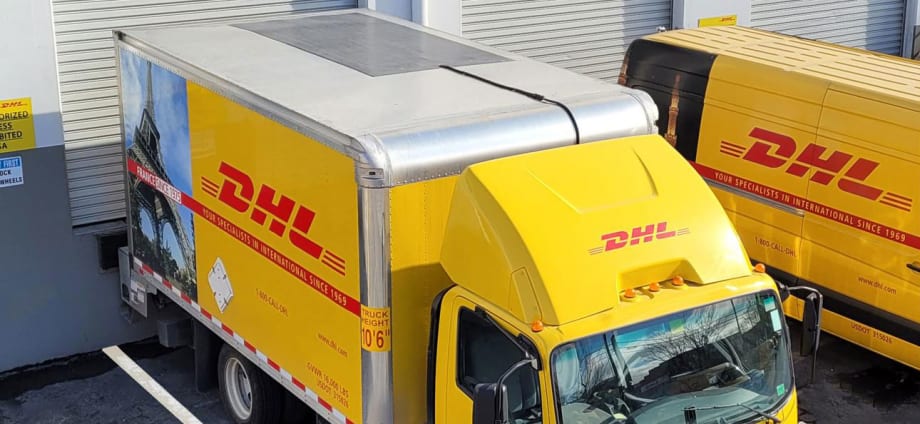
DHL has been installing Trailar-brand solar panel units on trucks its U.S. pickup and delivery fleet, generating electricity to charge lift gates, the battery, and other ancillary equipment.
Photo: DHL
Solar technology has advanced to where solar panels are flexible, thin, easily installed, and reliable enough for many trucking applications. One area gaining more attention is using solar energy to charge auxiliary (or truck starter) batteries to power liftgates.
Fleet owners can install solar panels on their trucks to provide a source of renewable energy for their electrical systems. This reduces reliance on truck alternator power to charge batteries that power these systems. Solar panels keep auxiliary batteries charged even when the truck engine is not running, so there is always power available for liftgate operations.
“Liftgates take loads down to the ground and back up to the trailer, using a tremendous amount of power in a very short amount of time,” says Kevin Otto, the electrification technical lead at the North American Council for Freight Efficiency. “As long as the sun is shining, solar panels will provide power to keep auxiliary batteries charged. If the sun is shining, solar will deliver a trickle charge to the batteries.”
Power Challenges of Tractor-Trailer Combinations
Traditionally power to brakes, running lights, and turn signals used to come via a seven-way connection between the tractor and the trailer. But as trailers evolved, manufacturers added more electrical loads to trailers and the demands on truck alternators grew.
Now, fleets also install auxiliary batteries to meet the power demands of electrical components. But when auxiliary batteries are used, fleets must decide how to charge them.
“You need a source to recharge the batteries to keep them topped off,” NACFE's Otto explains. “That can either come from the engine alternator or from solar panels mounted on the trailer.”
Typically, fleets rely on Group 31 batteries to deliver liftgate power, which need 200 to 300 peak Amps to operate. These batteries re-charged via the truck alternator as the trucks moved down the road. New idle laws and shorter drive times between deliveries now complicate keeping auxiliary batteries charged.
“These demands have driven many customers to seek supplemental sources of recharge, solar being one of them. If you are running at a deficit, [taking more energy out of the batteries over the course of the day than your putting back in] you will need a supplemental source of power replenishment,” says Arnold Kowal, director for after sales support at Maxon Lift.
“Solar is a standalone system, meaning if it’s installed on a truck or trailer, the tractor or truck chassis engine doesn’t have to be running in order for the solar system to create power for the battery. The availability and the angle of sunlight determines how much energy is put into the batteries.”
Otto warns if fleets allow auxiliary batteries to go dead, it will shorten their lives. Solar panels provide a trickle charge that keeps batteries topped off to prevent this from happening.
“You need to keep batteries charged as high as possible at all times,” he says. “A properly sized solar panel can deliver additional current and battery charging capacity to help manage refrigeration units, electric liftgates, and telematics devices.”
Still, Otto reminds this power “will be supplemental to the engine, engine alternator and the cab battery system. It may provide enough current for some operations so that you do not depend on the cab as much for power.”
Otto suggests putting solar panels on trailers to extend battery life and manage electrical loads. To calculate the number and size of solar panels the rig can support, he says to measure the trailer. Then the number of batteries needed and how they will be charged depends on lifts per day, load weights and sizes, weather and climate, distance between stops, and more.
“It depends on the usage profile of the fleet. What type of gate? How much energy is taken out of the battery pack?” says Kowal.
The next steps include mounting the appropriate number of solar panels using provided hardware, connecting them to the charge controller, then connecting the charge controller to the vehicle’s electrical system to deliver energy from the solar panel(s) to auxiliary batteries.
“If you have a solar panel installed and the duty cycles right—and you have sufficient sunshine—a solar panel can keep batteries topped off better,” Otto says. “Battery life will improve. Lead-acid batteries don't last as long if completely discharged.
"For most trailer applications, a single 3-foot by 6-foot panel will enhance the operation and would not be too expensive to put up there, whereas covering the entire trailer with solar panels would cost a pretty penny.”
Solar Considerations
Otto researched solar energy to power liftgates and other applications for NACFE. In his research, he cited several challenges solar use, all of which are important to consider as fleets weigh a switch to solar power.
Cost can be a consideration for fleets that have three or more trailers for a single tractor. Here, fleets would need to equip each trailer separately because solar systems are not portable between trailers. Still, the NACFE decision-making tool shows a medium to high confidence rating for liftgate support and a two-year payback.
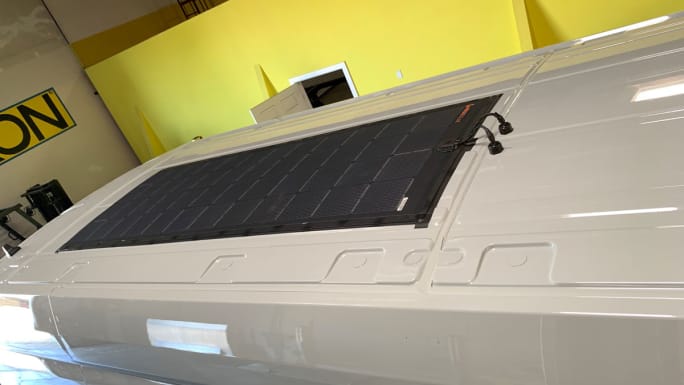
Maxon Lift Gate works with Merlin Solar for solar panels to power its liftgates.
Photo: Maxxon
One reason for the fast ROI is battery savings, Otto notes. Some solar panel manufacturers say it’s possible to double the life of a Group 31 battery with solar energy. Otto takes a more conservative estimate.
“If fleets replace these batteries every 1½ to 2 years, that’s a tremendous expense. The savings can be substantial if you extend that time by just 50%,” he says. “Installing solar panels is an investment. But the economics may work out for many fleets.”
Is There Enough Sunlight to Provide Solar Liftgate Power?
Sun availability also can present a challenge.
“The availability of sunlight determines how much energy is put back into the batteries,” Kowal explains.
Liftgate electrical systems are only augmented by solar panels during the daytime. How much power solar can provide depends on the angle of the sun and length of sun exposure. Cloud levels also differ from region to region. A 300- watt solar panel at 12 volts will deliver around 20 Amps. If the sun only shines 12 hours a day (and even less in certain areas), the power delivered will fall short of the maximum spec, according to Otto.
“You don’t get nearly as much power near sunset or sunrise as when the sun is very high in the sky,” he explains.
Dust, dirt, rain and snow also can lower the effectiveness of solar conversions. Manufacturers of solar panels have added resilient coatings designed to minimize damage from the elements and have designed panels to withstand intense vibration and thermal cycling, truck washes and debris, Otto says.
How Do You Know if Solar for Liftgates is Right for You?
When determining if solar makes sense, Otto recommends fleet managers consider:
The total cost of panels with installation.
Panel rating and physical size. He explains the area where solar panels can be installed may be limited.
The battery replacement rate for the fleet.
Roadside calls to jumpstart or replace batteries.
The country where the solar panels will be used.
“These considerations will help fleets evaluate if solar panels are a good investment,” Otto says, noting fleets may also see savings in reduced idling, less load on the alternator, increased battery life, and fewer roadside calls when solar panels are used.
Despite the challenges, solar is taking off. One reason is it’s become more acceptable, according to Anton Griessner, vice president of marketing and business development at Maxon Lift Gate.
“Solar is green. You are taking energy from the sun,” he says. “It’s a standalone system. If it’s installed on a truck or trailer, the chassis doesn’t have to run for the solar system to create power for the battery. If it’s on a trailer, for example, sitting in the yard, it’s still producing energy and putting it back into the batteries as long as there is sunlight.”
Maxon Lift Gate works with Merlin Solar for solar panels to power its lift gates. The reason for this is simple, “Merlin Solar panels did not start out with going on a building roof,” Griessner says. “They were always meant to go on a moving vehicle.”
More Equipment

How Volvo Updated Its D13 for EPA 2027 [Watch]
Volvo’s updated D13 promises lower emissions without sacrificing performance or fuel economy. Take a closer look at what changed inside the engine in this HDT Spotlight video.
Read More →
Michelin Tire Improves Efficiency and Durability for Regional Fleets
The Michelin X Multi Energy D2 is a regional haul drive tire engineered to help fleets improve fuel efficiency, durability and traction in demanding stop-and-go operations.
Read More →
ZF Expands Commercial Vehicle Push in North America
ZF is expanding its North American commercial-vehicle presence with new transmission applications, electrification, trailer technology and autonomous-driving systems.
Read More →
Tesla Wants a Self-Driving Semi. Are Cameras Enough?
Could Tesla’s camera-only autonomous driving technology work on an 80,000-pound Semi? In this commentary, HDT's Deborah Lockridge takes a look at Tesla, Cybercab, and how autonomous trucks see the road.
Read More →
Kodiak: Driverless Long-Haul Truck Launch on Track for 2026
Kodiak AI says its driverless long-haul safety case is 93% complete and it remains on track to begin commercial operations by year-end 2026.
Read More →
What DOT’s Automated Vehicle Strategy Means for Trucking
The U.S. Department of Transportation issued a new automated-vehicle strategy that outlines plans for driverless-truck regulations, cross-state freight corridors, and federal safety standards.
Read More →
East Coast Port Launches $45M Electric Truck Push
The Port Authority of New York and New Jersey announced millions in incentives for zero-emission drayage trucks, yard tractors, and new charging hubs near the port.
Read More →
PlusAI Going Public to Fund Autonomous Truck Launch
A SPAC deal could provide PlusAI with up to $300 million as it works toward a 2027 commercial launch of factory-built autonomous trucks.
Read More →
NHTSA Moves to Rewrite Truck Fuel-Economy Rules
The National Highway Traffic Safety Administration says it lacks authority to regulate medium- and heavy-duty truck engines separately from complete vehicles, but the existing standards have not yet been eliminated.
Read More →
Detroit Opens Orders for EPA 2027 Engines
Detroit isn’t starting from scratch to meet EPA 2027 diesel emissions standards. Its Gen 6 DD13 and DD15 engines keep much of today’s platform while updating the fuel and aftertreatment systems.
Read More →