




Using Augmented Reality in Technician Training
How Fox Valley Technical College in Appleton, Wisconsin, is using augmented reality to give its dlesel technician students a look inside the workings of a diesel engine.
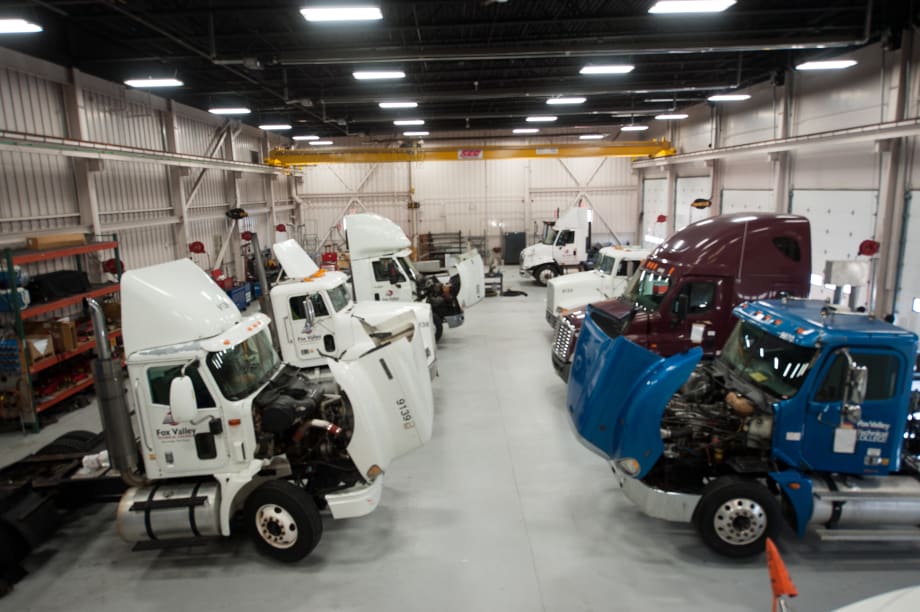
Fox Valley Technical College is on the front lines of the battle for the next generation of technicians. Photo by Ronnie Garrett.
Jay Duca, an instructor with Fox Valley Technical College in Appleton, Wisconsin, says he recently began noticing a new kind of student in his classroom. Where in the past, students entered the program with a lengthy mechanical background, today’s students often have “never even opened a toolbox.” To ensure the success of these students, FVTC has sought ways to better impart information to them.
As Duca dug into ways to speed up the learning process and further students’ understanding of the diesel engine, he learned of another program using augmented reality to teach anatomy and thought it would work well in the diesel program.
Upon receiving funding, Duca tapped into the expertise of Tou Xiong and Josh Janikowski of FVTC’s Learning Innovations team to create a VR-based diesel engine to use in the college’s diesel technology programs. The AR engine, which uses the Microsoft HoloLens, responds to voice commands and includes advanced vantage points to optimize the training experience for students. For example, the shell of the engine is removable by voice command, so students can see integral operating parts such as the crankshaft, pistons, valves, connecting rods, and more.
The prototype was rolled out in the fall of 2017 and has been used to teach students combustion. The first version focused on a single cylinder, but the next version will enable students to see all six cylinders firing at the same time.
Duca says the new technology really speeds up students’ learning curves. The AR system supplements traditional lecture and whiteboard drawings with a hands-on tool. “It’s one thing to draw it on the board, but to actually watch it fire is a totally different thing,” he says.
Many manufacturers already employ AR systems. Renault, for example, uses it to teach how to perform final inspections in engine assembly, while others use it in vehicle design and maintenance. “The sky is the limit for this technology,” Duca says. “But we need to be smart about it and only use the HoloLens for material that is hard to deliver via lecture, demonstration or lab activity.”
Duca also plans to use the system as a means of getting people excited about the diesel tech field. “We are about to start that,” he says. “We need to reach students early if we are to attract them to the field.”
Related: How Trucking is Addressing the Diesel Technician Shortage
More Maintenance

Color Match Smarter: Tools That Restore & Perform
For fleet managers and collision repair professionals keeping heavy-duty trucks on the road, getting the color right the first time isn't just about appearance — it's about efficiency, turnaround time, and bottom-line results. Discover how today's digital color tools are transforming the repair process from guesswork to precision.
Read More →
Wrong Repair Prompts Recall of Freightliner, Western Star 4x2 Trucks
DTNA is recalling more than 2,400 trucks that received an incompatible software fix instead of the hardware repair required to address brake valve corrosion.
Read More →
Truck Drivers Need More Than Another Alert
Fleets have more visibility into truck health, safety events, and driver activity than ever. The next challenge is turning all that information into useful guidance for the person who has to decide what to do next.
Read More →
The Maintenance Checks Trucking Fleets Should Prioritize Before Fall Freight Picks Up
Making it through August isn’t the same as being ready for the next several months of operation. Find out what systems may have suffered from summer heat and need to be checked out before fall.
Read More →
What Three Fleets Are Doing Differently When Buying Truck Parts in 2026
With freight improving but costs still climbing, fleet maintenance executives explain how they're balancing price, quality, and supplier relationships.
Read More →
Paccar Recalls 2027 Trucks Built This Summer for Possible Electrical Problem
The nearly 6,000 Kenworth and Peterbilt trucks in the recall could potentially lose engine power, among other things.
Read More →
Will API PC-12 Oil Change Trucking Fleet Maintenance?
The new API PC-12 heavy-duty engine oil category reflects the changing demands of modern diesel engines. But fleets like Foodliner are looking to getting their own data before making decisions on adopting the new oils and questions such as extending oil drain intervals.
Read More →
Brake Safety Week to Focus on Drums and Rotors
Commercial vehicle inspectors are focusing on truck brakes during CVSA's Brake Safety Week, August 23-29.
Read More →Possible Battery-Cable Fires Prompt Recall of 15,000+ International MV and HV Trucks
On the recalled vehicles, manufacturing variations can cause the battery interconnect cable to contact the auxiliary stud and hold down the bracket.
Read More →
Rush, MCT Team Up to Grow Refrigeration Service Network
The joint venture will operate MCT's network of Carrier Transicold dealerships and mobile service locations, with the companies promising greater service capacity and uptime for refrigerated fleets.
Read More →