




Two Fleets Divulge Keys to Award-Winning Safety Programs
Rocha Transportation and Bison Transport, winners of the 2012 Truckload Carriers Association's National Fleet Safety Award, admit that maintaining a high level of safety is hard work
Rocha Transportation and Bison Transport, winners of the 2012 Truckload Carriers Association's National Fleet Safety Award, admit that maintaining a high level of safety is hard work.
However, with top-notch safety programs, dedicated safety managers and heaps of appreciation for drivers, these two carriers make it look easy.
The 36th annual awards were presented at TCA's convention in Kissimmee, Fla., in March. Out of 18 semifinalists, Rocha won in the small carrier division (total annual mileage of less than 25 million miles) and Bison won in the large carrier division (total annual mileage of more than 25 million miles).
Rocha Transportation
Rocha, based in Ceres, Calif., strongly emphasizes accountability to its 61 drivers and 11 independent contractors, says Safety Manager Sam Cross.
"All of us are accountable for what we do," Cross says. "We're all human. We all make mistakes. If you're accountable, there's a tremendous chance you learn from that and won't repeat it."
Cross, who has been Rocha's safety manager for eight years, refers to people who always have excuses as "Teflon people." "'Teflon people' don't learn because nothing sticks," he says. "They just say, 'I can't believe it. Bad luck happened again.'"
Another component Rocha uses in driver training is the Smith System, a widely used set of five key points for safe driving that instructs drivers to stay alert and be aware of surrounding traffic.
"I use it with my wife," Cross says. "I'll say, 'In about 25 seconds, this guy's going to blow by us in the right lane,' and she'll say, 'How do you know that?' When you're prepared, you anticipate it and aren't surprised or angry."
Rocha uses a driver-training simulator to evaluate drivers on those five key points.
Rewarding safe driving is especially important. If a driver goes one quarter accident free, he or she gets a $175 Sears gift card. Earning all four quarterly bonuses results in an additional yearly bonus.
Rocha also offers a President's Award. Any money left over from what the company had set aside for little expenses - dings, nicks, bumps - goes to the drivers at the end of the year. It's an incentive to not only avoid the big accidents but also the little mishaps that can add up.
A yearly safety celebration at a local amusement park gives drivers a chance to enjoy their hard work with their families. "It's a lot of fun," Cross says. "Their families get to see them being rewarded. Kids in particular understand they're there because their mom or dad is great at what they do."
Cross says it's important to him to maintain a good relationship with the drivers and let them know they're appreciated. "We communicate on a regular basis with drivers. When they get called into my office, I want them to think 'Oh, he's going to tell me I'm doing a great job,'" instead of worrying about being reprimanded.
Rocha doesn't make a big deal out of titles to help create an environment of equality. "We are a business of equals," Cross says. "We do our jobs, and we all work hard to make a difference. Our drivers know it, and they want to be here."
Cross says ultimately, "It's just aying out expectations, getting commitment to it and thanking people - and constantly saying 'How can we improve this?'"
Bison Transport
This is the fifth time in the winner's circle for Bison Transport in Winnipeg, Manitoba.
After the company's first win in 2006, "it didn't take too long to say, 'How are we going to do this again?'" says Garth Pitzel, director of safety and driver development.
Bison went to a local ad company to create its "You're Safe With Me" campaign to promote a culture of safety to its 1,450 drivers, which includes 300 owner-operators. This year, the company expanded the campaign to "You're Safe With Me Because" to allow drivers to submit their own reasons for being safe.
Pitzel says Bison's driver training focuses on the individual. "If I'm going to invest 10 hours of training on a driver, I want to make sure they're getting something out of it," he says.
Around 2003, Bison added a simulator to its driver training, and the company introduced a rewards program in 2005. "We said we only wanted to worry about one thing: to reward drivers for accident-free driving," Pitzel says. Drivers can earn up to 3.5 cents extra a mile for being safe.
Since 2005, Bison has paid more than $12 million to its drivers for safe driving. "Our best insurance policy is our programs," Pitzel says.
The company also invests in technology in the truck to provide more information to drivers so they can improve on the road. "We went from having a large amount of rear-end accidents to having very few," Pitzel says. "We also reduced the severity of those accidents. They're happening at 5 mph, not at 50 mph. We've been able to change behavior of our drivers by providing them more information."
Bison also created a safety performance system that ranks drivers in three categories: low risk, medium risk and high risk. Pitzel, who has been director of safety since 2000, says he pays special attention to high-risk drivers. "The goal isn't to terminate," he says. "The goal is to come up with a plan to become that low-risk driver."
For Bison, Pitzel says, safety is truly a team effort. "I can say whatever I want from a safety perspective, but if I've got people in operations saying 'Just get the damn load there,' it's not going to work. Operations and management should get more recognition than me. They're living and believing what we as a business have set up."
For other fleets trying to up their safety game, Pitzel says: "A driver doesn't get up in the morning and want to have an accident or a speeding ticket. Develop your program and live it and breathe it every day. It takes a lot of time and effort, but once you have your drivers believing in it, it becomes very easy."
From the May 2012 issue of HDT
More Safety & Compliance

ZF Expands Commercial Vehicle Push in North America
ZF is expanding its North American commercial-vehicle presence with new transmission applications, electrification, trailer technology and autonomous-driving systems.
Read More →
Truck Drivers Need More Than Another Alert
Fleets have more visibility into truck health, safety events, and driver activity than ever. The next challenge is turning all that information into useful guidance for the person who has to decide what to do next.
Read More →
Tesla Wants a Self-Driving Semi. Are Cameras Enough?
Could Tesla’s camera-only autonomous driving technology work on an 80,000-pound Semi? In this commentary, HDT's Deborah Lockridge takes a look at Tesla, Cybercab, and how autonomous trucks see the road.
Read More →
What DOT’s Automated Vehicle Strategy Means for Trucking
The U.S. Department of Transportation issued a new automated-vehicle strategy that outlines plans for driverless-truck regulations, cross-state freight corridors, and federal safety standards.
Read More →
NYC Expands Speed, Pedestrian Safety Tech Across Fleet
New York City is expanding intelligent speed assistance and pedestrian-alert systems across its municipal fleet, moving the technologies from pilot programs into vehicle procurement and retrofit requirements.
Read More →
FMCSA Removes 110 Truck Driver Training Schools from Certified ELDT List
Federal regulators also are targeting more than 160 additional training providers and launching a nationwide audit of third-party CDL skills testers as part of a broader crackdown on trucking fraud.
Read More →
Beyond DOT Compliance: What Makes a Trucking Fleet Truly Safe?
A trucking fleet can follow every rule and still make unsafe decisions. The real test comes when safety conflicts with freight, productivity, or cost.
Read More →
Hours of Service Pilot Programs: FMCSA Readies for 2027 Rollout
Two pilot programs could eventually reshape hours-of-service rules, giving truck drivers options to pause their 14-hour clock or use longer split sleeper rest periods.
Read More →
New Guide Offers Pet Safety Tips for Truck Drivers
Hundreds of thousands of pets travel in truck cabs. A new safety guide from Volvo Trucks and the Center for Pet Safety offers practical advice for truck drivers who bring dogs and cats along for the ride.
Read More →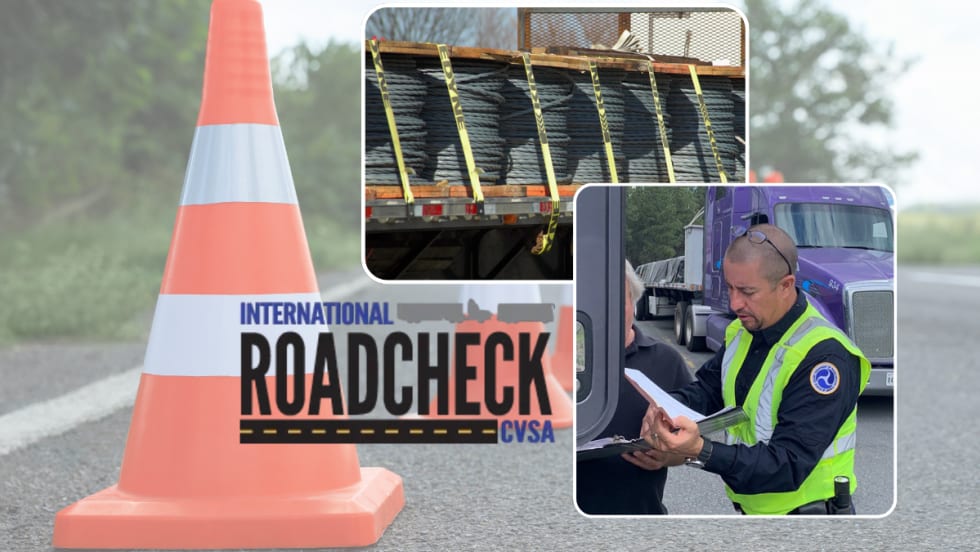
Medical Cards, English Proficiency Reshape Roadcheck Violations
Medical-card violations jumped to the top of the driver out-of-service list during CVSA’s 2026 International Roadcheck, while English-language proficiency violations appeared among the leading violations for the first time.
Read More →