




Trailers: Save Pounds By Looking Down
As fleets everywhere work on cutting fuel expenses, one strategy is shedding pounds anywhere they can stand to lose them. “Most fleets that are fuel conscientious are weight conscientious. The heavier the unit weighs, the higher cost per mile to operate it."

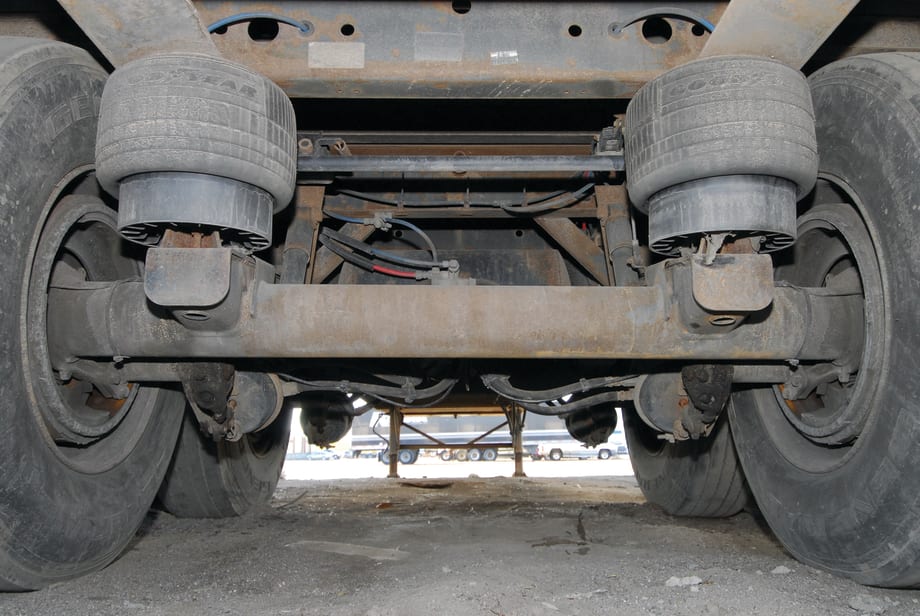
Pounds can be shed on parts
underneath the trailer including landing gear, suspensions, axles
and fifth wheels.
As fleets everywhere work on cutting fuel expenses, one strategy is shedding pounds anywhere they can stand to lose them.
“Most fleets that are fuel conscientious are weight conscientious. The heavier the unit weighs, the higher cost per mile to operate it,” explains Rob Nissen, the national service manager for SAF-Holland.
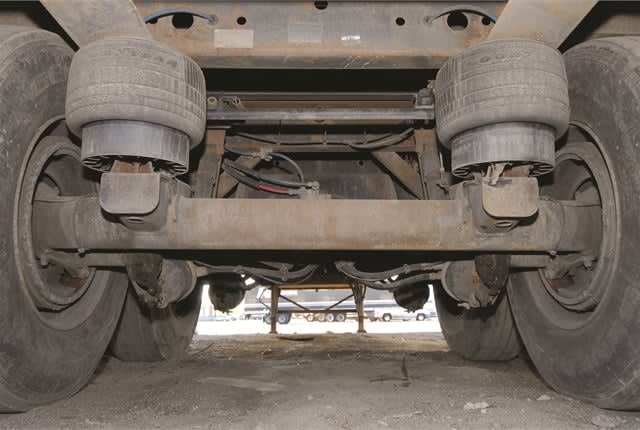
Pounds can be shed on parts
underneath the trailer including landing gear, suspensions, axles
and fifth wheels.
Every component on the tractor-trailer is being increasingly scrutinized for weight savings – including those beneath the trailer.
Landing gear
An average trailer can weigh anywhere from 10,000 to 15,000 pounds. While landing gear is only a small percentage of that, a few pounds here and a few pounds there add up. That’s why manufacturers of landing gear have been working to reduce weight.
“Landing gear weigh about 150 to 250 pounds per set so when you are talking about making your landing gear lighter by 15 to 25 pounds, that’s a savings of 10%,” says Zoran Tomic, director, global landing gear product planning & market development, Trailers Systems Business Unit with SAF- Holland.
While keeping an eye on the scale, the other eye has to be on the price.
“You have to determine if the weight savings benefit justifies the additional cost,” Tomic says. “Alternative materials may be considered but the cost penalty can be significant.”
He says in general, every pound of saved weight when replacing steel with aluminum will add $5 to $6 to the cost. Saving 10 pounds could increase the price by $60. If the cost of a lightweight product is significantly less than a steel “regular” product, he warns, than the quality or structural integrity might have been compromised.
SAF-Holland and Jost have lightened their landing gear with both structural and material changes.
Jost engineers say their A400 family of landing gear saves weight because they do not have an external gear box. The Jost Ultra Light series is produced from high-strength lightweight steel which provides for a thinner wall tube section and a weight savings of 25 pounds per set vs. a comparable landing gear model. Jost also offers an aluminum hybrid landing gear, which has a weight savings of over 50 pounds per set.
Axles and suspensions
The two main ways to reduce weight in suspension products is through design and materials used, according to Ray Mueller, senior vice president for business development at Reyco Granning Suspensions.
An example from Reyco Granning is the DockMaster 400 air ride van slider.
“The DM400 subframe is more like the unibody construction of an automobile than it is the traditional hangers welded to a frame,” explains Ken Wall, senior project engineer for Reyco’s Trailer Value Stream. “By incorporating unitized, wraparound hangers and 9-inch Super C frame rails, we were able to produce a suspension 33% stronger than our leading competitor and still have one of the lightest air ride sliders on the market.”
Another weight-savings strategy is the use of high-strength materials. “Austempered ductile iron, for example, is stronger than steel,” Mueller says, “so the parts can be thinner than steel parts without sacrificing durability.”
Hendrickson, which has trimmed the weight of a tandem axle air slider/suspension system by more 750 pounds since its first introduction in 1991, says it uses multiple approaches to reducing weight: 1) condense the number of components needed to do the same job; 2) integrate multiple functions into a single component; 3) decrease component size while maintaining performance; and 4) design components to be more efficient with material usage (put the strength where it is needed), leading to the use of thinner materials.
Some examples include:
• Integrated suspension and axle designs that eliminate loose parts like U-bolts while maintaining a straightforward, functional design.
• Integrating the brake chamber mounting and lower shock mounting.
• Using weld designs/techniques that allow for a trailing arm/axle connection to require less material.
• Shorter brake S-cams, which decrease system weight while enhancing performance by eliminating wind-up and reducing bushing wear.
• Suspension bushings and springs optimized for the specific trailer application.
• Larger axle diameters using thinner materials that reduce overall weight but offer increased bending and torsional stiffness for enhanced durability and roll stability.
Randy Flanagan, director, sales and marketing for Americas Trailer Systems with SAF-Holland, agrees that material is key.
“In all our DuraLite and UltraLite mechanical suspensions, SAF-Holland uses 80,000-yield steel as standard. This allows for lighter gauge yet stronger material.” For the company’s air ride suspensions, cast steel and 80,000-yield steel is used for the fabricated parts.
“If we look back 20 to 25 years, we have witnessed significant overall suspension weight reductions on the air ride systems, in the magnitude of 25 to 35%,” Flanagan says. “This significant reduction can be attributed to increased CAD/FEA engineering capabilities, advanced production/tooling capabilities for component manufacturing, and more economical and higher-strength material choices.”
Meritor says its MTA suspension series features some of the lightest-weight products on the vocational suspension market.
Three top mount models ranging from 23,000- to 30,000-pound capacities and two recently introduced low-mount models in 25,000- and 30,000-pound capacities optimize performance and weight. It also offers lighter weight axles, with lighter axle beams, a lightweight stamped spider, an optimized axle wall and lightweight automatic slack adjuster.
These are just a few areas where manufacturers are working to cut weight underneath the trailer. Don’t overlook other areas, such as wheels, axles, brake drums and more.
Saving weight on fifth wheels
Fleets looking for weight reductions can add lightweight fifth wheels to their list of options.
According to SAF-Holland’s Rob Nissen, historically, fifth wheels were “made from a fabrication of a stamped steel supported with welded gussets and rib supports. Also cast steel has been used as well in years past.”
Nissen, the company’s national service manager, says the move toward a lighter fifth wheel started many years ago. “The material chemistry and manufacturing processes have changed significantly over the past 10 years to reduce weight, but to maintain the durability of the fifth wheel. Ductile iron is a material used in the manufacturing of fifth wheels as well in most recent years.”
SAF-Holland now offers an aluminum fifth wheel that weighs 125 to 130 pounds. A cast steel fifth wheel weighs in at around 180 pounds.
Fontaine Fifth Wheel, after introducing its lighter weight No-Slack NT top plate, began looking at ways to reduce the weight of the lower assembly, which includes the slide bracket, slide rail and stationary mounts.
“The lower assembly takes less abuse in the field, so you have a better opportunity to optimize these areas of the fifth wheel system,” explains Terry Mennen, vice president of sales and marketing for Fontaine. “We now offer lower assemblies designed specifically to provide weight savings to our customers. For example, Fontaine’s LWO lightweight outboard slide weighs up to 78 pounds less than other outboard slide systems.”
Fontaine also works with truck OEMs to ensure that the fifth wheel mounting angles have been optimized. Its lighter weight systems have smaller footprints, which enable OEMs to use shorter angle lengths, for even further weight savings.
More Equipment

How Volvo Updated Its D13 for EPA 2027 [Watch]
Volvo’s updated D13 promises lower emissions without sacrificing performance or fuel economy. Take a closer look at what changed inside the engine in this HDT Spotlight video.
Read More →
Michelin Tire Improves Efficiency and Durability for Regional Fleets
The Michelin X Multi Energy D2 is a regional haul drive tire engineered to help fleets improve fuel efficiency, durability and traction in demanding stop-and-go operations.
Read More →
ZF Expands Commercial Vehicle Push in North America
ZF is expanding its North American commercial-vehicle presence with new transmission applications, electrification, trailer technology and autonomous-driving systems.
Read More →
Tesla Wants a Self-Driving Semi. Are Cameras Enough?
Could Tesla’s camera-only autonomous driving technology work on an 80,000-pound Semi? In this commentary, HDT's Deborah Lockridge takes a look at Tesla, Cybercab, and how autonomous trucks see the road.
Read More →
Kodiak: Driverless Long-Haul Truck Launch on Track for 2026
Kodiak AI says its driverless long-haul safety case is 93% complete and it remains on track to begin commercial operations by year-end 2026.
Read More →
What DOT’s Automated Vehicle Strategy Means for Trucking
The U.S. Department of Transportation issued a new automated-vehicle strategy that outlines plans for driverless-truck regulations, cross-state freight corridors, and federal safety standards.
Read More →
East Coast Port Launches $45M Electric Truck Push
The Port Authority of New York and New Jersey announced millions in incentives for zero-emission drayage trucks, yard tractors, and new charging hubs near the port.
Read More →
PlusAI Going Public to Fund Autonomous Truck Launch
A SPAC deal could provide PlusAI with up to $300 million as it works toward a 2027 commercial launch of factory-built autonomous trucks.
Read More →
NHTSA Moves to Rewrite Truck Fuel-Economy Rules
The National Highway Traffic Safety Administration says it lacks authority to regulate medium- and heavy-duty truck engines separately from complete vehicles, but the existing standards have not yet been eliminated.
Read More →
Detroit Opens Orders for EPA 2027 Engines
Detroit isn’t starting from scratch to meet EPA 2027 diesel emissions standards. Its Gen 6 DD13 and DD15 engines keep much of today’s platform while updating the fuel and aftertreatment systems.
Read More →