




Trailer Report: Weight vs. Cost
How important is saving weight? It's vital in some operations, such as hauling bulk commodities, especially if trailers are always loaded to the max and tare weight must be cut to enhance payload potential

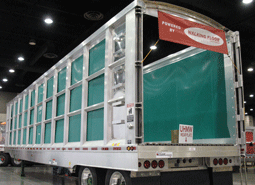
Plastic sheeting and aluminum extrusions and fabrications combine to cut many pounds from this trash-transfer trailer shown at the 2011 Mid-America Trucking Show.
How important is saving weight? It's vital in some operations, such as hauling bulk commodities, especially if trailers are always loaded to the max and tare weight must be cut to enhance payload potential.
Some fleet managers have calculated that a pound saved adds X number of dollars of revenue over the life of a trailer. For bigger fleets, "X" can run into the thousands.
In other operations, such as dry and refrigerated freight, saving weight is less important. Cargoes weigh varying amounts, and rates for certain dense commodities might not support the cost to buy lightweight trailers to carry them in the quantities that some shippers want.
An indirect example is the 53-foot trailer. It became the predominant length for vans and reefers by the end of the 1990s, when 53s replaced 48-footers in most fleets. A 53-footer weighs several hundred pounds more and costs thousands more to buy. But while shippers demand 53s, their full volume is seldom used.
That's the case in reefers, anyway, said Corey England, chief operating officer of C.R. England Inc. and a former chairman of the Truckload Carriers Association Refrigerated Division.
"The red line is back there on the floor, marking off the last 3 feet, but it's almost never filled," England commented in a conversation during a break at the group's annual meeting last year. "But customers want it."
Many shippers give loading responsibilities completely to forklift operators, and some of them want the flexibility of that long floor. They'll occasionally use all of it to spread out weight instead of figuring a correct way of stacking merchandise in a shorter length.
"We've thought of asking Utility or someone to build us 50-foot trailers, because they'd almost always be long enough," England said. "California requires the extra [SmartWay-type] equipment on 53s, so we could avoid that if we ran 50s. Of course, if enough of us did that, they'd catch on pretty quick and change the rules" to include 50-foot trailers.
"But we couldn't do that anyway because customers want 53s. If you can't display that '53' label on it, they turn you away."
Some types of dry "balloon" freight can completely fill a 53, so for-hire carriers use 53s to stay flexible. Private fleets use what's best for their products - unless they backhaul general freight. That can force them to operate equipment just like their for-hire brothers and sisters.
A long trailer is one thing. A long and especially lightweight one is another, or should be.
Schneider National looks carefully at payload versus rates and specs out trailers accordingly. But, "We've never come to a definite conclusion" about payback, said Steve Duley, vice president, purchasing. "We've had a weight that's acceptable to most accounts. If you've got 50 pounds to go, you look at what the freight will pay and how much money we can make on it. Then we might pay a lot for that last 50 pounds."
A Schneider van may look stout, but it's been carefully thought out, and some lightweight components are there, especially for dedicated hauls. "It may not be obvious, but given the work we do, we do look at weight," Duley said. "But we balance that against the life of the truck, the needs of the driver, and what they'll be doing."
Included are composite side walls. In Wabash National vans, Schneider buys the DuraPlate wall, which has steel skin over a plastic honeycomb. They buy a comparable wall from Hyundai. The Wabash wall has a 2-foot-high base rail, called the Heavy Duty rail. This is an aluminum extrusion to withstand forklift damage.
Schneider also specs a Havco wood-plastic composite flooring, which saves 50 pounds compared to a hardwood floor on a 53-footer.
"You can get more weight out by going with a thinner floor, but we upgraded the rating" while still saving some weight, Duley said. Going from four lock rods on the rear swing doors to three saves another 20 to 30 pounds. Four rods tightly lock the doors and stiffen the body, adding life, but three work almost as well.
Some of Schneider's dedicated accounts get wide-base single wheels and tires on the trailers that serve them. But wheels are steel instead of aluminum to make them less attractive to thieves. The big single tires alone save about 200 pounds per tandem over dual, standard-size tires and steel wheels. All vans ride on Hutch EZ-Pull steel-spring suspensions, which are lighter and cost less than air-ride. Trailers that go on rail cars have lift pads and other equipment, but some items are being removed and lighter-weight pads installed to save about 50 pounds.
More payload's not the only reason to spec weight-saving components. Schneider's weight-cutting efforts took about 200 pounds off each trailer, which allowed it to add Ridge Green Wing side skirts without adding weight. It's equipping all of its 30,000 vans with side skirts to comply with California's fuel and greenhouse-gas regulations.
While not a weight item, corrosion resistance has become important, so Schneider specs galvanized steel door headers, rear subframe, and landing gear. "We believe it will help, especially in the lower corners of the header, where moisture tends to gather, and in the subframe," he said.
"We don't try to lighten the underside," Duley said, because strength there is important to long life. Schneider aims to operate its vans at least 10 years, "then we inspect them and do some maintenance, and pull by condition" for as long as it's safely and economically feasible.
Schneider pays $25,000 to $30,000 for a van, depending on details. Each weighs 14,200 to 14,300 pounds, and can carry a payload of 47,500 pounds with an older tractor or 46,500 with a new tractor. With a 72-inch sleeper, an older tractor weighs 18,200 pounds, which is 1,000 less than a new tractor that has a heavier 2010-spec diesel with selective catalytic reduction emissions aftertreatment equipment.
The company considered a smaller sleeper, but they still have a thousand driver teams that need the large sleeper-cab. "They usually get new trucks, run them a year, then the trucks go into single driver use. We have bought some smaller sleepers, about a foot to 18 inches shorter. With reduced wheelbase and everything else that follows, they save 300 to 400 pounds" versus a 72-incher.
Tankers run by Schneider's bulk division get similar attention to weight-saving details balanced against other considerations. Among them is the fact that shippers often send loads that are less than a full truckload because that's what their customers specify. Some get the wide-base tires on steel wheels, which save about 200 pounds over standard duals. The fleet likes wide brakes for long lining life, but uses smaller brakes on certain accounts.
Otherwise the tankers are spec'd for durability and long service life. The cost is $50,000 to $75,000 for a standard chemical tank. Schneider wants them to last infinitely, and there is no trade cycle. "We do a lot of maintenance on them and inspect them often," Duley said. At 15 to 20 years they are put on limited runs.
To save weight in a trailer (or a tractor, for that matter), look at aluminum in everything. But it always costs more than steel. And while some aluminum components fight corrosion and last longer, others suffer fatigue and give less life. Some cost less than others on a per-pound-saved basis. For instance, cast or fabricated aluminum brackets and wheel hubs cost less than forged aluminum wheels.
Each builder has features designed to cut weight and add volume, like thin walls, where aluminum sheet-and-post is still a popular construction. Here aluminum posts can be spec'd instead of the usual steel. Newer composite walls, often employing a foam core with sheet metal skins, are also lightweight
More Equipment

ZF Expands Commercial Vehicle Push in North America
ZF is expanding its North American commercial-vehicle presence with new transmission applications, electrification, trailer technology and autonomous-driving systems.
Read More →
Tesla Wants a Self-Driving Semi. Are Cameras Enough?
Could Tesla’s camera-only autonomous driving technology work on an 80,000-pound Semi? In this commentary, HDT's Deborah Lockridge takes a look at Tesla, Cybercab, and how autonomous trucks see the road.
Read More →
Kodiak: Driverless Long-Haul Truck Launch on Track for 2026
Kodiak AI says its driverless long-haul safety case is 93% complete and it remains on track to begin commercial operations by year-end 2026.
Read More →
What DOT’s Automated Vehicle Strategy Means for Trucking
The U.S. Department of Transportation issued a new automated-vehicle strategy that outlines plans for driverless-truck regulations, cross-state freight corridors, and federal safety standards.
Read More →
East Coast Port Launches $45M Electric Truck Push
The Port Authority of New York and New Jersey announced millions in incentives for zero-emission drayage trucks, yard tractors, and new charging hubs near the port.
Read More →
PlusAI Going Public to Fund Autonomous Truck Launch
A SPAC deal could provide PlusAI with up to $300 million as it works toward a 2027 commercial launch of factory-built autonomous trucks.
Read More →
NHTSA Moves to Rewrite Truck Fuel-Economy Rules
The National Highway Traffic Safety Administration says it lacks authority to regulate medium- and heavy-duty truck engines separately from complete vehicles, but the existing standards have not yet been eliminated.
Read More →
Detroit Opens Orders for EPA 2027 Engines
Detroit isn’t starting from scratch to meet EPA 2027 diesel emissions standards. Its Gen 6 DD13 and DD15 engines keep much of today’s platform while updating the fuel and aftertreatment systems.
Read More →
Carrier Transicold Adds All-Electric TRU for Stationary Cold Storage
Carrier Transicold’s new Vector 8200 all-electric transport refrigeration unit gives fleets a diesel-free option for temporary refrigerated and frozen trailer storage.
Read More →
A Closer Look at Kenworth’s Electric T880E Vocational Truck [Video]
Learn more about Kenworth's T880E battery-electric vocational truck at the Paccar Technical Center, including its range, applications, upfitting considerations, and PTO options, in this HDT Spotlight video.
Read More →