




TMC Survey Reveals Misinformed View of Fuel-Efficient Tires
Do the fuel savings of low-rolling-resistance tires outweigh the assumed shorter miles-to-removal? A TMC survey found a disturbing lack of knowledge among members about their own fleet operations.

To answer a question posed by no small number of fleets, the American Trucking Associations' Technology & Maintenance Council's S.2 Tire & Wheel Study Group recently conducted a survey on tire mileage and fuel savings as they relate to low-rolling resistance tires.
It's often claimed by tire manufacturers that fuel savings accrued with LRR tires outweigh the shorter overall miles-to-removal generally assumed to be the result of their thinner treads.
The findings of the survey were a little surprising, with a few bits of what could even be called contradictory findings. The findings showed that in all cases except trailers, low-rolling-resistance tires actually lived longer than standard tires, which sort of lays to rest the assumption that they don't last as long. At the same time, a majority of fleets reported that fuel savings did not offset the cost of the "presumed" shorter-than-standard lifespan of the LRR tires.
Generally speaking, LRR tires are presumed to cost about 15% more than standard tires, with a reduced tread life of about 30%. The presumed 3-4% fuel savings potential of these tires is believed to offset the two negatives.
Peggy Fisher, president of Tire Stamp and regular contributor to TMC's S.2 task force work, had an interesting explanation for the apparent dichotomy.
"Among other things, the survey showed that a sizeable number of fleets (29%) do not know what their fuel economy is -- which is very odd in this day and age," she says. "Therefore, it is not surprising that they didn't know they are getting better tread mileage on low-rolling-resistance tires than non-low rolling resistance tires. Only the trailer tires were reported as getting less tread mileage, and it just so happens that we all know that trailer tires are the worst maintained in the fleet."
Fisher is quick to point out that there is a direct correlation between tire maintenance and tire life. It's not hard to believe that if maintenance is poor, then so too will be tire life.
"We know from studies done in previous years that maintenance of truck tires is poor, with only 44% of tires in an earlier study found to be within +/- 5 psi of target pressure," she points out. "If tire maintenance has not improved much since 2002 when that study was done -- and I do not think it has significantly -- then it is not surprising that fleets are not getting the fuel economy and tread mileage they had hoped for, since both tread mileage and fuel economy are seriously impacted by improper tire inflation."
Fisher presented the findings of the survey at the S.2 Tire & Wheel Study Group session at TMC in February.
Fisher says 51 fleets responded to survey, the vast majority being linehaul and regional operators running Class 7-8 vehicles. Of the responding fleets, 43% had 100-499 power units while 41% had 500 or more power units. Some 85% of fleets indicated they were running LRR tires, and 63% of those fleets have 50% or more of their vehicles on such tires.
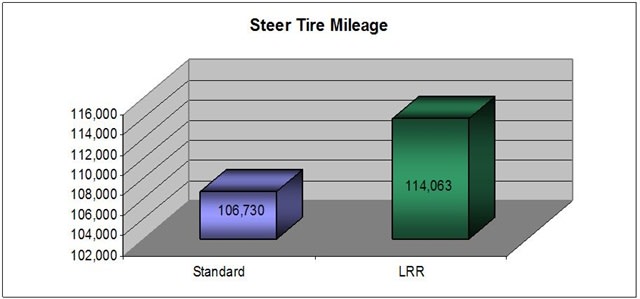
The range of mileages on steer tires may surprise some. Fleets were asked to check mileage range boxes (<50,000, 50-100,000 and 100,000-150,000 miles), so the exact number of miles the tires ran may not be reflected in the results. Fisher calls the results a "guesstimate" based on a weighted average for each group.
"The numbers seem a little low, but the interesting thing is that low-rolling-resistance tires, in general, outperformed the standard tire by almost 10%," she said. "The results of the drive tire section showed similar results."
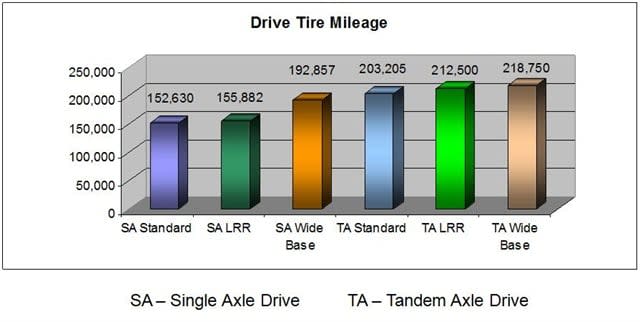
The drive tire section of the survey broke out single and tandem drive axles as well as standard, LRR and wide-base single tires. In both cases, WBS performed the best in terms of miles to removal, followed by LRR tires with standard tires bringing up the rear.
On single drive axles, WBS tires outlive the others by quite a margin. The range wasn't quite so stark for the tandem axles.
"I grouped these together for the benefit of fleets considering going from 6x4 to 6x2," Fisher said. "You can infer from these results that you will see a mileage shortcoming in the single-drive axle group, but that should hardly come as a surprise."
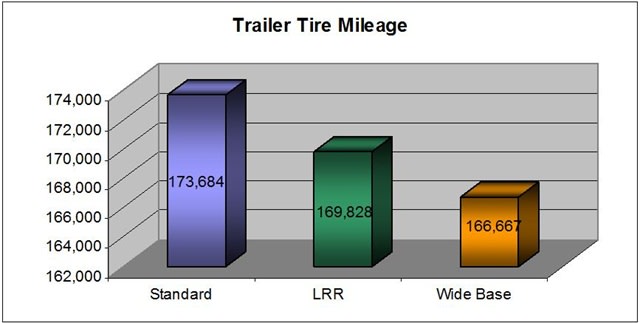
In looking at trailer tires, the victory went to standard tires. They outperformed LRR tires by an average of close to 4,000 miles, and outlived the WBS tires by about 7,000 miles.
"Trailer tires revealed results opposite to what we saw at the other wheel positions," said Fisher. "Maybe this is where people get the perception that they get poorer mileage from LRR tires. Are the trailers not performing as well because they are not being maintained as well? We don't know for sure that this is the case, but we do know that trailer tires are typically not well maintained."
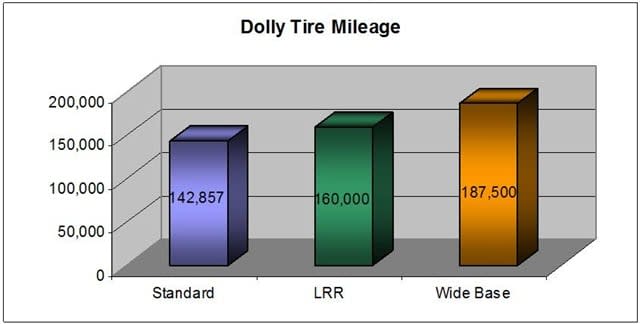
Trailer dollies also revealed an interesting exception. As a trailing wheel position, you might expect performance similar to a trailer, but here we see the opposite is true. WBS tire outperformed the other two handily, going out 45,000 miles further than the standard tire and about 27,000 miles farther than the LRR tires.
"The dolly tires were surprising," Fisher noted. "You expect to see dolly tires performing like trailer tires, but that is certainly not the case. Trailers are just dragged down the road in one direction, but dollies are going back and forth a lot. That's why we tend to get a lot of irregular wear on them but the LRR and WBS tires here actually got better mileage."
Perceived value?
When asked to report on the fuel savings they realized with their tire selections, fleets indicated low-rolling-resistance tires averaged a 1.9% improvement in fuel savings and 2.2% with wide-base singles. The next question was, "Did the fuel savings meet your expectations?" About one-third (29%) said yes, while slightly less than half (42%) said no. As might be expected, 29% said they were not sure.
"These results blow my mind," Fisher said, leaving little doubt at her dismay with the high level of uncertainty. "Nearly one third of the group who bought LRR to reduce fuel consumption didn't know if the tires were saving them money or not. It seems to me you’d be monitoring that a bit more closely."
The final shocker came with the question, "Did fuel savings pay for lost tread rubber?" Only 40% said yes; 60% said no. That's hard to reconcile with the fact that in most cases the LRR tires ran more miles than their standard counterparts -- with trailers being the notable exception.
It would seen that if some fuel economy improvement is a given with the fuel-efficient tires compared to standard tires, the additional tread life would be a bonus.
"If they were responding to that question based on trailer tire performance, I might tend to agree," Fisher said. " But if we're considering all wheel positions, I think fleets might be doing better than they think, based on these numbers."
Or, the answer may lie in something Fisher noted at the beginning: "A sizeable number of fleets do not know what their fuel economy is." Since that's a relatively easy thing to measure, and a figure fleets live and die by, one might have good reason to question how good a job fleets do at measuring tread life, which is a more labor-intensive and difficult calculation. "Therefore, it is not surprising that they didn't know they are getting better tread mileage on LRR tires than non-low rolling resistance tires."
This should be a wakeup call to any fleet prepared to condemn LRR tires as non-cost-efficient. Make sure you have accurate measurements before you start criticizing.
Corrected 3/10/2015-- Previous version contained incorrect references to the distances wide-base single Dolly tires ran compared to their standard and low-rolling-resistance counterparts.
More Fuel Smarts

How Volvo Updated Its D13 for EPA 2027 [Watch]
Volvo’s updated D13 promises lower emissions without sacrificing performance or fuel economy. Take a closer look at what changed inside the engine in this HDT Spotlight video.
Read More →
Diesel Price Spike Shortens Payback for Natural Gas Trucks, Report Says
Energy Vision estimates fleets could recover the higher purchase price of an RNG-fueled Class 8 tractor in 1.3 to 2.8 years under current fuel-price scenarios.
Read More →
Calstart Becomes Catalyst Mobility, Reflecting Broader Focus
Calstart is now Catalyst Mobility, reflecting the nonprofit’s growing national role in clean transportation, including zero-emission trucks, infrastructure and incentive programs.
Read More →

Record Diesel Prices Squeeze Trucking Fleets
Average U.S. diesel prices have climbed to nearly $6 a gallon, surpassing the 2022 record as tight refinery capacity and Middle East disruptions keep fuel costs elevated.
Read More →
How Fuel Delivery Shapes Engine Performance
Fuel delivery depends on more than what happens at the injector. For fleet, maintenance and technical professionals, looking at the full path from pump to injector can provide useful context for understanding engine performance.
Read More →
East Coast Port Launches $45M Electric Truck Push
The Port Authority of New York and New Jersey announced millions in incentives for zero-emission drayage trucks, yard tractors, and new charging hubs near the port.
Read More →
California Bill Could Shed Light on Electric Truck Prices
Why do battery-electric Class 8 trucks remain so expensive? A California bill headed to Gov. Gavin Newsom would give fleets and state agencies more visibility into what manufacturers charge.
Read More →
Detroit Opens Orders for EPA 2027 Engines
Detroit isn’t starting from scratch to meet EPA 2027 diesel emissions standards. Its Gen 6 DD13 and DD15 engines keep much of today’s platform while updating the fuel and aftertreatment systems.
Read More →
Zero-Emission Truck Corridor Planned for West Coast
California, Oregon, Washington, British Columbia and Baja California are coordinating plans for truck charging and hydrogen fueling from Canada to Mexico.
Read More →
A Closer Look at Kenworth’s Electric T880E Vocational Truck [Video]
Learn more about Kenworth's T880E battery-electric vocational truck at the Paccar Technical Center, including its range, applications, upfitting considerations, and PTO options, in this HDT Spotlight video.
Read More →