




TMC Sessions: Designing and Installing Trailer Aero Devices
It would be a good idea if fleets and truckers had some way to judge how good trailer aerodynamic products are, and to properly install what's available

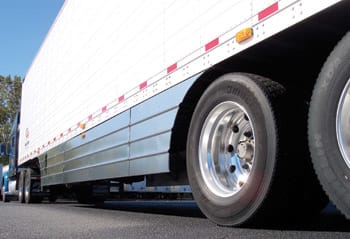
Belly fairings, like the ribbed aluminum panels made by Fleet Engineers, have been proven to reduce wind drag and save fuel. (Photo by Fleet Engineers)
It would be a good idea if fleets and truckers had some way to judge how good trailer aerodynamic products are, and to properly install what's available.
So trailer aero devices were the subject of three separate sessions during the Technology and Maintenance Council of ATA's meeting last month.
This shows a growing interest in a concept that, except for use by some progressive fleets, had largely languished until the California Air Resources Board recently mandated phased-in use over the next five years. The idea is to save fuel and reduce dependence on foreign oil and emission of greenhouse gases, but the right devices for box-type trailers can also pay for themselves in lower fuel costs for fleets.
California's regulations primarily affect 53-foot-long, box-shaped vans and refrigerated trailers, because these are the most common types operating at sustained highway speeds. Other trailer types are exempt because they tend to run on stop-and-go routes on city streets or because aero equipment is not practical.
Members of TMC's Future Trailer Productivity Task Force, headed by Rick Mullinix of Great Dane Trailers, noted that a number of other states have adopted California's rules on engine emissions and could adopt the trailer aero regs, too. It's also possible that the U.S. Environmental Protection Agency might make mandatory what it now only recommends in its SmartWay program.
Standards for aero devices
Members of the TMC task force have set out to write standards that manufacturers and users can follow in designing and choosing aero improvers that mount on trailers. Five areas were listed for consideration: performance, trailer location, installation, maintenance and operations.
Devices are available for installation on noses, underbellies, sides and the rear of trailers, and some might be usable on truck bodies. Members want to generically define what's available, how they can best be applied to common equipment, and standards for durability.
One standard discussed is a desired life of 10 years or 1 million miles with no special maintenance other than repairs from accidents. That might be attainable because most products' panels are made of sturdy metals and plastics. Members also agreed that aero appendages should not lose their shape or color and should not gain weight or suffer damage from exposure to sunlight and weather-borne moisture.
TMC has successfully pressured manufacturers to extend the lives of other components - engines, transmissions and axles, for example - so this effort might also see similar results.
Fairing manufacturers should know that trailer heights and widths vary. The 102.3-inch-wide trailer is now common, but some users still need vehicles that are 96 inches wide, so nose appendages should be designed for both, members observed. A height of 13 feet, 6 inches is common in vans, but some trailers sit as high as 14 feet, and many sit only 12 feet or less from the pavement. Trailer noses tend to have a variety of front-to-side contours, with vertical corners ranging from 90 degrees square to curves with radii as wide as 10 inches, though the most common radii are 3 to 6 inches. Rear doors are either hinged swing types or rollups, and users of both might be interested in some kind of boat-tail aero improver.
Many trailers have only rear doors, but some have one or more side doors that require steps. Space for those steps must be built into belly fairings, some participants pointed out. There must also be access holes for the filler necks and gauges on reefer fuel tanks, and for low-mounted turn-signal and marker lamps. Manufacturer representatives in the session said they already make fairings with those things in mind. More tricky are lift pads for intermodal trailers; operators of railroad forklifts and cranes are "lazy," someone said, and cannot be expected to avoid stabbing belly fairings.
Impact resistance
Impact resistance should be addressed in any TMC recommendations, some members said. Belly fairings will surely collide with high curbs and railroad crossings, large road kill like deer carcasses, and debris such as "alligator" rubber from blown tires. Fairings mounted between a trailer's landing gear and its axles are practical in many applications, but those hung behind the tandems seem susceptible to battering from blowouts and backing accidents.
"Should belly fairings be strong enough to resist side impacts with cars?" asked one participant, while others added pedestrians and bicyclists. "Don't even bring it up!" another hissed. They were referring to European trailers equipped with government-mandated side underride guards. Industry people here, remembering a federal mandate for expensive energy-absorbing rear underride guards in the mid '90s, don't want American authorities to require side impact guards.
Read the instructions
The underride question came up in another session during the TMC meeting that covered proper installation of aerodynamic devices. All the manufacturer-presenters said their belly fairings tend to deflect pedestrians and vehicles that collide at oblique angles, and at least one type will bend when it collides with high obstructions and resume its normal shape afterwards. But no one guaranteed any Euro-style impact resistance, because none is required by authorities.
The presenters - Andy Acott of Laydon Composites, Walter Hill of Fleet Engineers and Ray McDonald, representing Ridge Corp. - said they provide clear, written instructions for installation, and one suggested that workers read the instructions before they start. The men showed photos of their products being attached to the undersides of van and refrigerated trailers. They emphasized that installation has to be done correctly for the products to work properly and resist falling off.
The products differ in materials and layout. Laydon uses a series of flexible composite panels and braces that are bolted together. Fleet Engineers makes long, ribbed aluminum panels with steel braces. Ridge supplies continuous, bendable "polypro" panels and braces. All fill the underside gap between landing gear and the rear axle(s). To determine the required length of a fairing, the presenters advised sliding a trailer's tandem to where it usually is while under way, then measuring the area to be covered by the underslung fairings and ordering accordingly.
All products are clamped to trailers' crossmembers with metal stampings secured by locking nuts and bolts, and require no drilling into trailer frames because that would weaken them. Two people usually require two or three hours to install their first set of belly fairings, then get quicker as they learn the procedures. Installing a pair of fairings soon drops to about two hours, or four man-hours for one person. (Other devices require other times, it was noted in the earlier session. A nose fairing takes one or two man-hours and a folding boat-tail apparatus takes two to four man-hours.) The experience factor comes into play for almost any new product, whether on an assembly line or at a customer's shop, said several trailer maker reps in the session.
Belly fairings form a fence along the bottom of trailers, and that makes inspection of underbody components difficult. But a law-enforcement officer who really wants to get under a trailer will do so, either by wiggling under or working from a pit in an inspection garage, participants pointed out in the earlier session. In this session, McDonald suggested sliding the tandem rearward to create an access gap; Hill suggested detaching the tractor and accessing the trailer's underside from the front. Aside from running gear, electrical lines and air hoses, an inspection should include looking at the fairings' clamps and fasteners to be sure they're still tight.
More wind tunnels
Belly fairings and other devices have become a popular choice for flee
More Equipment

How Volvo Updated Its D13 for EPA 2027 [Watch]
Volvo’s updated D13 promises lower emissions without sacrificing performance or fuel economy. Take a closer look at what changed inside the engine in this HDT Spotlight video.
Read More →
Michelin Tire Improves Efficiency and Durability for Regional Fleets
The Michelin X Multi Energy D2 is a regional haul drive tire engineered to help fleets improve fuel efficiency, durability and traction in demanding stop-and-go operations.
Read More →
ZF Expands Commercial Vehicle Push in North America
ZF is expanding its North American commercial-vehicle presence with new transmission applications, electrification, trailer technology and autonomous-driving systems.
Read More →
Tesla Wants a Self-Driving Semi. Are Cameras Enough?
Could Tesla’s camera-only autonomous driving technology work on an 80,000-pound Semi? In this commentary, HDT's Deborah Lockridge takes a look at Tesla, Cybercab, and how autonomous trucks see the road.
Read More →
Kodiak: Driverless Long-Haul Truck Launch on Track for 2026
Kodiak AI says its driverless long-haul safety case is 93% complete and it remains on track to begin commercial operations by year-end 2026.
Read More →
What DOT’s Automated Vehicle Strategy Means for Trucking
The U.S. Department of Transportation issued a new automated-vehicle strategy that outlines plans for driverless-truck regulations, cross-state freight corridors, and federal safety standards.
Read More →
East Coast Port Launches $45M Electric Truck Push
The Port Authority of New York and New Jersey announced millions in incentives for zero-emission drayage trucks, yard tractors, and new charging hubs near the port.
Read More →
PlusAI Going Public to Fund Autonomous Truck Launch
A SPAC deal could provide PlusAI with up to $300 million as it works toward a 2027 commercial launch of factory-built autonomous trucks.
Read More →
NHTSA Moves to Rewrite Truck Fuel-Economy Rules
The National Highway Traffic Safety Administration says it lacks authority to regulate medium- and heavy-duty truck engines separately from complete vehicles, but the existing standards have not yet been eliminated.
Read More →
Detroit Opens Orders for EPA 2027 Engines
Detroit isn’t starting from scratch to meet EPA 2027 diesel emissions standards. Its Gen 6 DD13 and DD15 engines keep much of today’s platform while updating the fuel and aftertreatment systems.
Read More →