




The Ultimate Decision-Maker
Each year, government's primary regulatory focus falls more intensely on the driver. Oliver B. Patton, Washington Editor

Federal involvement in trucking has undergone a sea-change in the past three decades. Until 1980 the emphasis was on economic regulation – rates, routes and operating authority. Since deregulation the emphasis has been on safety and, lately, security. Each year brings new rules and proposals, and each year the government's focus falls more intensely on the person who is the ultimate decision-maker: the driver.
To be a truck driver these days is to be an HRI – a Highly Regulated Individual.
Just for starters: To obtain and keep a commercial license, a driver must pass skills and knowledge tests and, if he hauls hazardous materials or containers out of a maritime port, must clear criminal and immigration background checks.
He is tested randomly for drugs and alcohol. The hours of service rules say when and how long he may work, and how he must keep track of his time. Other rules prescribe the size, shape and operation of his equipment, from its gross tonnage to the travel distance of his brake pushrods, in millimeters. Dozens of rules that are not aimed specifically at him, such as recordkeeping requirements for his employer, still impact his daily life.
And regulators have much more in mind for drivers. Last year the Federal Motor Carrier Safety Administration completed a mammoth investigation of how and why truck accidents happen. The Large Truck Crash Causation Study analyzed almost 1,000 fatal and injury accidents, yielding detailed data that had never been collected before – data that confirmed that most accidents can be traced back to driver errors, rather than other factors such as weather, road conditions or equipment.
"I think what the study tells us is we need to spend a lot more time focusing on the driver," said then-FMCSA administrator Annette Sandberg. The data show that the truck itself is only a small piece of the problem, and the real safety gains will come from closer scrutiny of driver behavior, she said.
Right now the agency is considering electronic onboard recorders to track driver hours, tougher driver training requirements and a maximum governed speed limit. For the future, officials are contemplating a whole new category of technologies aimed at giving drivers more control over their trucks. The current administrator at the agency, John Hill, hopes to employ devices such as collision avoidance systems, lane deviation devices and adaptive cruise control to help drivers compensate for errors or inattention. Unspoken at this stage is whether such technologies would be mandated or voluntary – some cutting-edge companies already employ them voluntarily – but there is no doubt that the agency sees great potential in them.
The current regulatory scheme is to some extent in flux. In fact, the granddaddy rule, hours of service, has been a moving target for years as a consequence of regulatory changes and seemingly unending litigation. Right now the rules are in court for the second time in three years. An appeals court in the District of Columbia is considering the contention of safety advocates and the Teamsters union that FMCSA did not obey an earlier court order to consider driver health in its rewrite of the rules. Included in the proceeding is a challenge of the sleeper berth provision of the rules by owner-operators and truckload carriers.
As HDT went to press the court had not ruled, but its decision is due any time. It is possible that the court will reject the rules as they are now written, and require the safety agency to go back to the drawing board. That would be "huge," FMCSA Administrator Hill has said. The last time the court vacated the rule, the agency took 11 people from their regular jobs for a year and dedicated them to the rewrite. A reprise probably would require a similar realignment of resources.
It is not likely that these legal maneuverings would lead to an immediate change for drivers. Enforcement would remain in effect. But the people who manage the system – the regulators, the enforcement officials and the trucking company executives – long for these issues to be settled so they can plan for a more certain future.
Meanwhile, regulatory changes are possible. The agency is considering a petition by the American Trucking Associations to reconsider portions of the sleeper berth provision of the rule. Recently ATA reported that researchers have found that drivers would get better rest if the sleeper berth provision was more flexible. Circadian International, a sleep research firm, found that if drivers select sleep times and lengths based on their needs, rather than the limits of the rule, they make the most of the opportunity for sleep. The study was sponsored by ATA.
ONBOARD RECORDERS
Seven years ago, in its initial proposal for rewriting the hours of service rule, the safety agency wanted to require all long-haul carriers to keep track of driver hours with electronic onboard recorders. Carriers and drivers alike gave that idea a resounding thumbs down, and it was withdrawn. Now, however, the agency is back with another suggestion: Require carriers that regularly violate the hours rule to install electronic onboard recorders for two years, and create incentives for other carriers to use them voluntarily.
Only a few carriers would be hit by the mandatory requirement. For everyone else, the agency wants to promote voluntary use of recorders. Hill believes that if carriers and drivers try the devices they will find that they like them. That's why the agency is proposing to ease its compliance review procedures and supporting documents requirements for carriers that adopt the technology.
This proposal is a long way from becoming a rule. It will take at least two years for the agency process to unfold, and then there is the possibility of litigation of the type that has dogged the hours of service rule. Already elements of the industry are at odds with each other: ATA likes the agency's incentive-based approach, while the Owner-Operator Independent Drivers Association describes it as "Big Brother." And Public Citizen is contemptuous: "A do-nothing rule," said President Joan Claybrook.
DRIVER TRAINING
The same appeals court that is hearing the hours of service rule has told FMCSA that it must rewrite its driver training regulation because it does not spell out requirements for on-the-road training. The court issued that order just over a year ago, and the agency is expected to issue its proposed changes in early July.
This is an issue that has dogged the agency for years. The current rule requires would-be drivers to be trained in general information about qualification requirements, such as the hours of service rules, vision and hearing standards, wellness and "whistleblower" protections, but does not require on-road training. The agency has always held that it would be redundant to require drivers to pass the same skills test that they must pass to get a commercial license from their state motor vehicle department.
But the court found that the agency has disregarded evidence that extensive, on-road training improves driver performance, and ordered such training added to the rule.
The agency has given no hints of what it intends, but ATA has put forward a recommended curriculum that might inform the agency's thinking.
ATA wants tougher standards. "The federal government should require stronger training standards to ensure that drivers are truly prepared to meet the real-world driving conditions they will face every day," said President Bill Graves.
ATA begins with the observations that training should be focused on minimum, competency-based requirements for all drivers that are working toward a CDL. The training, whether by a carrier or a training school, should meet federal standards and should be audited by the government from time to time, ATA said. Also, the federal program should set forth requirements for the trainers, and it should require the states to adopt stronger CDL skills testing standards.
The association's curriculum covers basic operations, such as steering and braking; defensive driving skills; advanced practices such as hazard perception and emergency maneuvers; and special training for hazardous materials and longer combination vehicles.
Also pending at FMCSA and its sister agency, the National Highway Traffic Safety Administration, are petitions to require truck manufacturers to limit the top speed in heavy-duty trucks to 68 mph. The petitions were submitted by ATA and a safety advocacy group, Road Safe America, with support from a number of truck lines: Schneider National, C.R. England, H.O. Wolding, ATS Intermodal, Dart Transit, J.B. Hunt Transport, U.S. Xpress, Covenant Transport, and Jet Express.
Drivers are intensely interested in this one. There are at least 1,000 comments in the docket, some by drivers supporting the limiters and others in opposition. OOIDA plans to oppose the petitions. ATA, unusually, is supported by Public Citizen in its bid to get a rule passed.
Among the comments are an unusual number from the general public, which usually does not get involved in truck safety proceedings. In an indication of public concern about truck speeds, many individuals have weighed in favor of limiters – they appear to have been directed to the docket from Road Safe America's web site.
Do not look for action on this very soon. The agencies must study the record, a process that could take many months since there is no statutory deadline for this kind of proceeding. And if the agencies do decide to propose a rule, that process could take more than a year.
There's another ATA initiative in the works that would directly affect drivers. The association is asking FMCSA to change its rules to promote quicker notification to the company if a driver receives a traffic violation, a conviction or if there's a change in his license status.
Without employer notification systems, driver mistakes can go undetected for months, according to ATA. The way it works now in many states, carriers can get annual or semi-annual record checks, and must rely on the driver to self-report in the interim.
The safety agency has not yet said what it intends to do with this petition.
More Fleet Management

What Trucking Events are Happening in 2026?
Looking for trucking-related conventions, expos, and other events? Heavy Duty Trucking has developed this list of national and larger regional trucking shows and events.
Read More →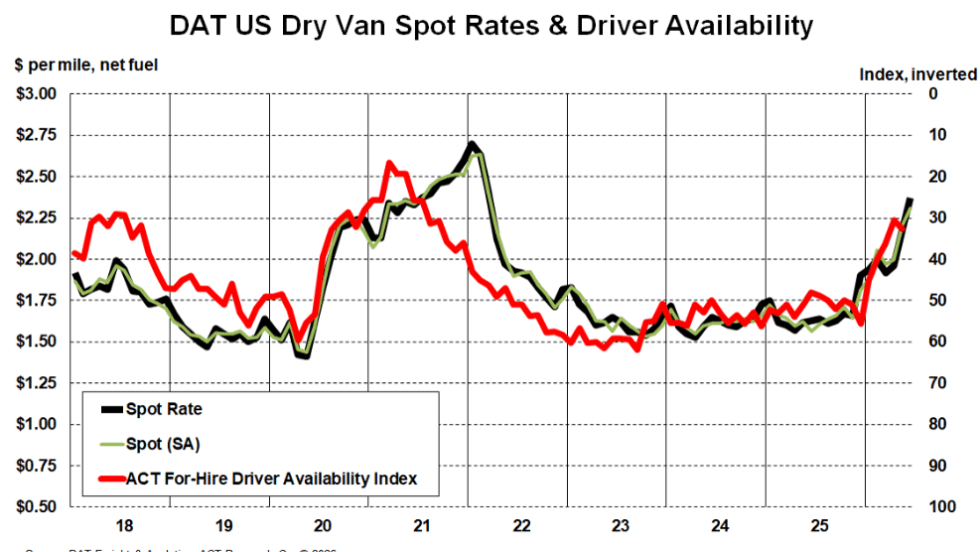
Truckload Rates Keep Rising as Tight Capacity Fuels Freight Market Recovery
Spot and contract rates continued climbing in May and June, not because freight demand is surging, but because fewer trucks and drivers are available.
Read More →
What Geotab's New AI Connector Means for Fleets
Fleets can now ask their usual AI assistants questions about maintenance, safety, fuel use, and vehicle performance, using their live Geotab data, and take action on the answers without leaving their preferred AI tool.
Read More →
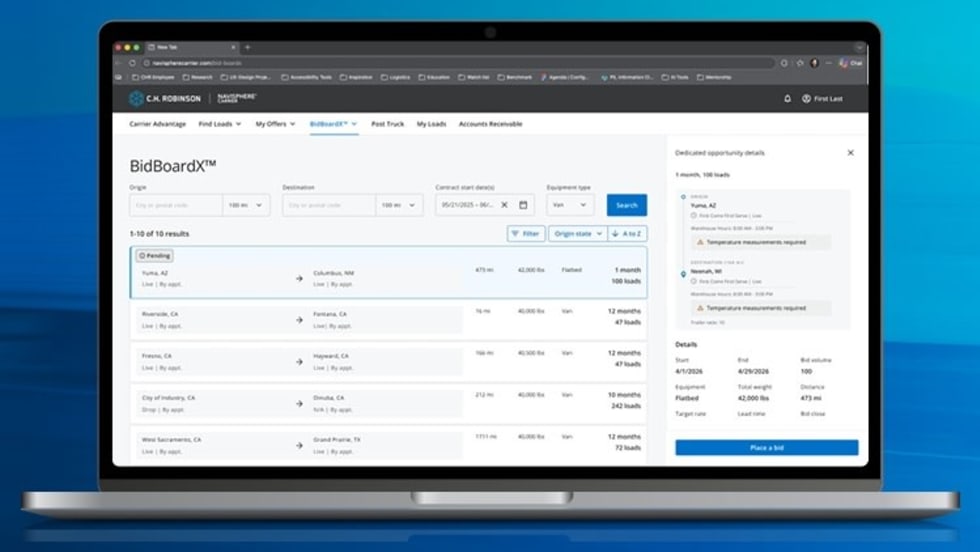
New C.H. Robinson Tool Opens Door to More Predictable Freight
BidBoardX lets carriers search, bid on, and secure committed freight opportunities through a single digital marketplace.
Read More →
New York City's Microhub Project is Delivering Results
Trucking, last-mile delivery companies, and environmental advocates like what they are seeing so far with New York's microhub program.
Read More →
Why Truck Detention Keeps Costing Fleets Time and Money
A 2024 ATRI study found detention affects nearly 40% of truckload stops and costs the industry more than $15 billion annually. Despite the toll on drivers, fleets, and supply chains, the problem remains stubbornly persistent.
Read More →
Time is Running Out to Apply for Exclusive HDT Event
Heavy Duty Trucking Exchange brings fleet managers and suppliers together for the deeper conversations that lead to ideas, partnerships, and solutions. Time is running out to apply for the September event.
Read More →
Amazon Launches Less-Than-Truckload Freight Offering for All Businesses
This launch is the latest addition to Amazon Supply Chain Services, a portfolio of supply chain capabilities from Amazon, including freight, distribution, fulfillment, and parcel shipping.
Read More →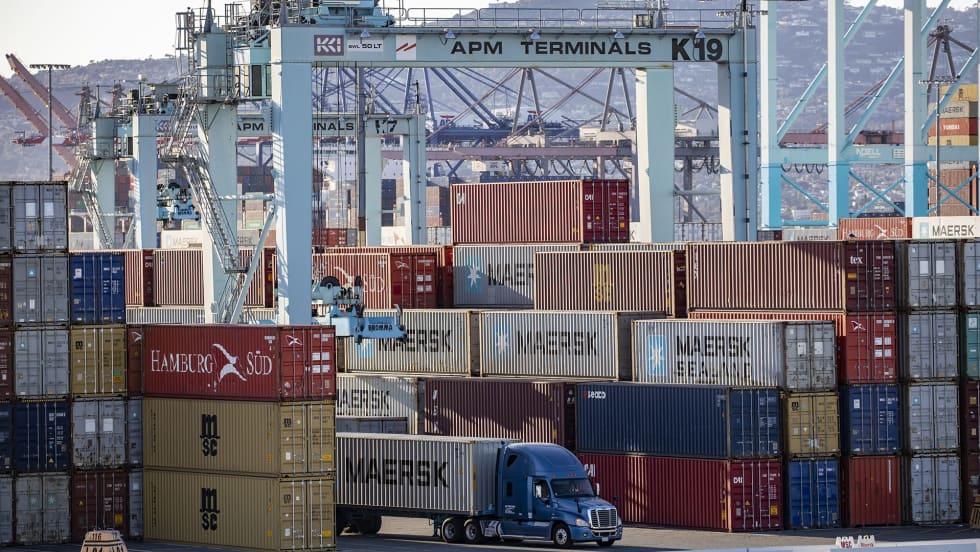
Import Cargo Volume to See Year-Over-Year Gain Again in June, Then Remain Below 2025 Levels Into Fall
After July, the report predicts a weakening in import volume as consumer uncertainty remains high and the impact of increasing inflation takes its toll.
Read More →
AUCTION OF EQUITY INTEREST IN HEAVY HAUL TRUCKING COMPANY!!
Mark your calendar: June 30, 2026 (10:00 a.m. PDT). A 37.5% ownership interest in MagnaTrans, LLC, a California limited liability company doing business as Magna Transportation Group, will be sold in an in-person and online auction to the highest bidder or bidders under Article 9 of the Uniform Commercial Code. The Rancho Cucamonga-based heavy haul and over-dimensional trucking company operates across California, Oregon, and Arizona.
Read More →