




The Feds' Safety Wish List
Topping the list of federal initiatives on truck safety technology is a proposal due any time from the National Highway Traffic Safety Administration to require stability control systems on heavy-duty tractors


An estimated 25% of new trucks have stability control systems, such as the one Bendix offers.
Topping the list of federal initiatives on truck safety technology is a proposal due any time from the National Highway Traffic Safety Administration to require stability control systems on heavy-duty tractors.
The agency also is working on a proposal for mandatory speed limiters and is studying forward collision warning, lane departure warning and collision-imminent braking technology. It has begun discussions on crashworthiness standards.
The stability control proposal could lead to a mandate for technology that many carriers already have adopted. Major suppliers of stability control systems, Bendix Commercial Vehicle Systems and Meritor Wabco Vehicle Control Systems, estimate that as many as 25% of new trucks have these controls. Among tank truck carriers, in particular, stability control is practically standard, according to John Conley, president of National Tank Truck Carriers.
Ted Scott, engineering director at American Trucking Associations, says the association is likely to support the proposal.Owner-operators likely will oppose a mandate. It's a cost issue, says a spokesman for the Owner-Operator Independent Drivers Association. A stability control system on top of other federal requirements could be more than small businesses can afford, he says.
Details of the proposal were not available as HDT went to press. At press time, it was at the White House Office of Management and Budget, the last step before publication.
However, it is clear from the record that the proposal will cover only tractors, rather than tractors and trailers, and that it is not likely to include a retrofit requirement.
NHTSA says its research shows the technology can provide a significant safety benefit.
Rollover and loss-of-control crashes are responsible for 304 deaths and 2,738 injuries a year, and the agency estimates the systems will save as many as 66 lives and prevent almost 1,000 injuries a year.
The out-of-pocket cost to carriers would be as much as $107 million a year, but the savings from preventing property damage and travel delays alone would amount to $372 million, the agency says.
Which type?
The big question, which will not be answered until the NHTSA proposal goes public, is how the agency handles the distinction between the two types of stability systems on the market, roll stability control and electronic stability control.
Both systems perform a similar function: If sensors detect the risk of rollover or instability, the control module slows the vehicle by cutting back the throttle and applying the brakes automatically.
The difference is that RSC is triggered only when the system detects roll instability, which might occur when a truck is going too fast into a turn or maneuvers too quickly. ESC, in contrast, reacts to both roll instability and yaw instability, such as a skid that could lead to a jackknife. In addition to slowing the vehicle to prevent a rollover, it applies the brakes on the wheel that needs to be slowed to counteract the skid.
Studies have demonstrated that both systems are effective but not equally so. In 2009 the University of Michigan Transportation Institute concluded that if all five-axle tractor-trailers had RSC, there would be 3,489 fewer crashes and 106 fewer deaths each year. If all of these trucks had ESC, there would be 4,659 fewer crashes and 126 fewer deaths.
The other difference is cost. Costs range from $800 to $1,600 for RSC, while ESC might go for $1,800 to $2,300. Discounts are common, though, and if NHTSA mandates the systems, prices should go down due to economies of scale.
Dan Murray, vice president of research for the American Transportation Research Institute, says the institute will soon begin looking into the cost-benefit breakdown between RSC and ESC.
"A number of carriers have internal data showing that while ESC has a few extra crash scenarios thrown in because of the lateral sensors, RSC may have a better cost-benefit outcome because it does most of what ESC does at a lower cost," he says.
Speed limiters
NHTSA also is working on a proposal to require speed limiters in tractors. The proposal is in the drafting stage and is not scheduled for publication until September at the
earliest, which would push a final rule well into 2013.
The details of what the agency will propose are not available, but discussions so far have centered on a 68-mph limit that would apply to all trucks built after 1992, which means virtually all highway trucks.
This proposal is being pushed by ATA and the activist group Road Safe America. Both see safety benefits - the faster a driver is going, the less time he has to respond and the worse any crash is likely to be - but ATA also says speeding contributes to a poor public perception of the industry.
In addition, there's an economic rationale. The Technology & Maintenance Council of ATA notes that an increase of 1 mph results in a 0.1 mpg increase in fuel consumption.
OOIDA does not like the idea, however. It says a speed limiter would harm safety by creating a speed differential between cars and trucks. It also contends that ATA wants limiters in all trucks so its members can recruit drivers who now gravitate toward companies that don't limit speed.
The Federal Motor Carrier Safety Administration recently weighed in with a study that found a "profound safety benefit" for trucks with speed limiters. Using three years of data from 15,000 crashes involving about 138,000 trucks and 20 carriers, the research that the crash rate ratio for trucks without limiters was almost twice that of trucks with limiters.
Crashworthiness standards
Although ATA and OOIDA are at odds on many of these issues, they are united when it comes to protecting truck drivers involved in crashes.
Last year, they jointly petitioned NHTSA for crashworthiness standards like those the agency requires for automobiles. Some 700 truck drivers die each year in single- or multi-vehicle crashes, the groups said.
Rollover crashes are the most dangerous, accounting for about 63% of fatalities. The first priority in these crashes is to keep the driver in the cab and protect him during the violence of the motion.
"An annual reduction in fatalities of approximately 23% is possible if cab structural integrity can be improved sufficiently to prevent crushing in rollover," the groups said.
In addition to structural standards, the most promising countermeasures are seat belts in combination with air bags, stronger windshields and doors, and more forgiving interior surfaces, they said.
The agency did not say no, but it didn't say yes, either.
Administrator David Strickland said in his reply to ATA that although the agency would be pleased to discuss crashworthiness, its research indicates that the best way to prevent driver injury is to prevent the crash in the first place.
That is the approach that led the agency to the stability control regulation. It also is behind NHTSA's ongoing research into other crash avoidance technologies, such as forward collision warning, collision-imminent braking and lane departure warning, Strickland said.
"The agency believes that such technologies offer the most effective and practical approach to enhancing truck safety," he said.
Recently, trucking interests got a provision in pending highway legislation that would require NHTSA to conduct a comprehensive analysis on crashworthiness standards.
The bill has not yet passed, but the message is clear: Congress is interested in this research. Recently, the agency scheduled a mid-April meeting to discuss the issue, says ATA's Scott.
While regulators have been focused on crash-prevention technologies, OOIDA's concern is to make certain that the driver survives if th
More Safety & Compliance

Kodiak Lines Up Fleets for Driverless Trucking
An agreement for 75 trucks, a new Texas freight lane, and progress on safety validation move Kodiak closer to its planned driverless highway launch.
Read More →
More Trailer Data Through the Same Seven-Way [Video]
Can trucking’s standard seven-way connector handle more cameras and trailer data? Grote’s Adam Slade shows HDT how the company is using new technology with its 4See trailer system, not only to add a new backup camera but also to expand other capabilities — without adding another connection.
Read More →
PrePass Intelligence Mines Fleet Bypass, Toll and Safety Data
PrePass Intelligence helps fleets measure bypass savings, flag potential toll overcharges, and spot suspicious transactions by combining data from separate systems.
Read More →
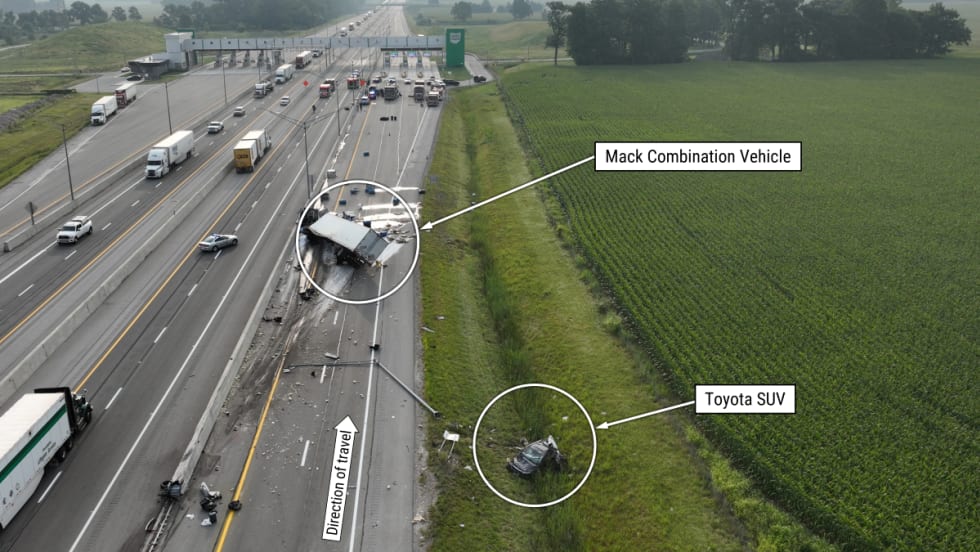
Fatal Crash Exposes Toll Plaza Risks
An NTSB investigation found that last-minute lane changes and large speed differences at an Ohio toll plaza created a hazard the truck driver couldn't avoid in time.
Read More →
When Language Stops the Truck: The Return of ELP Out-of-Service Orders
English language proficiency rules for commercial drivers aren’t new, but renewed out-of-service enforcement has raised the stakes. Here’s what carriers need to know before a driver reaches a roadside inspection.
Read More →
A Camera Isn't a Safety Program. Here's What Brokers Are Screening for Now
Footage alone may not be enough to pass broker vetting processes. Here's what counts as a defensible safety program now.
Read More →
Marijuana and Trucking’s Drug-Testing Dilemma
Marijuana is getting stronger, laws are changing, and drug tests still can’t reliably establish impairment. What does that mean for truck drivers and the fleets that employ them?
Read More →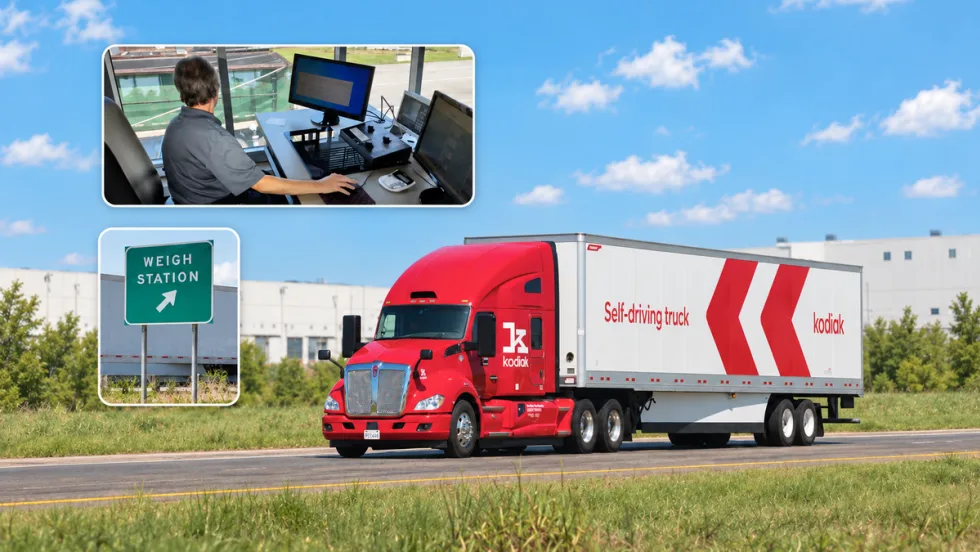
PrePass, Kodiak Connect Driverless Trucks to Roadside Enforcement
The system will allow enforcement agencies to verify Enhanced Inspection information and decide whether Kodiak’s autonomous trucks can bypass roadside screening sites.
Read More →
From One Generation to the Next: How Mentorship Builds Safer Truck Drivers
After three decades in trucking, Harold Perry shares what he's learned about driver safety, mentorship, and helping the next generation build confidence behind the wheel.
Read More →
FMCSA Pauses Biennial-Update Enforcement Amid Motus Transition
Carriers whose updates were due on or after June 1 have more time, while FMCSA works to stabilize its new registration system and warns of phishing sites impersonating its new carrier registration system, Motus.
Read More →