




The Challenge of Standardizing Aerodynamic Testing
Aero device manufacturers now have a choice of test methods to prove the effectiveness of their devices. Are consumers any better off?

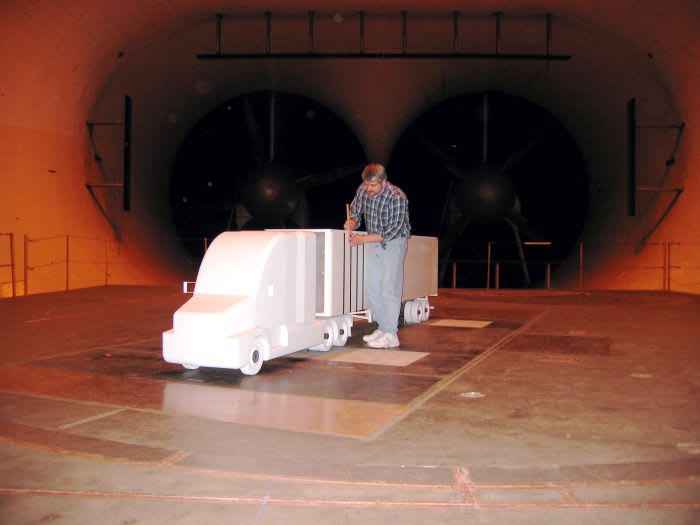
One of the new testing methods allowed for EPA SmartWay verification is wind tunnel testing. Here a scale model is prepped carefully before the test; small irregularities can make a big difference in the outcome.
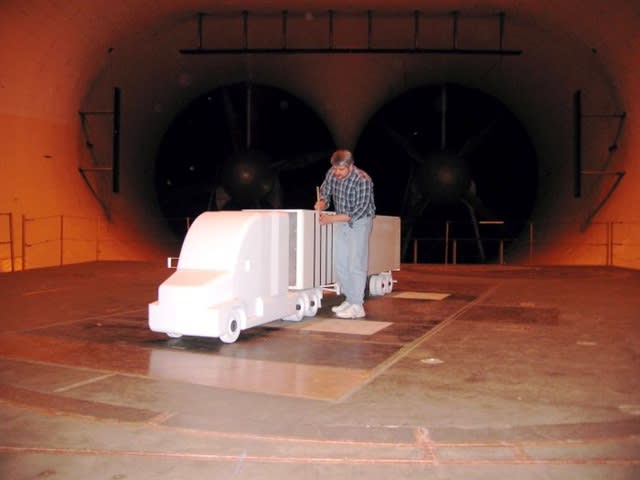
One of the new testing methods allowed for EPA SmartWay verification is wind tunnel testing. Here a scale model is prepped carefully before the test; small irregularities can make a big difference in the outcome.
Trying to standardize evaluations of aerodynamic devices is challenging. On one hand, you have to establish testing methods that will yield results consumers can have faith in. On the other hand, consumers need to recognize that the results of standardized tests may not reflect their operational realities.
Somewhere in the middle lies the U.S. Environmental Protection Agency’s SmartWay Trailer and Aerodynamic Device Program.
Until recently, trailer aero technology suppliers had to use a version of the Society of Automotive Engineers’ J1321 track test to have their product accepted and verified by SmartWay. Now they have a choice of three methods, each with its own benefits and challenges. Fleets may have to accept data from test methods that may favor certain devices, or place their faith in “fuel savings” numbers that are mathematically derived from a series of very complex calculations rather than direct fuel-used comparisons between test and control vehicles.
“It’s a difficult situation for EPA,” says Rick Mihelic, a retired manager of vehicle performance and engineering analysis with a major OEM. “Marketplaces want simple answers to hard questions. When those simpler answers are provided, they sometimes get abused for not being accurate.”
Mihelic cites a former California-based customer whose operation was not remotely similar to the test protocol and was disappointed in the performance of the trailer skirts it purchased.
The test measured fuel use differences from a pair of test vehicles tested at 60 or 65 mph. In California, he explains, “average truck speeds are capped at 55 mph and average speeds with traffic conditions and secondary road operations can be as low as 40 mph. The quoted savings was applicable to the test conditions, but did not simulate the customer’s specific actual operations.”
SmartWay’s new testing and reporting protocols (see page 72) may prove too simple for the marketplace, but at the same time, they will be technically challenging for manufacturers.
SmartWay now displays verified devices in a table rather than a list. The table lists the device in a certain performance “bin,” and it also shows the method used to test the device with a check mark in the appropriate column. The table will show a star to indicate if the device’s performance was also tested using an optional second test method.
“Suppliers now have the option, and we certainly hope there is an incentive, to test the same device or combination of devices using multiple test methods,” says Sam Waltzer, an environmental engineer at EPA and SmartWay’s Technology Team leader for heavy trucks.
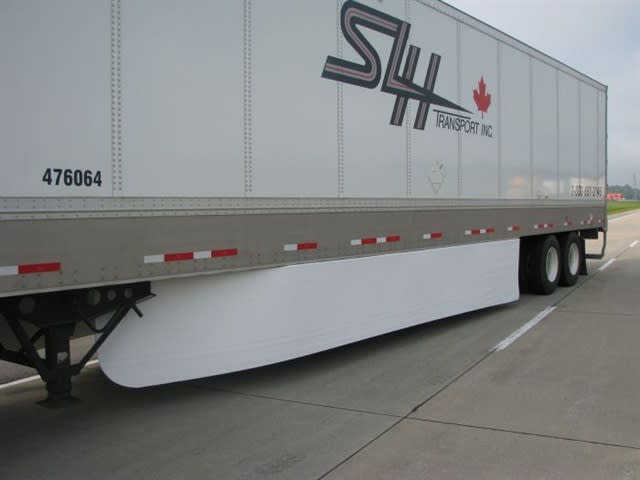
When it comes to trailer skirts, the longer and taller the better.
So far, so good. Providing data from two test methods should help inspire confidence in the results at the consumer level – if the suppliers decide to shell out $20,000 to $40,000 for two separate tests. At press time, none of the products on the SmartWay Verified Aerodynamic Devices table showed results from the optional secondary test.
SmartWay is working on testing protocols for four testing options: SAE J1321 Type II track test (SmartWay modified 2012 version), coast-down, wind tunnel, and computational fluid dynamics (CFD). The CFD method will not be allowed as a primary SmartWay verification test but can be used to provide that secondary, optional data.
The actual SmartWay protocols are not yet posted on the program’s website, but generally speaking, here are the pros and cons of the various test methods.
For better or worse
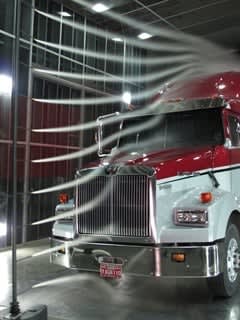
Smoke streams are used to help designers and engineers fine tune the shape. They are not used in actual aerodynamic testing in a wind tunnel.
The J1321 track test is the only test that gives you an actual fuel-consumed value, while trying to eliminate or isolate as many variables as possible that could impact the test. These would include unforeseen winds, track geometry, and/or truck-specific factors. Properly notated, the results of a J1321 test would give you a percent of fuel saved number, say 5% with a confidence interval (also known as uncertainty value or margin of error), of, for example, plus or minus 1.5%. (Read part one in the March issue for more on confidence intervals/uncertainty values.)
In coast-down, CFD and the wind tunnel, fuel saved can only be a calculated value based on the reduction in drag demonstrated by the device(s) on a test truck or model. The confidence interval is much harder to calculate.
According to Kevin Cooper, president of CooperAero Ltd. and a former wind tunnel technician and engineer with Canada’s National Research Council wind tunnel programs in Ottawa, Ontario, this does offer the advantage of being able to average the drag curve in a way that should represent a truck’s exposure to North American average wind conditions.
“That won’t be anybody’s actual number necessarily, but that gives you a better number in a way, and everything is weighted the same,” he points out. “It’s like the EPA’s track test number; no one ever gets that on the road, but it’s usually a good indicator of what’s better is better and what’s poorer is poorer.”
If there’s a problem with the wind tunnel, it’s calculating the percent-fuel-savings figure. It will be a calculated value, and therefore influenced by the variables in the testing process.
“Wind tunnel testing gives you an aerodynamic term, a drag coefficient,” explains Richard Wood, past chairman of the Society of Automotive Engineers’ Truck and Bus Aerodynamic and Fuel Economy Committee. “It’s done in a laboratory environment where you have a high degree of repeatability, but getting the fuel-saved number requires some very complex calculations. It also fails to provide a confidence interval, that plus-or-minus value that tells you how trustworthy the fuel-saved figure really is.”
Coast-down testing, like the J1321 Type II test, is done outdoors, so it’s subject to environmental factors like wind. These can be controlled for. The track is critical as well, in that the test portion must be completely flat and straight, as both can affect the test.
In a coast-down test, the test truck is run at a predetermined speed, usually 65 mph, and on a straight, flat section of track, the truck is placed in neutral and allowed to coast down to some predetermined speed. Measurements are taken to determine the relative impact of rolling resistance and mechanical drag (usually constant) and aerodynamic drag (variable with speed). The test requires 20-30 runs and each is measured, compared and averaged along a curve.
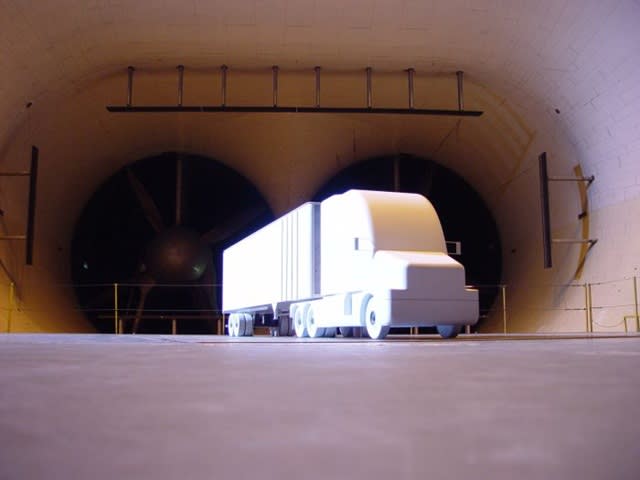
Scale models of trucks are often used in wind tunnels to minimize interference from the tunnel itself.
“What it gives you is a ‘road load’ number, which is rolling resistance, mechanical resistance and aerodynamic resistance,” Wood says. “In coast-down testing you measure a total number and then through mathematics and assumed relationships you try to pull out an aerodynamic number.”
According to Wood, coast-down was developed for the automobile industry as way to prove that data collected in a wind tunnel using scale models could be correlated to real-world car-on-the-road effects of aerodynamic drag.
“The coast-down tests provide comparisons that could be mathematically manipulated to relate to wind tunnel test data,” he says. “But is doesn’t transfer easily to trucks because of the complexity of their shape.”
The other problem with coast-down is that it cannot be used to generate comparative data. Every other procedure allows you to calculate an uncertainty, so you can do a direct comparison. But coast-down does not allow that. A coast-down test gives you one result for one vehicle for one test.
CFD testing is also on SmartWay’s radar screen, but it has some challenges and limitations as well.
“I know EPA is talking about it, but I think it’s going to take a long time before they get there,” says one testing expert we spoke to who did not want his name used. “They are going to need to establish a protocol for everyone to follow so that the results can be compared objectively.”
He describes CFD as like watching a test in real time; you see a cycle that’s always moving.
“The question is, where do you stop the cycle to get some sort of result?” he asks, adding, “EPA will have to establish some way to interpret the results.”
CFD is highly repeatable, but it’s still a computer simulation. It’s based on certain data inputs and calculations along with a huge number of assumptions about how the truck performs in air and how air behaves around a moving truck – with all its complex shapes, like mirrors, grilles, engines, and air flow under the hood and around the undercarriage. Not that the process is prone to error, but errors can be built into the simulation in the way the problem is set up.
“What CFD gives you is a coefficient of drag, which then has to be rendered into a fuel saved number,” Wood says. “That requires extensive calculations based on engine maps, tire rolling resistance and other factors.”
So there you have it, an over-simplified assessment of the pros and cons of the testing procedures and protocols we expect to see someday soon from the EPA’s SmartWay Trailer and Aerodynamic Device Program.
More Fuel Smarts

How Volvo Updated Its D13 for EPA 2027 [Watch]
Volvo’s updated D13 promises lower emissions without sacrificing performance or fuel economy. Take a closer look at what changed inside the engine in this HDT Spotlight video.
Read More →
Diesel Price Spike Shortens Payback for Natural Gas Trucks, Report Says
Energy Vision estimates fleets could recover the higher purchase price of an RNG-fueled Class 8 tractor in 1.3 to 2.8 years under current fuel-price scenarios.
Read More →
Calstart Becomes Catalyst Mobility, Reflecting Broader Focus
Calstart is now Catalyst Mobility, reflecting the nonprofit’s growing national role in clean transportation, including zero-emission trucks, infrastructure and incentive programs.
Read More →

Record Diesel Prices Squeeze Trucking Fleets
Average U.S. diesel prices have climbed to nearly $6 a gallon, surpassing the 2022 record as tight refinery capacity and Middle East disruptions keep fuel costs elevated.
Read More →
How Fuel Delivery Shapes Engine Performance
Fuel delivery depends on more than what happens at the injector. For fleet, maintenance and technical professionals, looking at the full path from pump to injector can provide useful context for understanding engine performance.
Read More →
East Coast Port Launches $45M Electric Truck Push
The Port Authority of New York and New Jersey announced millions in incentives for zero-emission drayage trucks, yard tractors, and new charging hubs near the port.
Read More →
California Bill Could Shed Light on Electric Truck Prices
Why do battery-electric Class 8 trucks remain so expensive? A California bill headed to Gov. Gavin Newsom would give fleets and state agencies more visibility into what manufacturers charge.
Read More →
Detroit Opens Orders for EPA 2027 Engines
Detroit isn’t starting from scratch to meet EPA 2027 diesel emissions standards. Its Gen 6 DD13 and DD15 engines keep much of today’s platform while updating the fuel and aftertreatment systems.
Read More →
Zero-Emission Truck Corridor Planned for West Coast
California, Oregon, Washington, British Columbia and Baja California are coordinating plans for truck charging and hydrogen fueling from Canada to Mexico.
Read More →
A Closer Look at Kenworth’s Electric T880E Vocational Truck [Video]
Learn more about Kenworth's T880E battery-electric vocational truck at the Paccar Technical Center, including its range, applications, upfitting considerations, and PTO options, in this HDT Spotlight video.
Read More →