




Is CARB Snubbing Natural Gas as a Truck Fuel?
Renewable natural gas isn't perfect as a truck fuel. But, from availability, performance and infrastructure standpoints, no other fuel comes close to it today, proponents argue.

Renewable natural gas isn't a perfect fuel from an emissions standpoint. But is there anything better available today?
Photo: HDT/Canva
Renewable natural gas may not be a perfect fuel for trucks, as Jim Nebergall, general manager, hydrogen internal combustion engines, Cummins, noted in Part 1 of this series on The Case for RNG in Trucking.
But RNG is a fuel that is ready for prime time, argues Chad Lindholm, vice president, sales, Clean Energy.
“In 2024, the natural gas industry will provide nearly one billion gallons of RNG to fleets in North America,” he says. “And that’s fuel produced entirely from organic waste. RNG is a created by capturing methane produced in landfills or on dairy farms.
"By capturing that methane before it is released into the atmosphere, you’re doing even more to reduce our carbon footprint – long before the fuel is used in a truck.”
The transportation industry is the hardest sector of a modern economy to decarbonize, Lindholm explains. But, a widespread switch to renewable natural gas could reduce carbon emissions in trucking by an average of 30%.
“There’s not another fuel or technology that can do that today,” he says.
Winning the Well to Wheel Emissions Debate
A key problem, Lindholm says, is that environmental regulators tend to focus on tailpipe emissions exclusively. “And really, the discussion needs to shift to well-to-wheel,” he says.
The term “well to wheel” refers to the method of evaluating the efficiency and environmental impact of a fuel or ZEV propulsion system as it relates to its entire life cycle. This means looking at how the fuel is produced in the first place, how it is transported and stored, and what happens (in the case of a fuel) when it is burned or consumed to create energy to power a vehicle.
“Five years ago, I was very frustrated and concerned about that regulatory disconnect,” Lindholm says. “But I think that as the industry has gotten real-world feedback on new transportation technologies, we’re getting a clear picture of what truly works. And we can better understand what that means for the future of trucking.
"So, I think regulators and policymakers are finally getting beyond the headlines and zeroing in on solutions that work today.”
And that’s good news for RNG, Lindholm adds. That’s because RNG checks the boxes when it comes to the environment and sustainability.
“But beyond that, the next thing any fleet is going to look at is economics,” Lindholm says. “They want to know what any new fuel or technology is going to cost them. Because they have to pass any increased costs on (ultimately) to the consumer.”
And this is where renewable natural gas really shines from a fleet perspective, Lindholm argues.
“We have a fuel today that saves fleets, on average, over $2 a gallon on fuel,” he says. “So right there in itself, when you plug that into a total cost of ownership model, you have a full package ready to go: A truck running a Cummins X15N utilizing RNG fuel, makes total business sense to that fleet’s bottom line. And that's what's ultimately going to move this market toward RNG as a truck fuel.”
Renewable Natural Gas 101
The key to getting the maximum environmental benefit possible from natural gas engines lies in using RNG as the primary fuel.
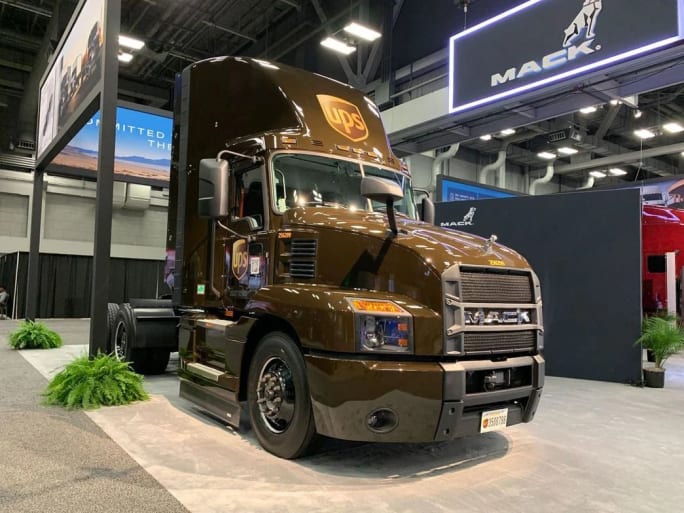
UPS has the second largest CNG fleet in North America today, and almost 30 years' experience with the fuel.
Photo: Deborah Lockridge
Dan Gage, president of the Transport Project, hosted a roundtable discussion on the benefits of renewable natural gas (RNG) during ATA MCE 2024 in Nashville, on October 13.
The Transport Project is a national organization representing the natural gas in transportation industry. The panel’s goal was to outline the benefits of natural gas as a truck fuel and call for action by the industry to push legislators to formally incorporate its use into decarbonization legislation going forward.
Gage was joined on the panel by:
Ryan Bankerd, director of sustainability, UPS Corporate Affairs
Matt Copot, VP, fleet maintenance, Saia LTL Freight
Matthew Spears, executive director, global regulatory affairs, Cummins
Eric Bippus, EVP, sales and systems engineering, Hexagon Agility
Brett Lindsay, VP, national accounts, Clean Energy
Marty Tufte, corporate fleet director, Waste Management, and Chair of the Transportation Project
Gage opened the discussion with an overview of what RNG is and how it differs from fossil fuel-derived natural gas.
“It's a low carbon fuel,” he explains. “And on the chemical level, its exactly the same as natural gas obtained by drilling. And that's a good thing, because it means we can use the existing natural gas infrastructure to distribute RNG to fueling stations nationwide.”
What makes RNG different is the source, Gage went on. RNG is made entirely from organic waste. It doesn't involve drilling or fracking. It is not a fossil fuel.
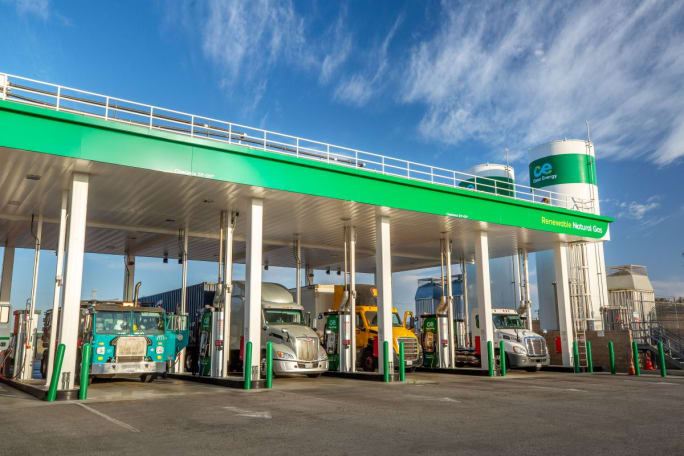
One strong argument for the use of renewable natural case in trucking is that its infrastructure and fueling network is already well established on a national level.
Photo: Clean Energy
“When organic matter decomposes, it naturally releases methane, one of three gases most detrimental to the environment,” Gage says. “That's why places with large quantities of waste, like landfills and livestock farms are responsible for nearly a quarter of methane emissions in the U.S.”
Cow manure (or other organic waste materials) are first collected and placed into a large tank called a digester. As the manure decomposes, the digester traps the methane, preventing it from entering and damaging the atmosphere. It's then processed and purified into RNG and dropped into the interstate pipeline system for rapid distribution to clean energy fueling stations nationwide.
What makes RNG such a powerful tool in the fight against climate change, Gage adds, is that RNG reduces carbon emissions both at the source where it's made, and on the road when used as a fuel in a natural gas engine like the Cummins X15N.
Burning RNG as a fuel in heavy duty truck engines delivers the same power, torque and range as diesel trucks, Gage notes. But RNG also eliminates carbon emissions by up to 300% (compared to diesel) as an affordable renewable fuel that's available now.
A Fuel with a Winning Track Record
Waste Management has been a pioneer in the use of natural gas as a fleet fuel. The company first began running trucks with CNG in the late 1990s, Tufte says. Today, the fleet is running more than 13,000 natural gas Class 8 trucks on daily routes. Waste Management also has 210 proprietary natural gas fueling stations that it designed, built and operates. And 26 of those stations are retail locations that are open to the public. The fleet also has over 2,000 technicians trained to work on natural gas engines and fuel systems. And it has over 10,000 drivers trained on running natural gas-powered trucks.”
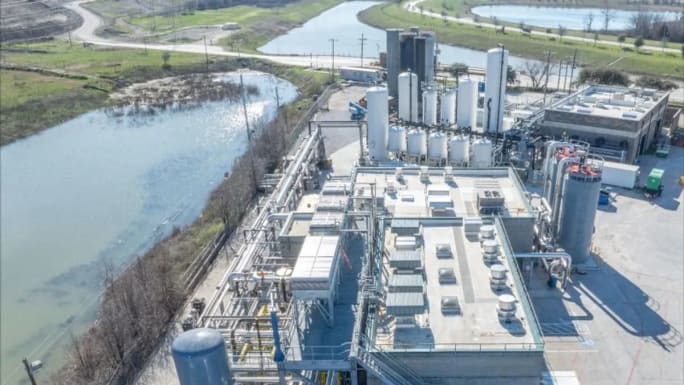
Waste Management currently has seven RNG production facilities in operation, including this site near the Dallas-Fort Worth Airport.
Photo: Waste Management
“We have over $4 billion invested in natural gas,” Tufte told MCE attendees. “In 2023, we displaced over 100 million gallons of diesel fuel. This used to be a pet project of mine. And now it’s simply how we do business.”
By early 2026, Tufte adds, Waste Management’s fleet will be 100% RNG powered. “We have seven RNG production facilities up and running,” he says. “We have 17 more coming online in the near future. And once we’re able to fuel our entire fleet and have excess, we will begin selling RNG at retail prices.”
Normally, UPS is ranked as the biggest natural gas-powered fleet in North America. And that is true – if you discount refuse applications.
“We are definitely Number Two, compared to Waste Management,” Bankerd chuckled, after Tufte finished speaking. “And UPS also realized in the 1990s – around the same time as Waste Management – that natural gas just made good sense in fleet operations.
"As we began to explore its possibilities, we partnered with Cummins. I think we're on our fifth generation of engines now, with the 15-liter engine. And we've solved a lot of problems and worked out a lot of issues.
"We believe there's a great opportunity here, especially when you overlay the biofuel side of this technology — which is RNG — and that we can really make a positive impact customers and environment burning this fuel today.”
Indeed, Lindholm points to UPS as an early and consistent success story when it comes to natural gas in trucking applications.
“UPS has been a long believer in exploring all technology options to reduce their carbon footprint,” he notes. “They’ve been running natural gas tractors on the road for many, many years. And we’re excited to see that solution now expand into the LTL space.”
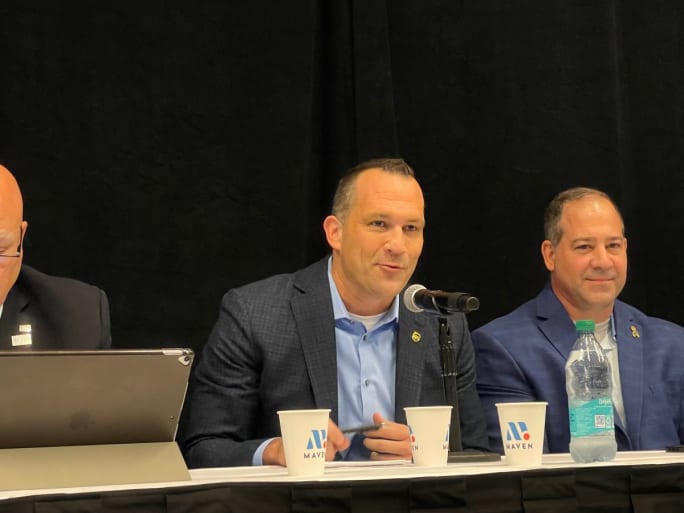
Ryan Bankerd said UPS believes that RNG combined with mature CNG engines and fuel systems can make a positive impact on diesel exhaust emissions.
Photo: Jack Roberts
And the crossover benefits are obvious as well, Lindholm argues.
“You have a fuel system that can carry more than 200 gallons of fuel onboard a truck,” he says. “That easily takes trucks out around 1,000 miles in terms of range. And the engines today have diesel-like performance and reliability. So, both drivers and fleets have the horsepower and torque they need to get over grades and easily haul 80,000 lbs. without having to compromise any other part of their operations.”
Things get even better when the conversation shifts to infrastructure, Lindholm adds.
“People don’t realize that on top of the millions of proven miles run on natural gas, this is a fuel with a pipeline infrastructure that is already in place,” he notes.
“Natural gas already serves all the major distribution hubs across the country. And having the ability to inject RNG into those existing pipelines makes it a no-brainer in terms of a quick, easy solution that reduces trucking’s carbon footprint.”
Editor's Note: A typographical error resulted in a sentence saying "a widespread switch to renewable natural gas could reduce carbon emissions in trucking by an average of 300%." As a sharp-eyed reader pointed out, that's mathematically impossible. It has been corrected to 30%.
More Fuel Smarts

How Volvo Updated Its D13 for EPA 2027 [Watch]
Volvo’s updated D13 promises lower emissions without sacrificing performance or fuel economy. Take a closer look at what changed inside the engine in this HDT Spotlight video.
Read More →
Diesel Price Spike Shortens Payback for Natural Gas Trucks, Report Says
Energy Vision estimates fleets could recover the higher purchase price of an RNG-fueled Class 8 tractor in 1.3 to 2.8 years under current fuel-price scenarios.
Read More →
Calstart Becomes Catalyst Mobility, Reflecting Broader Focus
Calstart is now Catalyst Mobility, reflecting the nonprofit’s growing national role in clean transportation, including zero-emission trucks, infrastructure and incentive programs.
Read More →

Record Diesel Prices Squeeze Trucking Fleets
Average U.S. diesel prices have climbed to nearly $6 a gallon, surpassing the 2022 record as tight refinery capacity and Middle East disruptions keep fuel costs elevated.
Read More →
How Fuel Delivery Shapes Engine Performance
Fuel delivery depends on more than what happens at the injector. For fleet, maintenance and technical professionals, looking at the full path from pump to injector can provide useful context for understanding engine performance.
Read More →
East Coast Port Launches $45M Electric Truck Push
The Port Authority of New York and New Jersey announced millions in incentives for zero-emission drayage trucks, yard tractors, and new charging hubs near the port.
Read More →
California Bill Could Shed Light on Electric Truck Prices
Why do battery-electric Class 8 trucks remain so expensive? A California bill headed to Gov. Gavin Newsom would give fleets and state agencies more visibility into what manufacturers charge.
Read More →
Detroit Opens Orders for EPA 2027 Engines
Detroit isn’t starting from scratch to meet EPA 2027 diesel emissions standards. Its Gen 6 DD13 and DD15 engines keep much of today’s platform while updating the fuel and aftertreatment systems.
Read More →
Zero-Emission Truck Corridor Planned for West Coast
California, Oregon, Washington, British Columbia and Baja California are coordinating plans for truck charging and hydrogen fueling from Canada to Mexico.
Read More →
A Closer Look at Kenworth’s Electric T880E Vocational Truck [Video]
Learn more about Kenworth's T880E battery-electric vocational truck at the Paccar Technical Center, including its range, applications, upfitting considerations, and PTO options, in this HDT Spotlight video.
Read More →