




Test Drive: Peterbilt’s Fuel-Saving Model 579
Equipment Editor Jim Park gets an extended test drive of Peterbilt's UltraLoft integrated sleeper and Model 579's latest fuel-saving specs.

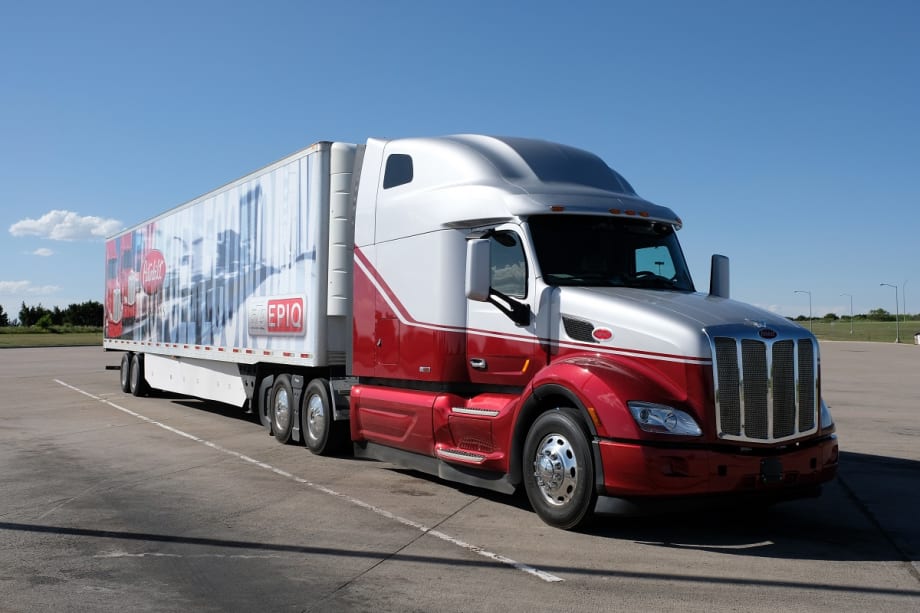
Peterbilt’s Model 579 was destined to become the company flagship from
the moment it was introduced in 2012.
Photos: Jim Park
What more could a driver ask for than to be cruising across the high plains of New Mexico and west Texas at 70 mph with a good tail wind in a Peterbilt Model 579? Such was my task in May, when Peterbilt asked if I wanted to go for a ride in a 579, delivering it from a sales meeting in Scottsdale, Arizona, back to the plant in Denton, Texas.
Seven years have passed since my first drive in a Peterbilt Model 579. That particular truck was built right around the time the model was being unveiled at the Mid-America Trucking Show in March of 2012. The model has only improved with the passing of time.
Designers added the Epiq aero-trim package in 2015, which included a roof fairing bridge to reduce the gap between truck and trailer, enhanced chassis fairings, rubber wheel closeouts on the front wheel wells, a bumper dam and a bumper-to-hood seal to improve the frontal profile. At the time, Peterbilt said that version would be up to 8% more efficient compared to the Epiq-less 579. In 2019, following even more refinements, the Model 579 can now claim to be the most fuel-efficient truck to ever wear the Peterbilt badge.
While the classic-styled Model 389 was top-of-the-heap when the 579 was introduced (and still maintains a very strong following today), fleets and even owner-operator priorities have shifted to more aerodynamic cab designs. The Model 579 was destined to become the company flagship from the moment it was introduced. This drive was a good chance to get re-acquainted.
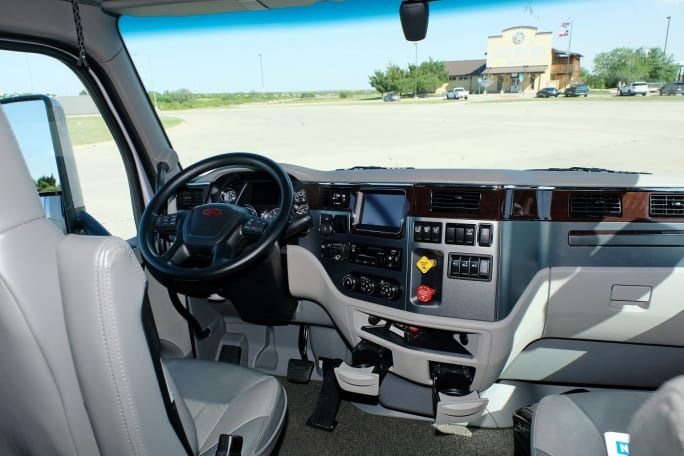
The Model 579 dash layout is attractive and functional, and there’s plenty of room overhead and between the seats for even the largest drivers.
On the road
I flew out Thursday afternoon and picked up the truck Friday morning. Peterbilt PR Manager Nick Smith and I spent the next two days driving 1,028 miles from Scottsdale to Denton. Our route took us on Arizona Highway 87 from Scottsdale to Payson, then Arizona 260 and Arizona 377 up to Holbrook, where we picked up I-40 eastbound. We ran I-40 east to Amarillo, Texas, where we swung southeast on U.S. 287 and rode that practically right to the Peterbilt factory in Denton.
I don’t know what the engineers had in mind when they spec’d the truck’s powertrain (see Spec Sheet on page 38), but I suspect it was a fairly generic truckload application, operating on flat to rolling terrain with a cruise speed of 65-70 mph (105-115 km/h) at a gross combination weight of 80,000 pounds or less. At 65 mph, the engine turned 1,100 rpm, just 100 rpm above a seemingly hardwired downshift point. It turned 1,200 rpm at 70 mph, leaving 200 rpm before dropping out of peak torque. I found the transmission hunted a bit while at 65 mph in the rolling hills but held 12th gear nicely on flat ground.
The 455-hp/1,650-lb-ft Paccar MX-13 did better than I expected it would on the 6% and 7% grades through the Mazatzal Mountains in central Arizona. I pulled the grades on Arizona 87 in 8th or 9th gear at 30-40 mph at a gross weight of about 77,600 pounds. Coming down said grades, I ran 7th gear at 1,800-2,000 rpm, toggling the engine brake between first and second position. The 579 has disc brakes all around, so I wasn’t worried about stopping. I just wanted to drive the descents as they should be done to see how well the 13L engine held me back.
Overall, driving a Model 579 is a real treat. The visibility is fantastic, it’s really quiet (67.2 dB on my iPhone sound meter app), and the Peterbilt air-leaf suspension shakes out all the rough stuff before it gets to the cab and the driver’s seat. And I always give top marks to Peterbilt’s steering geometry. You can’t go wrong with a Sheppard steering gear, and this 579 was no exception. Firm and sure-footed on the highway and not too firm for maneuvering in tight quarters.
The physical aspects of driving the truck are very good, with all the commonly used controls within easy reach. This one had steering-wheel mounted cruise and radio controls. Even the cup holders were in the right place, though the driver’s cup holder rattled a little.
My only beef with the dash layout comes from reaching for the headlight switch. Call me old-fashioned, but I still like to flash the lights for a passing driver, and the headlight switch is down low on the left side of the A-panel. To reach it, you have to squeeze your hand between the turn-signal stalk and the grab-handle mounted on the forward door post. Not a deal breaker, just a little awkward.
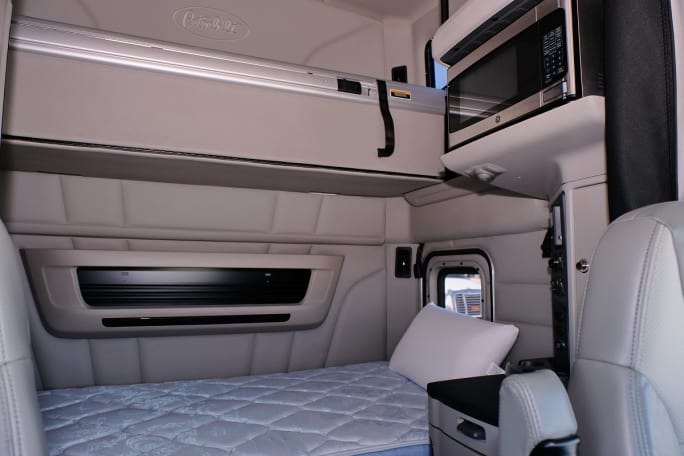
The living quarters are roomy and quiet. The upper bunk can serve as additional storage space when not occupied by a co-driver.
Living quarters
While I did not spend a night in the truck, I did have a good poke around inside the 80-inch UltraLoft sleeper, and it’s all it’s hyped-up to be. We had the double-bunk version, and the upper bunk remained stowed except to pull it down to get a few pictures of it. It deploys easily and stows with a fairly light push, as only about a third of the upper bed flips down. In the up position with a single driver, that space turns into storage. Even with the upper bunk in the down position, the space above the lower bunk isn’t cramped or claustrophobic.
The wardrobe cabinet on the right side is tall enough to begin with, but the hangar bar is mounted even higher in the cabinet. Drivers can hang even long/tall shirts in there without them dragging on the cabinet bottom.
The microwave cabinet can accommodate a near-full-size appliance, not the little shoe-box sized ovens we sometimes find in trucks. And speaking of larger appliances, the right-hand wall can fit a 32-inch flat-screen TV. That’s huge.
The other feature I really liked was the new thermal insulation package. While it’s said to maintain the internal temperature longer, it’s also a great noise attenuator. It’s quiet in there, even parked next to a roaring reefer. It also helps with the road noise generally, making the driving environment extremely quiet. In fact, the external profile of the sleeper, coupled with the aero cab, hood, etc., nearly eliminates wind noise. I was shooting some video while driving, and you could barely tell the difference with the driver-side window up or down. That lack of wind noise is a hallmark of a well-designed, aero-shaped cab and sleeper.
This was the longest run I’ve made since I stopped driving in 1998. With two 500-mile days, I probably deserved to be tired at the end of the shift, but I wasn’t. That’s a walk in the park for most drivers, but I’m fat and happy now behind my desk and rarely get any more than a few hours in a test truck. The 579 is a very nice truck to drive, and I turned my back on it wanting a little more as I walked away.
More Equipment

How Volvo Updated Its D13 for EPA 2027 [Watch]
Volvo’s updated D13 promises lower emissions without sacrificing performance or fuel economy. Take a closer look at what changed inside the engine in this HDT Spotlight video.
Read More →
Michelin Tire Improves Efficiency and Durability for Regional Fleets
The Michelin X Multi Energy D2 is a regional haul drive tire engineered to help fleets improve fuel efficiency, durability and traction in demanding stop-and-go operations.
Read More →
ZF Expands Commercial Vehicle Push in North America
ZF is expanding its North American commercial-vehicle presence with new transmission applications, electrification, trailer technology and autonomous-driving systems.
Read More →
Tesla Wants a Self-Driving Semi. Are Cameras Enough?
Could Tesla’s camera-only autonomous driving technology work on an 80,000-pound Semi? In this commentary, HDT's Deborah Lockridge takes a look at Tesla, Cybercab, and how autonomous trucks see the road.
Read More →
Kodiak: Driverless Long-Haul Truck Launch on Track for 2026
Kodiak AI says its driverless long-haul safety case is 93% complete and it remains on track to begin commercial operations by year-end 2026.
Read More →
What DOT’s Automated Vehicle Strategy Means for Trucking
The U.S. Department of Transportation issued a new automated-vehicle strategy that outlines plans for driverless-truck regulations, cross-state freight corridors, and federal safety standards.
Read More →
East Coast Port Launches $45M Electric Truck Push
The Port Authority of New York and New Jersey announced millions in incentives for zero-emission drayage trucks, yard tractors, and new charging hubs near the port.
Read More →
PlusAI Going Public to Fund Autonomous Truck Launch
A SPAC deal could provide PlusAI with up to $300 million as it works toward a 2027 commercial launch of factory-built autonomous trucks.
Read More →
NHTSA Moves to Rewrite Truck Fuel-Economy Rules
The National Highway Traffic Safety Administration says it lacks authority to regulate medium- and heavy-duty truck engines separately from complete vehicles, but the existing standards have not yet been eliminated.
Read More →
Detroit Opens Orders for EPA 2027 Engines
Detroit isn’t starting from scratch to meet EPA 2027 diesel emissions standards. Its Gen 6 DD13 and DD15 engines keep much of today’s platform while updating the fuel and aftertreatment systems.
Read More →