




Test Drive: Peterbilt Model 587 with Paccar MX Make Dynamic Duo
You can't argue with the design, engineering, and manufacturing synergies of improving on an existing product

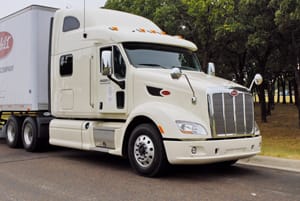
You can't argue with the design, engineering, and manufacturing synergies of improving on an existing product.
Peterbilt's Model 587 is an upgrade of the 10-year-old Model 387, but that's simply where the story begins. While the only readily obvious changes are the re-sculpted hood and some aero refinements around the cab, the enhancements made to the 587 run chassis-deep and windshield-tall.
The hardware is on point. So is the soft stuff, like ergonomics, visibility, and sound attenuation. It's a truck that'll please fleet owners as much as drivers.
When I slipped my bum into the driver's seat of the 587, the first thing that struck me was the view. The dashboard and instrument panel seemed taller than usual, but the forward visibility remained outstanding. The hood, from the driver's perch, is nearly invisible. My first impression was one of being safely ensconced behind the wheel of a truck that was designed as much for driver comfort and security as for safety and efficiency. I was anxious to get the pre-trip briefing over with and get out on the road, but without an introduction I wouldn't have much of a story.
Starting from the ground up, the 587 sits on the same chassis as the 386. Besides offering manufacturing efficiencies, this gives the 587 an additional 9 degrees of wheel cut compared to its predecessor. That comes from improved steering geometry and TRW's new high-pressure steering gear.
Engineers clearly paid a lot of attention to the front axle, and still brought it home at less than 11,000 pounds bobtail with a driver and about 200 gallons of fuel on board.
According to Peterbilt's chief engineer, Landon Sproul, improved forward visibility was one of the key design objectives.
"We had heard from shorter drivers that visibility over the hood of the 387 could be a problem," he said. "We were able to lower the front edge of the hood by a couple of inches, which shortens the distance the driver sees the ground in front of the truck by 2 feet."
Aerodynamic improvements were also high on the list. The 387 was good to begin with, but certain refinements improve the aerodynamics of the 587 by about 2.5 percent, according to Peterbilt. This was achieved mostly from re-sculpting the hood and the front end of the truck. The lip on the lower edge of the bumper, for example, improves the air flow under the bumper and around the wheels.
The electrical system has been revamped and now features extensive Gen II multiplexing and advanced diagnostics. You'll not find many wires under the dash, but those wires are pretty busy.
The engine compartment was pretty tidy, especially the firewall, and with some designed-in efficiency offered by the MX, routine maintenance and even some basic repair tasks appear to be less complex. Driver inspection items were easily accessible, with one notable exception. I predict more than a few jugs of oil will be spilled as drivers attempt to pour into the nearly concealed filler spout.
In The Cab
This truck was a fleet spec - rubber floor, vinyl upholstery, and just a handful of gauges. It's easy to impress guys like me with deep-pile carpet, leather seats, 7.1 surround sound entertainment systems (which I can never figure out how to operate), and a cooler full of soda. Having none of the above, this truck had to stand on its own humble merits, and stand it did.
Despite the lack of noise-dampening amenities, the cab was still very quiet. Not perhaps as quiet as the Cascadia or the ProStar, but I'd bet given the full treatment, it would be a contender. Visibility was amazing, and the set-forward mirrors leave little doubt as to what's happening beside the truck. The cab's build quality and fit and finish were very good to excellent, and despite near 100-degree ambient temperatures, I was very comfortable at the helm - even chilled.
If it lacked anything, it was a place to put little loose stuff, like change, pens, notepads, etc. As well, the window activation switches lacked a full-up or full-down detent. I know I'm whining here, but why should I have to keep my finger on the button when I've got more important things to do?
I found the truck highly maneuverable and easy to place on the road. Getting into and out of Peterbilt's Denton plant from I-35 can be a challenge. It's located on the far side of a couple of oddly difficult turns to steer through, but I got around the corners without curbing the trailer tires something I couldn't do with a 389.
The ride was firm and predictable, but smooth enough that none of the coffee left the cup I had stashed in the cup holder not very scientific, but a practical observation.
The MX Performs
I had the truck for only about five hours, so wanting to give it an effective workout I choose to avoid the traffic in the Dallas-Ft. Worth area. I'm sure it does as well in bumper-to-bumper traffic as any other truck out there. The Interstates in north Texas aren't that inspiring either, tending to be straight and flat - not much of a workout for a spiffy new engine. It's worth noting, however, that this particular truck was a customer spec. The application listed on the line-set ticket was 100-percent on-highway, meaning it was engineered for flat, straight four lane roads. I didn't think a little two-lane time would bother it.
I ran north from Denton on I-35 to Gainesville, and then headed west on U.S. 82 to Wichita Falls before heading back to Denton southeast along U.S. 287 and U.S. 380. The principal advantages of this route were the rolling hills with steeper-than-usual grades.
Here's where that broad, low (and very fuel-efficient) torque curve comes into play. The truck was geared so it ran 65 mph at 1,400 rpm; 1,300 rpm at 60 mph and a little less at 55, which is the state speed limit on some of those two-lane roads. I went up there wondering how well the MX would fare mated to a 10-speed overdrive transmission and long-legged rears running at close to peak torque.
I'm pleased to report that 1,750 pounds-feet of torque was enough to pull the truck (65,000 pounds GVW) over all those rolling hills, with some grades in excess of 6 percent probably closer to 8 percent in some cases.
Drivers who might be inclined to run a gear down in such circumstances will be surprised at how well the MX pulls down in the lower rpm range 1,000-1,200 rpm. I went over a few hills at less than the 1,100 low-end point of the peak-torque band, and the engine kept on churning. And better still, it didn't sound or feel like it was coming apart. Some engines develop a distinctly unpleasant knocking sound at very low rpm, but not the MX. In fact, it ran as smoothly at 1,600 rpm (a gear down) as it did at 1,200 rpm at 55 mph. So there's no longer any excuse to run a gear down on roads where speed limits are less than the truck was optimized for.
The engine I drove was a multi-torque design, offering 1,750 pounds-feet in the top two gears, meaning in a pull, you'll have max torque down to 1,100 rpm in 9th gear, or at about 40 mph. You won't run into many hills on an Interstate highway where you'd need to go much below that and you won't need a beefed-up drive train. Conversely, a higher-horsepower, lower-torque engine, like the 485/1,650, would need to be shifted sooner in a pull. That would put the driver up into the higher horsepower range a synonym for higher fuel consumption - sooner than the 430/1,550-1,750.
The 430-horsepower rating is actually a bit misleading. If you look at the published horsepower curve for this engine, it seems to develop something very close to 450 horsepower just above 1,600 rpm. While the torque might be higher at 1,750 pounds-feet, the torque plateau is slightly narrower than some of the other MX offerings (1,100-1,300 rpm). From a drivability viewpoint, I have to say it's a nearly perfect setup.
At 60-65 mph (1,300-1,400 rpm), you're 200-300 rpm above the torque
More Equipment

ZF Expands Commercial Vehicle Push in North America
ZF is expanding its North American commercial-vehicle presence with new transmission applications, electrification, trailer technology and autonomous-driving systems.
Read More →
Tesla Wants a Self-Driving Semi. Are Cameras Enough?
Could Tesla’s camera-only autonomous driving technology work on an 80,000-pound Semi? In this commentary, HDT's Deborah Lockridge takes a look at Tesla, Cybercab, and how autonomous trucks see the road.
Read More →
Kodiak: Driverless Long-Haul Truck Launch on Track for 2026
Kodiak AI says its driverless long-haul safety case is 93% complete and it remains on track to begin commercial operations by year-end 2026.
Read More →
What DOT’s Automated Vehicle Strategy Means for Trucking
The U.S. Department of Transportation issued a new automated-vehicle strategy that outlines plans for driverless-truck regulations, cross-state freight corridors, and federal safety standards.
Read More →
East Coast Port Launches $45M Electric Truck Push
The Port Authority of New York and New Jersey announced millions in incentives for zero-emission drayage trucks, yard tractors, and new charging hubs near the port.
Read More →
PlusAI Going Public to Fund Autonomous Truck Launch
A SPAC deal could provide PlusAI with up to $300 million as it works toward a 2027 commercial launch of factory-built autonomous trucks.
Read More →
NHTSA Moves to Rewrite Truck Fuel-Economy Rules
The National Highway Traffic Safety Administration says it lacks authority to regulate medium- and heavy-duty truck engines separately from complete vehicles, but the existing standards have not yet been eliminated.
Read More →
Detroit Opens Orders for EPA 2027 Engines
Detroit isn’t starting from scratch to meet EPA 2027 diesel emissions standards. Its Gen 6 DD13 and DD15 engines keep much of today’s platform while updating the fuel and aftertreatment systems.
Read More →
Carrier Transicold Adds All-Electric TRU for Stationary Cold Storage
Carrier Transicold’s new Vector 8200 all-electric transport refrigeration unit gives fleets a diesel-free option for temporary refrigerated and frozen trailer storage.
Read More →
A Closer Look at Kenworth’s Electric T880E Vocational Truck [Video]
Learn more about Kenworth's T880E battery-electric vocational truck at the Paccar Technical Center, including its range, applications, upfitting considerations, and PTO options, in this HDT Spotlight video.
Read More →