




Test Drive: Peterbilt Model 579
The urge to compare is great, but I will resist. Both Peterbilt's Model 579 and Kenworth's T68O were introduced with much fanfare at the Mid-America Trucking Show earlier this year

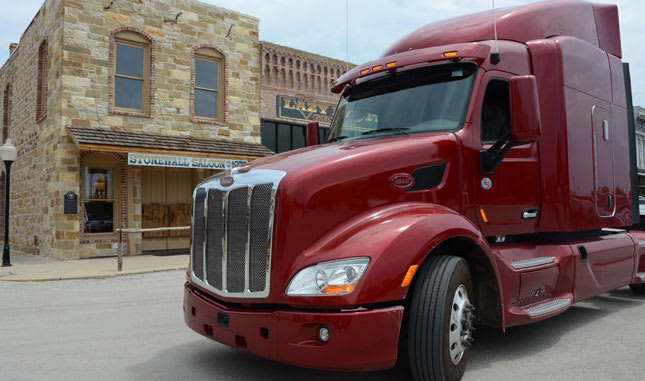
The urge to compare is great, but I will resist. Both Peterbilt's Model 579 and Kenworth's T68O were introduced with much fanfare at the Mid-America Trucking Show earlier this year.
I have already said in this space that I really like the latter, and now I can echo those sentiments for the Model 579.
Both trucks benefited from a great deal of market research, some shared between the two Paccar companies, some kept private. It's interesting to see how the two companies and their design teams prioritized various features and design elements.
You can tell from a distance that the two trucks began life on the same drawing board, but it's unlikely anyone will mistake the two. Both, I'm convinced, will further a sense of brand loyalty among their customers rather than blur the lines.
At the cab and chassis level, the similarities are obvious, but up close, it's a different story.
The cab
Let's begin where the driver meets the truck - the cab. As you climb in and sit behind the wheel, the truck sort of wraps itself around you. As a confessed fan of the smaller cockpit type cabs - which are becoming rare these days - I admit to being absolutely sold on this 2.1-meter-wide cab. I have never measured off what I consider a comfortable space; I just know intuitively what feels good. The 579 felt good.
Because it was designed as a solo driver's truck, the amenities and storage were conceived for a single occupant. There's not as much storage as there could be, but it's more open and airier as a result. Personally, I'll take the openness over more boxes into which I can stuff more junk. The cab and sleeper of the 579, with their light grey, taupe and tan color scheme, are warmly inviting, roomy and very easy on the eyes.
The dash line in the truck is lower than Peterbilt's Model 587, and the top of the windshield is higher, so overall there's more glass. This gives the driver excellent forward visibility but doesn't make you feel like you're sitting in a fish bowl. The lower beltline in the side windows adds to that open feeling.
Those with a keen eye will notice that the sleeper compartment, at least from the outside, appears to be the same as the one on the Model 386. Landon Sproull, Peterbilt's chief engineer, says the shell is manufactured the same way, but the front bulkhead and everything inside are different.
"It's a discrete sleeper, detachable for subsequent owners if desired," he says. "Peterbilt believes that will add value to the second or third owner who might be using it for local or regional work, or even for a vocational conversion. We've also changed the forward bulkhead completely, and we have a much bigger walkthrough opening."
Peterbilt engineers looked at repair and service records and found that damage to the rear quarters of the sleeper was common in jackknife incidents, and even in tight cornering situations, so they elected to go with a proven, easy-to-repair, flat sheet metal and huck-bolt design.
The hood, the cab styling and the aero trim, including the side skirts, roof fairing, sun visor and cab extenders, are all unique to Peterbilt. The roof fairing, for example, is pulled farther forward than on other models, and because the sleeper is detachable, the cab roof, the detachable side trim and fairings are designed to optimize airflow over and around the cab.
It starts with the shape of the hood, of course, which gets air flowing in the proper path. A testament to the effectiveness of the design comes when cruising at 65 mph with the side windows down. You can barely hear the air rushing by and the wind does not billow into the cab.
Creature comforts
The driver's perch and the dash panel are very well done in the 579. It's a trucky-enough dash, but with a nod to upscale automotive styling. The fit and finish is reminiscent of BMW or Audi quality. Switch and gauge layouts are a matter of personal preference, but because they are multiplexed, they can be moved around to suit individual taste. The bottom line is, they are very easy to read and reach, and they look great at night. Better still, they can be dimmed, and there's almost no distracting reflection from the dash panel on the side windows.
Back in the sleeper, you'll find an asymmetrical layout with a workstation on the driver's side, along with a couple of cubby holes and the sleeper lighting and HVAC control panel. It's well set up for work, and again, nice and open. A drawer conceals a pull-out desk, and below that is a good-sized storage bin.
On the right-hand side are the fridge and the wardrobe cabinet. On the wall is the mounting hardware for a flat-screen TV or computer monitor. The roomy storage bins are mounted high to keep them from spoiling the view, but they are easy enough to reach into.
On the outside
The big hood took quite a tug to get open, and it needed a bit of a push to close, too. Nothing a 200-pound driver can't handle, but someone leaner might have a bit of a hard time checking the oil.
The daily inspection points were easy to get to, and the engine compartment - stuffed with a big Cummins ISX engine - was generally neat, orderly and easy to inspect visually. The addition of disc brakes makes it easier to get right up beside the engine, but I think climbing up onto the wheel to clean the windows could prove a little challenging. There aren't many convenient grab points and fewer footholds, save for the drag link on the power steering. The mirror gets in the way if you're coming up the cab access steps.
I also found access to the rear deck a little awkward. When in close proximity to a trailer, the driver would be able to press a hand against the trailer for stability, but reaching around the fairing to the grab handle is quite difficult. The steps up the deck are great, and the deck itself is huge, but the climb up wasn't graceful. I'd like the air and electrical dummy hookups moved to the side of the sleeper rather than where they are in the center, so they would be easier to reach without climbing.
To be fair, I noticed similar challenges driving the Kenworth T680, not on the original test drive, but on a subsequent, longer drive.
Driving the 579
I really can't say enough about the way the 579 takes to the road. The Peterbilt Air-Leaf front suspension smooths out the highway without taking away the feel of the pavement. You can certainly feel the imperfections in the road, but they aren't jarring. It holds itself well on Interstates as well as two-lane roads, and there's little doubt about where you are in a lane, thanks to the tremendous visibility.
A nod to the mirrors is in order. They are big, but not obtrusive, and they are far enough away from the cab that they don't create turbulence you can feel and hear in the cab. Importantly, the right-hand mirror and the right-hand A-pillar do not blend together to form a large obstruction. There's a gap between them so you can see what's coming at you from the side.
It was raining when I picked up the truck at the Peterbilt factory in Denton, Texas, so the windshield wipers got a test, too. They are nearly as tall as the windshield, and the sweep is very broad, giving excellent visibility.
A new UltraNav option, will fit where the six analog gauges are on this truck, just above the radio.
The truck I drove wasn't a top-of-the-line owner-operator spec, but it wasn't lacking, either. The cloth interior and the carpeted floor made a big difference in the personal feel of the truck. It made for a nice, quiet ride and very comfortable environment - in and out of the sleeper. It's a truck you won't get tired of driving anytime soon.
From the November issue of HDT magazine.
Related Stories:
6/4/2012 Test Drive: Kenworth T680
3/22/2012 Peterbilt Introduces 'New From the Ground Up' Model 579
More Fleet Management

How Telematics Improves Visibility, Control, and Performance in Refrigerated Fleets
Explore how telematics help refrigerated fleets improve visibility, uptime, efficiency, compliance, and cargo protection across connected cold chain operations.
Read More →
What the U.S.-Canada Trade War Means for Trucking
Escalating U.S.-Canada tariffs could disrupt cross-border freight, reduce truck volumes, raise costs, and create new uncertainty for carriers on both sides of the border.
Read More →
What Are Trucking’s Top Concerns for 2026?
The American Transportation Research Institute wants to know what's worrying trucking fleet managers, drivers, and other stakeholders in its annual Industry Issues survey.
Read More →

American Trucking Associations Looks for a New Leader
ATA President and CEO Chris Spear abruptly left his job at the association on August 21, at a pivotal time for the trucking industry.
Read More →
Public Wi-Fi Cybersecurity Risks: How Truck Drivers and Fleets Can Protect Their Data
Public Wi-Fi can expose truck drivers and fleets to credential theft, malware, and other cyber threats. Here’s how to reduce the risk on the road.
Read More →
For Nicky Cupp, Fleet Innovation Starts With Frustration
HDT Truck Fleet Innovator Nicky Cupp turns everyday pain points at Fraley & Schilling into opportunities for better technology and smarter processes.
Read More →
Adam Buttgenbach’s Approach to Electric Trucks: Start With Where They Fit
HDT Truck Fleet Innovator Adam Buttgenbach helped PepsiCo build one of North America’s largest EV fleets by focusing on where electric trucks make operational sense.
Read More →
Deen Albert: Let Automation Do the Math, People Make the Decisions
HDT Truck Fleet Innovator Deen Albert makes sure people are still at the heart of operations at Grand Island Express, even while adopting artificial intelligence tools. AI-assisted dispatch helped boost revenue 25% with the same number of trucks.
Read More →
Trimble’s New AI Agent Takes Aim at Fleet Back-Office Busywork
Arc Agent works across Trimble TMS products to automate repetitive tasks such as freight orders, maintenance, invoices, fuel costs and more.
Read More →
How HDT’s 2026 Truck Fleet Innovators Are Rethinking Fleet Operations
Meet five trucking leaders who are challenging assumptions, solving operational problems, and putting innovative ideas to work.
Read More →