




Test Drive: MX-13 in a Peterbilt 365
Paccar, the corporate parent of Kenworth Truck and Peterbilt Motors, should print up some new stickers that say, "Low Revs 'R' Us," then smack 'em on the dashboards of all trucks equipped with its new MX-13 diese

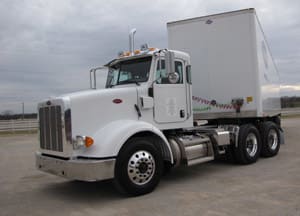
Most Peterbilt 365s are built as dump trucks or mixers, but this one is set up as a city delivery tractor, with 4.11 axle gears and no aero fairings. (Photo by Tom Berg)
Paccar, the corporate parent of Kenworth Truck and Peterbilt Motors, should print up some new stickers that say, "Low Revs 'R' Us," then smack 'em on the dashboards of all trucks equipped with its new MX-13 diesel
. It seems as happy at 1,000 rpm as at 1,900, and it's as smooth down low as up high.
That's my main impression after about three hours behind the wheel of a Peterbilt 365 P&D tractor powered by an MX, mostly on Interstate highways in northern Texas, near Pete's Denton headquarters.
Unveiled in late January, the MX-13 is now the data-book standard in Class 8 KWs and Petes. Unlike the PX-6 and PX-8, the sole power for the companies' midrange trucks that are actually Cummins' ISB and ISC with proprietary accessories and dark-gray paint, the MX is a purely Paccar product. For now it's built in Holland by Paccar's DAF subsidiary. DAF has been designing and making truck diesels for more than 50 years and began building the first MX engines in 2005. This summer Paccar plans to activate its new $400 million assembly plant in Columbus, Miss., which will first trim MX engines sent from The Netherlands for North American use. Later the Mississippi plant will assemble the engines from parts sourced here and in Europe.
The MX is a quiet engine, Paccar people said when they showed it to news reporters at their tech center north of Seattle. At that time they allowed brief drives of MX-powered trucks on the big, oval test track; as installed in upscale highway tractors, the engines were almost inaudible. Two of the three tractors I drove there had Eaton UltraShift automated mechanical transmissions, and the engines were so unobtrusive that I paid more attention to how the trannies worked.
The engine
Not so a month later with the Pete 365. This is a more bare-bones vocational model usually built for construction work, but in this case it was outfitted for city pick-up and delivery duties. Its MX, rated at 485 horsepower and 1,650 pounds-feet, was mated to an Eaton Fuller 10-speed manual. The 365's cab seemed less insulated from outside noise, so engine sounds were more noticeable but still somewhat muted, and with no growls or barks to bring either enthusiasm or fatigue to a driver. It simply went about its work ably and efficiently. If I had first driven another tractor with an older, noisier engine and then hopped into this one, I might have been more impressed with the sound quality.
To meet federal 2010 exhaust emissions limits, the MX has advanced electronic controls, exhaust-gas recirculation, and selective catalytic reduction. Mechanical features include a single turbocharger (where some competitors use two), proven low-mounted camshaft-and-pushrod valve actuation (rather than newer-but-heavier overhead cams), a standard integrated compression brake (instead of an optional bolt-on retarder), standard full-flow and bypass oil filters (no aftermarket filtration needed), and a novel belt-driven water pump offset to the right so it's easy to get at and fix (versus removing a shroud and fan to reach the usual in-engine pump).
The MX also has rear-mounted timing gears to cut torsional vibrations, and its precisely cast crankshaft needs no counterweights. During manufacturing, connecting rods are frozen and end caps are cracked off along scribed lines, then drilled and bolted back together during assembly; the rough "fractured" surfaces cling together tightly and securely, preventing even slight wobbling (though each cap is therefore a mate to its con-rod and cannot be interchanged with another cap). All this enhances an inline six-cylinder engine's already smooth operation, as I discovered during this drive.
Both block and cylinder head are cast of compacted graphite iron, which makes them stiffer than if done in standard gray iron, and saves about 150 pounds, Paccar people said during the unveiling. A 12.9-liter (788-cubic-inch) MX weighs 325 pounds less than a 15-liter Cummins ISX, which remains optional, as do other Cummins diesels in various KWs and Petes. Paccar considers Cummins a valuable partner, as Cummins makes the PX-6 and -8 midrange engines, helped with MX development and supplies the MX's variable-nozzle turbo.
The drive
Much of this was reviewed for me during the Texas drive by my guide, Todd Wickstrum, Peterbilt's Paccar-engine field service liaison manager. He advises customers and dealer sales people on how to set up trucks with the new MX and how to drive and service it. He explained that this Model 365 daycab tractor was built to deliver a "blend" of performance and economy for a fleet in Vancouver, British Columbia. It'll pull heavy trailers, like the Utility 53-by-102 test van hitched up for our run that was ballasted for a GCW of a little over 72,000 pounds. This tractor will see a lot of stops and starts, and freeway dashes might get above 100 kilometers per hour (kph is what the speedometer's larger numbers were calibrated in) but not much more.
So the stubby-looking Pete had short legs - 4.11 gears in the Dana rears and single-overdrive "C" gearing in the Fuller tranny. This caused the engine to spin at a busy 1,600 rpm at 100 kph (62 mph) after we left the Texas Motor Speedway, our rendezvous point, and ran north on I-35W and I-35 into southern Oklahoma. Wickstrum said some stiff grades up there would let the engine show off its lugging ability, but we ran out of time and turned around short of them so we could return to the speedway before it closed for the night.
An over-the-road tractor would have aero fairings and taller gearing, allowing the engine to loaf at 1,350 rpm at 65 mph, Wickstrum said, so "it would average 7 mpg, easy" in OTR operations, with higher numbers entirely likely. The instant readout on the dash for this truck was less impressive, but this P&D tractor was not as aerodynamic as its OTR brethren, and it was nearly new with only a few thousand miles on the clock. Test fleets have reported that once an MX breaks in at 80,000 to 100,000 miles, mpg goes up by 0.4 mpg.
(Instead of the Interstate trip, a better test of this tractor's city duty specifications might have been just running around access roads in the speedway complex, then buzzing into nearby Fort Worth to simulate some P&D stopping and starting.)
The compression brake is said to be capable of as much as 460 retarding horsepower, but didn't seem as strong while decelerating down shallow grades and freeway off-ramps. It was quiet, though, and drivers might find they can ignore "no engine brake" signs posted outside many towns and cities. At slow speeds in low-range gears, the brake aggressively slowed the truck and I had to declutch to keep the driveline from a-clunkin', and sometimes simply switched off the brake.
Luggability
While we had no real highway grades to climb, I did do some slow lugging during turn-arounds at the speedway and while positioning the truck for photos. At one point I let speed drop so the tachometer read only 1,100 rpm, then tromped on the foot feed; the engine picked up quickly, with absolutely no vibration or groaning of any kind. I did it again from 900 rpm, with the same smooth results. It surprised me until I read the engine's specs and found that its stated torque peak is 1,100 rpm. You sure couldn't lug like that with big ol' diesels in the good ol' days.
Luggability also begs for drivers to upshift early and often. I usually grabbed the next gear at no more than 1,500 or 1,600 rpm, and even that was a little too much. Most drivers today still rev their engines way too high, so if you're a manager with some new MX engines beat the boys and girls over the head with a gearshift lever to get them to run the new engines correctly. Once they learn to keep revs down, everyone'll be happy.
From the April 2010 issue of Heavy Duty Trucking.
More Equipment

How Volvo Updated Its D13 for EPA 2027 [Watch]
Volvo’s updated D13 promises lower emissions without sacrificing performance or fuel economy. Take a closer look at what changed inside the engine in this HDT Spotlight video.
Read More →
Michelin Tire Improves Efficiency and Durability for Regional Fleets
The Michelin X Multi Energy D2 is a regional haul drive tire engineered to help fleets improve fuel efficiency, durability and traction in demanding stop-and-go operations.
Read More →
ZF Expands Commercial Vehicle Push in North America
ZF is expanding its North American commercial-vehicle presence with new transmission applications, electrification, trailer technology and autonomous-driving systems.
Read More →
Tesla Wants a Self-Driving Semi. Are Cameras Enough?
Could Tesla’s camera-only autonomous driving technology work on an 80,000-pound Semi? In this commentary, HDT's Deborah Lockridge takes a look at Tesla, Cybercab, and how autonomous trucks see the road.
Read More →
Kodiak: Driverless Long-Haul Truck Launch on Track for 2026
Kodiak AI says its driverless long-haul safety case is 93% complete and it remains on track to begin commercial operations by year-end 2026.
Read More →
What DOT’s Automated Vehicle Strategy Means for Trucking
The U.S. Department of Transportation issued a new automated-vehicle strategy that outlines plans for driverless-truck regulations, cross-state freight corridors, and federal safety standards.
Read More →
East Coast Port Launches $45M Electric Truck Push
The Port Authority of New York and New Jersey announced millions in incentives for zero-emission drayage trucks, yard tractors, and new charging hubs near the port.
Read More →
PlusAI Going Public to Fund Autonomous Truck Launch
A SPAC deal could provide PlusAI with up to $300 million as it works toward a 2027 commercial launch of factory-built autonomous trucks.
Read More →
NHTSA Moves to Rewrite Truck Fuel-Economy Rules
The National Highway Traffic Safety Administration says it lacks authority to regulate medium- and heavy-duty truck engines separately from complete vehicles, but the existing standards have not yet been eliminated.
Read More →
Detroit Opens Orders for EPA 2027 Engines
Detroit isn’t starting from scratch to meet EPA 2027 diesel emissions standards. Its Gen 6 DD13 and DD15 engines keep much of today’s platform while updating the fuel and aftertreatment systems.
Read More →